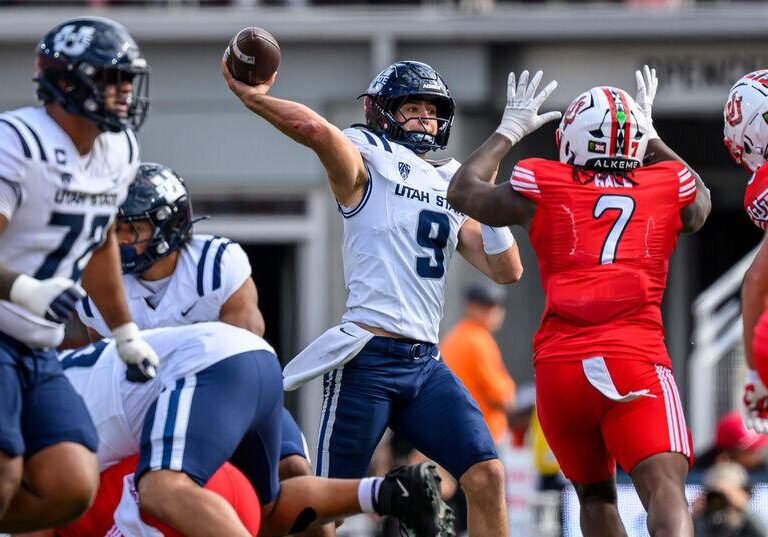

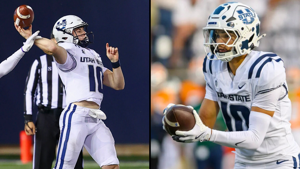
Utah State will see a new starting quarterback for the 2026 season as fan-favorite Bryson Barnes has graduated and used up all of his eligibility. And the stage has now been set for an offseason quarterback competition.
The actors in this drama are ready, and will consist of returning QB/WR Anthony Garcia, Virginia transfer Grady Brosterhous, BYU transfer/former Aggie McCae Hillstead, freshman Kaleb Maryland and freshman Brady Goodman. Returning QB/WR Anthony Garcia could theoretically be in the mix, but is not expected to compete for a spot on the quarterback depth chart (more on that later).
As of now, the top two candidates are probably the two transfers from power conference teams, Hillstead and Brosterhous (though the former’s status as a P4 transfer is somewhat muddied by the fact that he started his career at Utah State). Theoretically, they’d have the highest potential. That will be put to the test this spring, summer and fall when all of these players do battle behind the scenes.
Here, we’ll break down as in-depth as possible both of these transfers and what they can bring to the table as a potential starter. But we won’t completely neglect Garcia or the incoming freshmen entirely as they’ll have their own abbreviated breakdowns at the end.
Grady Brosterhous
Bio/Measurables:
- Height: 6’3”
- Weight: 219 lbs
- Class: Graduate
- Career Stats: 13 games played (0 starts) | 1/1 passing, 21 yards | 14 rush att, 21 yards, 4 rush TD
Although Brosterhous is coming from a former home of Mendenhall, the University of Virginia, there is no direct connection between the Aggies’ head coach and the former Cavalier. But that didn’t stop Mendenhall from being impressed by the “leadership and size and physicality and speed” that is coming in at the quarterback position with Grady.
In a couple different ways, Brosterhous shares similarities with the Aggies’ former starter, Barnes. For one, both began their careers as walk-ons at power conference schools. They also developed fun little media stories around themselves. Barnes became the lovable pig farmer and Brosterhous became part of a unit known as “The Grady Bunch” which specialized in short-yardage situations.
The similarity Brosterhous might love to share with Barnes the most is being the starting quarterback at Utah State. It’s an attainable goal, though how likely is hard to tell. He has barely seen the field outside of very specific, typically run-centric, scenarios which makes it hard to know just how good of a quarterback he can be. Brosterhous has one official career pass attempt on film. Said singular pass occurred three years ago during Virginia’s 45-17 loss to Georgia Tech in November 2023. It was a solid pass, an eventual 21-yard reception, on an out route where Brosterhous pretty easily got the ball from the left hash to the right-side numbers.
Despite this being the only video of a Brosterhous throw during a game, there are a couple different sources of extra film and highlights. One comes from Brosterhous himself in the form of a personal highlight reel he posted upon entering the transfer portal. It features clips not only from his in-game snaps, but also practice and scrimmage reps that offer a bit more of a showcase of his skills that he simply hasn’t had a chance to put in front of a national audience. There are only highlights, though, so we don’t get the whole picture and can’t make sweeping judgements. What we do get, though, is an idea of his potential, even if we won’t have an idea for how likely he is to reach it.
There’s a solid mix of types of throws shown in the highlight reel, though there is an emphasis on more difficult passes. These include anticipation throws, downfield passes or just plain fitting the ball into tight throwing windows. We don’t know how often he was able to hit these windows and complete tougher passes, but the ones we have on tape are really nice.
Here’s a compilation taken from his published highlight reel that were arguably the most impressive in terms of timing, anticipation and accuracy.
Brosterhous pretty clearly has enough arm talent to complete every throw necessary, and at the very least has shown the accuracy to do so with these specific reps.
Let’s not get too high on Brosterhous after looking just at these because this isn’t the whole picture. And once we dive a bit deeper, there’s some uncomfortable trends. Brosterhous got some notable reps in each of Virginia’s 2024 and 2025 spring football scrimmages, the stats of which have been reported. In 2024, he completed 7 of 14 passes for 51 yards and in 2025 completed 6 of 16 throws for 93 yards with one touchdown and one interception. Altogether, that’s 13 of 30, a 43.3 completion percentage, for 144 yards and a 4.8 yards per attempt average.
Those are not good numbers, even in the context of a spring game where things can be a bit more sloppy for offenses.
We also have the full 2024 spring game film (the 2025 spring game was apparently broadcast on the ACC Network but no archive seems to be publicly available). Brosterhous didn’t take snaps until the second half as he was the third-string QB, but that left one full half of snaps with the offense. Here’s his full collection of pass attempts (plus one scramble at the end) from that game.
And this is where having a bit more than just highlights can help because for every one of those impressive throws we see in the highlight reel, there’s a corresponding similar throw in this compilation that shows Brosterhous missing the mark. Often multiple cases, like with downfield throws and out routes. And with a small handful of stats available from these spring games, there’s a heavy hint that while Brosterhous has the potential to make great throws, he struggles to consistently do so.
To finish on a bit of a higher note, there is another important aspect to Brosterhous’ game that is important to bring up and is yet another similarity to Barnes. And that is the fact that the UVA transfer is a very solid runner. Whether he has the same tough-as-tungsten mindset as Barnes is something to be determined later, but at the very least Brosterhous has the same or even better rushing ability as the man he is trying to succeed.
At 6-foot-3 and listed at roughly 220 pounds, Brosterhous is a threat in the short run game but also mobile enough to get out in the open field. The short-yardage rushing is what led to the whole “Grady Bunch” thing as it was the nickname given to Virginia’s version of the Tush Push play. Brosterhous tallied four rushing touchdowns in 2024, three via Tush Push-style play calls and another from four yards out on a read option.
As already mentioned, though, Brosterhous isn’t just some big body that can run QB sneaks. From clips in his own highlight reel, you can see some instances of him running effectively in the open field.
It’s hard to emphasize just how valuable it can be to have a quarterback that isn’t just athletic and can scramble, but that can be an integral part of the rushing attack. USU head coach Bronco Mendenhall spoke about it multiple times last year, primarily noting how it changes the numbers game that is played between offensive and defensive units. When a defense has to account for the QB as a runner, it forces them to dedicate resources to that threat, which weakens their ability to cover other parts of the field.
McCae Hillstead
Bio/Measurables
- Height: 5’10”
- Weight: 195 lbs
- Class: Junior
- At USU — 8 games played (4 starts) | 94/158 passing (59.5%), 1,062 yards, 11 TD, 8 INT | 44 rush att, 36 yards
- At BYU — 5 games played (0 starts) | 4/5 passing, 33 yards, 0 TD, 0 INT | 5 rush att, 28 yards
Career Stats: 13 games played (4 starts) 98/163 passing (60.1%), 1,095 yards, 11 TD, 8 INT | 49 rush att, 64 yards
Aggie fans have already had the benefit of watching Hillstead. In fact, the USU faithful have a much better idea of the QB Hillstead is than BYU fans despite him having spent more time in Provo than in Logan. The best Cougar fans got came from whatever time he got in spring or fall camp and from the mouth of head coach Kalani Sitake. Hillstead threw a total of five passes in five total appearances and scrambled a handful of times for 28 total yards. In contrast to that, Hillstead started four games for Utah State in eight total appearances in 2023. Throughout those stints on the field he threw 158 passes, accumulating 1,062 yards with 11 touchdowns and eight interceptions.
The chance to return to Logan brings not only some familiarity but, just as important, the chance to play and fulfil his dreams of being a starting QB.
“I think he’s craving and dying for the chance to be able to be the starting quarterback,” Mendenhall said. “And have that experience, and to lead a team, and to learn and grow, and become, and demonstrate what he’s truly capable of.”
There already exist archives on this site that break down how Hillstead performed in those games, but we’ll pull some of those breakdowns and clips forward in time so they can be re-examined in the present.
Hillstead sprinted onto the scene during a blowout loss to Air Force back in 2023. Cooper Legas began the season as the starter but was benched early in the second quarter of the Week 3 game against the Falcons when the Aggies found themselves trailing 22-0 by the end of the first quarter. Hillsted stepped in and threw for 202 yards and three touchdowns to make the final scoreline a little more respectable, 39-21.
Multiple throws in that game showcased the talent that Hillstead brought. Even as a true freshman, he was someone that could sling the ball around the field and had the guts to do so. His first two throws against Air Force went deep down the field and he connected on one for a 20-yard gain. Hillstead also showed his ability to scramble for effective yards, with an 18-yard run and later a seven-yard rush that had an unnecessary roughness penalty on the defense tacked on to the gain.
That initial drive led by Hillstead didn’t yield any points, but the Aggie offense got going after five scoreless drives. Hillstead started the game just 1 for 3 on his passes but went on to complete 17 of his next 24 passes where he got most of his 202 yards and all three of his touchdowns. Of the seven incompletions, two were drops by the receiver, two were passes thrown away because of the pass rush, one was deflected by a defensive lineman, only one was a bad pass the receiver simply couldn’t catch.
Hillstead’s stats looked good and his film did as well, with passes like this one to Micah Davis for a 24-yard gain.
While many coaches might have publicly avoided naming a starting QB going forward, even after benching the starter and allowing the backup to play (and seeing the backup play better than the starter). But Utah State’s head coach at the time, Blake Anderson, didn’t waste time with any gamesmanship. He left no doubt as he immediately named Hillstead as the clear starter going forward.
That next game was against James Madison, led by future national title-winning head coach Curt Cignetti. Hillstead wound up setting a USU freshman record with 399 yards, completing 25 of 47 passes which included four touchdowns and three interceptions. It’s a game that not only showed the highs of Hillstead’s talent, but also the downsides of his gunslinger mindset. Utah State had a chance to win a game against a JMU team that went on to go 11-2, but the Aggies lost after Hillstead threw an interception on what could have been a game-tying drive.
The highs from Hillstead were a thing to behold. He hit some very narrow windows in some clutch situations, like converting a 3rd & 10 with a throw to Jalen Royals that Hillstead lifted above a linebacker but within the catch radius of his receiver.
That throw began Utah State’s near-comeback as the Aggies were losing 38-17 at the time of that completion. The comeback was really on when Hillstead threw a dot over two defenders in the back of the end zone for Terrell Vaughn.
These throws weren’t just about arm talent, which Hillstead has plenty of. They were also very well-placed and came in tough situations. At this point in the game, James Madison knew the Aggies were going to pass and Hillstead was able to get the ball to his receivers anyway. Hillstead threw for 265 yards in the second half alone, which led to Utah State tying the game at 38-all early in the fourth quarter.
That’s where the positives ended in that game, unfortunately. After throwing the game-tying touchdown, Hillstead went on to complete just one pass to a teammate and threw two into the hands of the defenders.
The first of those two interceptions was a brutal turn of events. Utah State was trailing again, 45-38, but its defense had forced a turnover, recovering a fumble in JMU territory. Then a 35-yard run by Davon Booth set the Aggies up with 1st & Goal. But on 2nd & Goal, Hillstead was put under pressure. And instead of doing the responsible thing and throwing the ball away, he threw a pass across his body into double coverage and it was easily picked off.
The two other interceptions from Hillstead in that game are actually hard to pin on him, one was a dropped pass that bounced to a DB and the other came on a screen where it was mostly just a great play by the defender and Hillstead could hardly have seen the defender coming (and, strangely enough, it didn’t hurt the Aggies since the player who intercepted the ball fumbled and USU recovered it). Despite blame being able to be shifted from those two passes, Hillstead came out with three overall “turnover worthy passes” according to Pro Football Focus grading, meaning there were other throws that should have been intercepted but weren’t.
Even with those negatives, if you look at the first seven quarters of Hillstead’s time at quarterback, you could see a lot of upside. He had thrown for 601 yards on a 58.1 completion percentage and accumulated seven touchdowns to three interceptions. And when adjusting out yards lost to sacks, Hillstead had run for 34 yards on four rush attempts. That had Aggie fans pretty excited about the future of the true freshman as Hillstead would theoretically only get better.
Hillstead didn’t get better, though. He regressed from that hot start and also struggled to stay healthy. In his second career start, he completed 6 of 11 passes for one touchdown and two interceptions against UConn, having to leave the game with a concussion and didn’t return until three weeks later. He started for a third time against San Jose State but again threw multiple interceptions and completed just 59% of his passes. His final start was against San Diego State where he did complete 12 of 16 passes, but for only 62 yards and zero touchdowns. That led Anderson to put Legas back in and he would win the starting job back in leading USU to an overtime win over the Aztecs.
In the three starts after playing James Madison, Hillstead completed 63% of his passes for a combined 333 yards, three touchdowns and four interceptions. Fewer yards and touchdowns than he pulled off in one full game against JMU. The Aggies also never won a game in which Hillstead was the starter for the majority of the game, going 0-2 against JMU and SJSU but winning against UConn and SDSU only after Hillstead left the game.
The long and short of Hillstead’s career is that his highlight reel is genuinely impressive but with concerns over consistency and ability to lead a highly efficient offense.. He has the best arm talent of anyone on the roster and the above clips from him are far from the only great throws of his career. Pro Football Focus’ grading metric includes what it terms “Big Time Throws” and Hillstead ranked 24th in the country in 2023 for ratio of BTTs per attempt (6.0%). He threw five in the James Madison game alone. Hillstead’s main issue is that these throws can’t fuel an offense by themselves. They will augment and accelerate an offense, making it more explosive. But you can’t live on hero shots. When it came down to making ordinary plays on a consistent basis, Hillstead struggled. It seems both he and Brosterhous share this weakness, though it’s pretty clear that Hillstead has put far more impressive throws on film than Brosterhous has.
The good news is that all of this data from Hillstead is two full seasons ago when he was a true freshman. That was his very first encounter with college-level defenses and he had a couple of good units by the throat at times. With two years of development, even if behind the scenes, Hillstead could very well be a much more consistent and capable passer. Mendenhall, and new offensive coordinator Robert Anae, are certainly happy about the potential Hillstead has in their offense.
“I think he’s a great fit, and when you match him with Robert and I, and you start thinking about Taysom Hill. You start thinking about Bryce Perkins.”
Evoking the names of Hill and Perkins, two players who were star and dual-threat QBs under Mendenhall at BYU and Virginia, respectively, is a testament to what they see out of Hillstead in terms of his rushing ability. Mendenhall also brought up that his former offensive coordinator from his days at New Mexico, Jason Beck, learned under Anae and has applied that offense to what he was able to do with UNM and Utah QB Devon Dampier. The former UNM and current Utah signal-caller is of similar stature (6-foot, 200 pounds) to Hillstead, though the parallel between physical traits isn’t exact. Still, there are many similar things that could be done that helped turn Dampier into an All-MW quarterback and P4 starter.
The Remaining Candidates
While Hillstead and Brosterhous are probably the leading candidates, the Aggies will have as many as five players competing for the starting quarterback job. Anthony Garcia may have played wide receiver last year, but his roots as a collegiate athlete are at quarterback. He also represents nearly 100% of returning passing production (punter Landon Rehkow technically accounts for a small fraction himself thanks to one pass attempt). But we also have to take into account the possibility of a freshman starting or taking significant snaps in one or more games this season. After all, since 2011 the Aggies have had seven different freshman quarterback start or throw at least 20 passes in a game at some point in the season. It didn’t happen in 2024 or 2025, but that may only indicate that we’re due for a freshman to finally jump in and make an impact.
Let’s take a shallow dive into each of the remaining candidates, including USU’s two incoming freshmen, Kaleb Maryland and Brady Goodman.
Kaleb Maryland
- Height: 6’0”
- Weight: 195 lbs
- Class: Freshman
- High School Senior Year Stats: 15 games, 170/265 passing (64.2%), 3,266 yards, 34 TD, 8 INT | 102 rush att, 549 yards, 10 TD
Something that is a little awkward for Utah State in hindsight with losing McGiven to Utah is the comment Mendenhall made a couple months ago about Maryland’s commitment to Utah State. Mendenhall said that what McGiven was able to do with Barnes played a big role in why Maryland wanted to come to Logan. We’ll see if that has any long-term impact on the Texas native’s desire to be an Aggie, but he has already enrolled and will be participating in spring ball.
Maryland is a talented prospect, likely overlooked because he’s undersized at just 6-foot (and maybe shorter as high school prospects often have an inflated listed height). He defies that small size, though, by having a really solid arm. Here’s him throwing a pass 50 yards in the air, pretty effortlessly, with a tight spiral. And also on the dot for a touchdown.
There were a couple other solid throws from this same game — the 6A Texas state championship game — including an off-balance throw that showcases another aspect of Maryland’s arm talent.
Although these throws were all impressive, this championship game ends up being a possible representation of Maryland’s year one college potential in both a good and bad way.
For one, Maryland wasn’t a massive driving force of the offense. North Shore ran the ball on around 62% of its offensive plays, though it’s worth noting that Maryland was the second-leading rusher on the team so he did play a big role in that run game. Overall, Maryland would get about 25 touches per game (roughly 18 passes and seven rush attempts). And that was reflected in that championship game where he played his role well, but didn’t exactly blow the doors off the hinge. He completed 12 of 20 passes for 154 yards and the one TD shown above in a game that was much more of a defensive battle where the final score was 10-7. But a lot of his passes (outside of the three shown) were screens. He wasn’t tasked, on that particular day, with making many of the more challenging types of throws that veteran college QBs routinely make. It also showed Maryland having to deal with much tighter throwing windows and near-constant pressure in the pocket.
Maryland did overcome that increased difficulty for the most part, still completing 60% of his passes and his team ended up winning. However, there were several throws that were just off target and he had a couple near-interceptions.
What is clear from the tape is that Maryland has undeniable skill. His rushing ability that led him to 549 yards and 10 touchdowns on the season hasn’t even been brought up yet. The refinement that will lead to college success will probably take at least a year to ensure Maryland can be consistent.
Brady Goodman
- Height: 6’4”
- Weight: 215 lbs
- Class: Freshman
- High School Senior Year Stats: 12 games, 185/299 passing (61.9%), 2,256 yards, 28 TD, 9 INT | 135 rush att, 463 yards, 11 TD
If prototypical QB stature were everything, then Goodman would have everything. He’s got good height, good size, a good arm and good athleticism. A scout’s dream. His senior year stats don’t even show his full potential since, as a junior, he threw for 3,087 yards, 43 TDs and only four interceptions (plus another 435 rushing yards and 11 rushing scores).
Unlike Maryland, Goodman was a heavy feature in his team’s offense. He averaged 25 pass attempts and 11 rush attempts as a senior (up from 22 and six his junior year where he had a 1,500-yard rusher to share the backfield with). The fact that Goodman was a bit more of a one-man show likely impacted his efficiency. He went from averaging 220.5 yards per game with a 64.3 completion percentage and a 43/4 TD-INT ratio as a junior to averaging 188.0 yards on a 61.9 completion rate and a 28/9 TD-INT ratio. Or, put another way, his passer rating went from 130.9 to 103.8. It’s not like he was bad as a senior, but you can see how much good help can turn a QB from looking good to looking elite.
Although he’s the biggest QB in the bunch, Goodman doesn’t display a much bigger arm than his future teammates. Something you’d expect from the 6-foot-4 guy with a couple of teammates that are 4-5 inches shorter than him. That may be a disappointment to some, but his throws all show plenty of arm talent to make any throw at the college level. His own posted highlight reel showcases throws with solid zip on them and some pretty good touch. And these are from his junior year, so he’s only gotten more time to refine his talent.
With Goodman being a fairly mobile QB (more on his rushing ability later), the offense ran rollout passes quite a bit and he showed the ability to hit throws rolling in either direction. Goodman seems to be almost more comfortable making throws rolling to his left as he was able to hit his target (whether or not the WR caught it) almost every time even while throwing across his body.
His ability to read defenses is also pretty solid. Goodman is able to make adjustments during a play to where to throw the ball if the defense isn’t doing something the play-call is wanting it to do. This allowed Goodman to avoid throwing as many interceptions as he could keep the ball out of harm’s way, even if that meant an incompletion.
Goodman doesn’t have an advantage in rushing ability over any of the other candidates. In fact, he’s possibly the slowest and least shifty of them all. But that’s relative to some really good athletes (heck, Maryland was a track athlete which is a pretty high bar to clear for any rival prospect). What Goodman has over (most of) the competition is size and reliability as a rusher. Coaches can be hesitant to sent a 185-pound quarterback into a pile of 250-pound defenders for designed runs. With Goodman coming in already at a listed 215 pounds, he’s likely to be a lot more durable and capable of running the ball on a consistent basis and not be torn apart by college defenders.
It allows for him to be a constant threat as not only a designed ball-carrier but also a significant threat as a scrambler.
Anthony Garcia
- Height: 6’2”
- Weight: 195 lbs
- Class: Junior
- Career Stats: 14 games played 0 starts at QB) 6/7 passing, 79 yards, 4 TD, 0 INT | 12 rush att, 75 yards, 1 TD | 20 receptions, 348 yards, 2 TD
With every other QB on the team leaving this offseason, there was an initial thought that Garcia might return to his original position. Garcia started out as QB, first being at San Jose State in 2023 and then moving to Arizona. But neither yielded opportunities to play quarterback. Neither did his 2025 season at Utah State, but last year ended up being Garcia’s first big break. Except he played wide receiver. Garcia ended the season as the Aggies’ fourth-leading pass-catcher but also gave the coaching staff the chance to be incredibly creative.
Not all of Garcia’s myriad of roles showed up on the stat sheet, as a few of his plays were two-point conversions, but what he did do was become the first Aggie in a half-century to throw for, run for and catch a touchdown pass in a single season. Isolating to just his role as a passer, Garcia ended up with seven official pass attempts plus one pass on a two-point attempt. He completed six of those passes for 79 yards and four touchdowns.
So will Garcia move back to quarterback?
Likely not according to Mendenhall.
“I see him becoming more skilled at being trained year-round as his predominant position being wide receiver,” Mendenhall said.
The “more skilled” part is a rather ill-defined range, in a good way. There’s a lot Garcia has shown he can do, and some things he has yet to try in a game.
“He can throw it. We know he can run it. By the way he can punt, so that takes on a different weapon-ish, we chose not to do that year ago, however,” Mendenhall said. “Could he line up a quarterback? Oh yeah. But in terms of the quarterback battle separately, no. In terms of every other way possible to touch the ball or kick it, I don’t know if he can kick field goals yet, maybe we’ll find that out.”