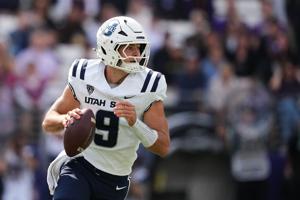

SALT LAKE CITY — There are well over one million words in the English language, with nearly 200,000 in active use in the modern dialect. But it doesn’t take very many to describe what the Utah Utes did to Utah State Saturday afternoon during the 114th edition of The Battle of the Brothers.
The Utes made the Aggies look like the little brother in this sibling rivalry.
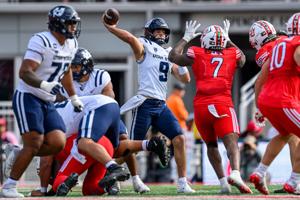
Utah put on an almost complete evisceration, a 33-0 win on the final score tally, for the entertainment of the announced sellout crowd of Rice-Eccles Stadium. Within the first two possessions, the Utes had already outgained the visiting Aggies by more than 100 yards and held a 13-0 lead. Essentially the perfect start for the home side.
“That was the script we presented as Utah’s ideal. And to their credit, they executed and got to that point, and we didn’t,” said USU head coach Bronco Mendenhall.
Utah ultimately scored on their first four possessions — five if you count the fact they recovered a muffed punt and scored a touchdown after taking back over on offense — and outgained the Aggies on offense 301-85 in the first half alone.
“It’s hard for us putting the defense on the field, you know, basically all game,” said Aggie running back Javen Jacobs. “We got to be able to sustain drives and go score.”
A big part of that first-half offensive explosion was former USU wide receiver Braden Pegan, who transferred from Logan to Salt Lake this past winter. The 6-foot-3 senior caught eight passes for 122 yards and two touchdowns in the match against his old team. Seven of those catches, 110 of the yards and both touchdowns came in the first half.
“He made plays when it came his way, and he did his thing,” said Jacobs, who played alongside Pegan last year. “Super happy for him.”
The Utes took full advantage of their opportunities during what competitive portions of the game existed. Utah State failed to find that same groove, and backed away from chances to seize the handful of opportunities which came its way.
After a first quarter in which they gained just 10 yards, the Aggies got their first hint of daylight on offense early in the second quarter. A pair of chunk plays on passes to Eli Wood and Noah White took Utah State into opposing territory for the first time in the game. The drive stalled, bringing up a 4th & 4 on the Utah 36-yard line. By this stage, the Aggies had given up three scoring drives, two touchdowns and a field goal, with relative ease, and trailed 16-0.
But rather than try to make it those yards, and maybe turn the tide slightly, Mendenhall sent out his punt team.
On two other occasions, Mendenhall made the same call in similar situations. The Aggies trailed 19-0 on a 4th & 6 from the Utah 37. Later, they were down 26-0 when facing a 4th & 3 on the Utah 45.
A punt was the only option ever elected for these situations.
“I thought their defense was playing really well, their offense super dynamic, and there’s a team that can score from anywhere super fast. And so I chose to play field position,” Mendenhall said of those decisions. “And I believe it was the right call for our team at this time today against that team. And so, yeah, I chose field position with the scoring potential they have.”
To Mendenhall’s point, a lack of faith in the offense may have been called for. When the Aggies did go for it on a 4th & 1 on the Utah eight-yard line, the offense couldn’t make it. Javen Jacobs was stacked up behind the line of scrimmage by the Utes despite every blocker on the team, including two lead fullbacks, being called in to get that singular necessary yard.
That was one of two instances in which the Utah State offense made it inside the Utah 10-yard line. On the other occasion, quarterback Grady Brosterhous threw an interception on an end zone fade intended for Wood.
Although he had the interception in the end zone, Brosterhous still produced most of what little offense the Aggies had. He completed 15 of 29 passes for 130 yards and ran for 42 yards (though 25 came back on sacks for a net of 17). Depending on how you interpret Mendenhall’s words, the Virginia transfer appears to have taken the role of QB1, even in the event of Week 1 starter McCae Hillstead being healthy.
“Grady starting was a coach’s choice based on the effort Grady gave last week against Washington,” Mendenhall said. “That was inspiring. So it’s just like, how could we not? And McCae now is becoming back and available. And so yeah, just stay tuned there.”
No matter who is in at quarterback for the Aggies, their main issues on offense stem largely from a run game, which Mendenhall said “doesn’t really exist at this point.” Utah State’s rush attack netted only 58 yards. Utah receiver Daniel Bray gained more than that by himself on one play with a 63-yard touchdown run.
The numbers look slightly better when taking out sacks, which count as negative rushing yards. But, once again, the USU running backs failed to make an impact. Jacobs and Noah White, the two running backs to log carries in the game, combined for just 33 yards on the ground, and 16 of those came on a draw play that caught the Utah defense when it was looking for a passing play on third down.
“It hasn’t been that we haven’t been addressing (the run game) or working on it or looking and trying to find options,” Mendenhall said. “Javen had a really nice run, kind of on a windback draw that you guys saw. And so there has to be some deception to it currently, some conflict to it. But we haven’t cracked that code yet. So I think it’s a fair question. But it’s not happening yet, and it would really be helpful when it does.”
A lot of things would be helpful for Utah State, which now sits at 0-3 for the first time since 2020 and only the second time since 2008. The Aggies will host Troy next week at the culmination of Homecoming.