

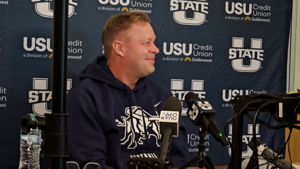
The 2025 Early Signing Day has arrived and it’s brought 17 new players to the Utah State football program, all of whom signed with the Aggies in hopes of continuing their football careers and elevating both themselves and the program. USU head coach Bronco Mendenhall, and the program’s Director of Player Personnel, Evan Butts, spoke with the media Wednesday afternoon to discuss the newest additions to the Aggie football family.
First things first, let’s take a look at who is part of this signing class before diving into some of the players and general trends from this class.
Utah State Football 2026 Early Signing Class
| Name | Pos. | HT | WT | Hometown | High School |
|---|---|---|---|---|---|
| Luke Baker | OL | 6-8 | 270 | North Logan, UT | Green Canyon |
| Tiki Bell | DL | 6-4 | 310 | Hamilton, Ontario, Canada | Episcopal (Va.) |
| Dontae Dyson | CB | 6-1 | 170 | Layton, UT | Northridge |
| Brody Flores | OLB | 6-3 | 210 | Aurora, CO | Grandview |
| Brady Goodman | QB | 6-4 | 215 | Mesa, AZ | Mountain View |
| Easton Hammond | OL | 6-3 | 275 | Millville, UT | Ridgeline |
| Matekitonga Havea | OL | 6-6 | 315 | Lehi, UT | Lehi |
| O’Shea Jackson-Webb | CB | 6-0 | 170 | Clovis, CA | Clovis East |
| Kaleb Maryland | QB | 6-0 | 195 | Houston, TX | North Shore |
| Cade McCall | WR | 6-0 | 180 | Katy, TX | Katy |
| John McClellan | LB | 6-2 | 215 | Rohnert Park, CA | Rancho Cotate |
| Preston McDaniel | TE | 6-4 | 225 | Idaho Falls, ID | Thunder Ridge |
| Lucas Neidig | OL | 6-7 | 270 | South Jordan, UT | Bingham |
| Jude Nelson | TE | 6-4 | 225 | Long Beach, CA | Millikan |
| Tripp Palmer | OLB | 6-4 | 200 | Blanding, UT | San Juan |
| Jackson Regan | RB | 5-10 | 200 | New Braunfels, TX | Canyon |
| Viliami Tapa’atoutai | LB | 6-3 | 200 | Woods Cross, UT | Woods Cross |
Today’s press conference with Utah State football head coach Bronco Mendenhall, discussing the Aggies’ 17-player early signing class.Topics include Broncos’ thoughts on the current CFB calendar, his focus on recruiting in-state and regionally, and comments on a few specific… pic.twitter.com/hp65Hp13c4
— Jason Walker (@jwalker_sports) December 3, 2025
Utah State’s Director of Player Personnel, Evan Butts, also spoke with the media this afternoon, sharing his insight on USU’s early signing class. pic.twitter.com/4lRoKV9XHO
— Jason Walker (@jwalker_sports) December 3, 2025
Focus on in-state and regional recruiting
Of the 17 players signed, seven come from inside the state of Utah, two even from Cache Valley itself. Another three of those 17 come from states that border Utah. This is something that falls in line with something Bronco Mendenhall has made a theme of his recruiting. Mendenhall said he’s studied, though exit interviews, how proximity to a player’s hometown has correlated with their enjoyment and satisfaction. The results of that, according to Mendenhall, is that players within a six-hour driving distance or a single plane flight (i.e., not having to take connections and have layovers) made a significant difference.
“Their family seeing them play mattered,” Mendenhall said.
With that criteria from Mendenhall, virtually all of the 17 recruits are within either that six-hour drive or one relatively short plane ride to Logan/Salt Lake City.
Part of the emphasis on local recruiting can come with the worry that it might come at the cost of limiting the talent pool. The recruiting hotbeds of college sports have long been places like Texas, California, or most of the states in SEC country. Mendenhall himself outlined how he can’t compromise just to focus on recruiting players out of Utah.
“Was there any compromise made in terms of ability because of proximity? That can’t happen,” Mendenhall said. “Problems can happen when you compromise the ability standard for the proximity.”
But given Mendenhall ended up with a class filled with players in close proximity, it’s a sign he trusts local talent. Utah and the surrounding states have been a growing source of great prospects, and Mendenhall clearly doesn’t believe he has to compromise his standards for talent and athleticism even when focussing on regional recruits.
Development on offensive line
One of the most frustrating aspects of Utah State’s season was its offensive line. According to CFB Graphs, the unit ranks dead-least (136th) in FBS for pressure rate allowed on passing plays and is 89th in short yardage/goal-line situations. It hasn’t been uniformly bad (there were some bright spots in the run game), but it’s very clear improvement has to arrive by next season.
To that end, this recruiting class is unlikely to solve the issue in the short term but the pipeline is being started. Last winter the team signed Sam Brousseau, a 6-foot-8 offensive tackle out of Murray High School and added 6-foot-6 OL Tommy “Rock” Olsen in the same class. And in this year’s crop, the Aggies signed 6-foot-8 Luke Baker out of local Green Canyon High School, a 6-foot-7 lineman in Lucas Neidig, and the 6-foot-6 Matekitonga Havea, though the latter of those three will not be joining USU until after a two-year mission for the Church of Jesus Christ of Latter-day Saints.
Developing these players will take time. After all, Jr Sia was a highly ranked recruit for the Aggies and only got his first collegiate snaps until his third year with the program. But, when everything is put together, Mendenhall is hoping his O-line will be a very intimidating group.
“I love the idea of possibly, two years from now, we’re in the Pac-12 and opponents are looking at our offensive front and say, ‘Where? How?'” Mendenhall said.
Excitement for new QBs
There are questions to be answered about who will be standing on the field behind center next year for Utah State. Bryson Barnes has served very admirably for the Aggies this season, overcoming being sacked numerous times and taking countless hits on QB hurries and throughout his 176 total rush attempts. But his career will end in the next few weeks after USU’s bowl game. So what’s next?
Two obvious answers present themselves. One is a popular answer: just look in the transfer portal, but just as likely is that USU will look in-house. They’ve got two notable options with CJ Tiller and Anthony Garcia, though neither were impactful on the field this season for the team at the QB position. Garcia did play a role, but as a wide receiver and gadget player, reeling in 19 passes for 338 yards and a pair of TDs while also completing 6 of 7 passes for 79 yards and four touchdowns. Tiller, a redshirt sophomore who transferred to Utah State prior to 2024, is the current third-string QB and has appeared in one game. He played five snaps in USU’s blowout win over Nevada a few weeks back but didn’t log any pass attempts, only one nine-yard run.
Beyond the portal or the players already present on Utah State’s roster, there’s a possibility that one of the incoming freshman quarterbacks make their mark. It’s unlikely, but not insanely so. Just look around at BYU or two of Utah State’s Mountain West mates, Hawaii and Nevada, all of which have had true freshmen start at quarterback for multiple games or even the entire season. And, according to Butts, Utah State’s two freshmen recruits could be in the mix as well.
“They’ll definitely have an opportunity to compete,” Butts said. “We’re really excited to get those two guys in. And then obviously, CJ being here too, he’s got a great opportunity to be the guy as well.”
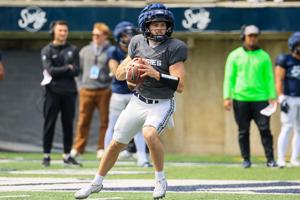
The names of the two incoming freshmen are Brady Goodman out of Mountain View High School in Arizona and Kaleb Maryland from North Shore High School in Texas. These are two players that have put up impressive numbers and look good in their film. Goodman threw for more than 7,000 yards in his high school career and exactly 100 total touchdowns. Maryland has track-star speed and has put up impressive numbers as a senior, throwing for 3,387 yards and 31 touchdowns along with 500 rushing yards and five more TDs.
Mendenhall was asked about Maryland and noted that the Texas QB was very impressed by what the coaching staff did with a running QB like Barnes.
“It’s why he’s coming. And that’s an oversimplification. I’m not saying he doesn’t care about Logan. I’m not saying he doesn’t care about Utah State. And I’m not saying he doesn’t care about our approach. He does about all those things,” Mendenhall said. “He watched Bryson Barnes. And he’s watched Kevin McGiven coach Bryson Barnes and the innovation and the creation.”
Can Utah State hold on to its recruits?
The issue hanging over the head of any coach in college football when it comes to their high school recruits is the transfer portal. What happens when (not if) a recruit develops well but then seeks to leave the program to chase money and exposure? Utah State can put all the work into making these incoming freshmen Division I caliber players, but even in-state schools like BYU and Utah will scoop up athletes they previously ignored by offering bigger paychecks.
Mendenhall is keenly aware of this, as he must be and as all coaches are. His focus isn’t attempting the frankly unrealistic sentiment of holding onto a player for five years, but in keeping them at least one year longer than perhaps expected.
“It’s not only how do you keep them, but how long can you keep them.” Mendenhall said. “The better that we (develop), the more tampering will happen. And so a lot of times then it becomes an additional year. Our relationships, our culture, our success will then possibly hold a player an additional year. It might not hold them for all five. But an additional year.”