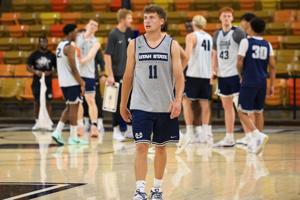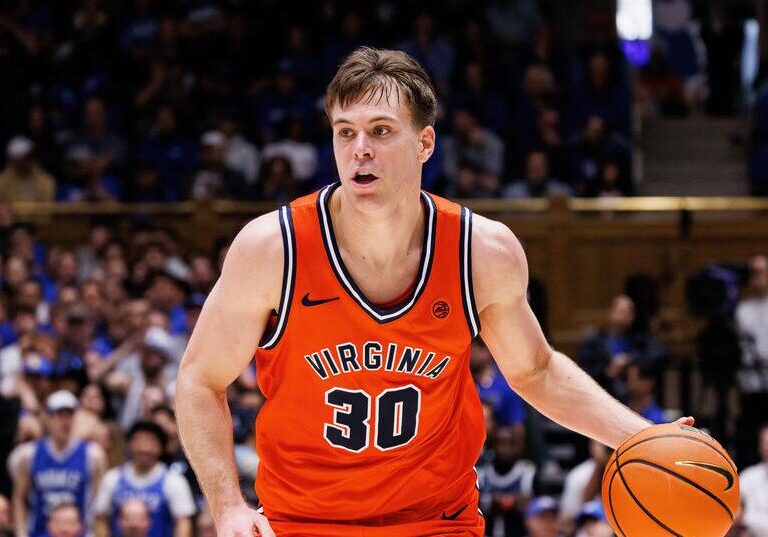


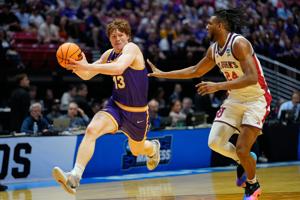
The first commitment for Utah State men’s basketball in the 2026 transfer window is one many saw coming. Northern Iowa forward Will Hornseth is following his head coach to Logan, continuing his career under Ben Jacobson. Hornseth is entering his junior year, a time in which players can make a big jump thanks to added experience. Though it wouldn’t be a jump from obscurity to a rotation spot. Hornseth already has a record of solid production and impact for an NCAA Tournament team.
✍️ 𝓢𝓲𝓰𝓷𝓮𝓭Welcome to the @USUBasketball family @will_hornseth!➡️ https://t.co/YBevvNUbRZ pic.twitter.com/GzRuFqcpdI
— USU Men’s Hoops (@USUBasketball) April 10, 2026
A native of Wisconsin, right in Jacobson’s recruiting backyard, Hornseth was a natural pickup. He excelled in high school, scoring north of 1,400 points with more than 500 rebounds and 130 blocks in career which also included two First Team All-State selections. At UNI, Hornseth played right away, coming off the bench in year one for an average of 14.2 minutes per game before moving to a full-time starter in year two. He was named to the Missouri Valley Most Improved Team for the strides he took from his freshman to sophomore season.
Biographical Info/Stats
- Height: 6’8″
- Weight: 235 lbs
- Class: Junior (2 years of eligibility)
- Hometown: De Pere, WI
- High School: De Pere
- Previous College: Northern Iowa
Here are a couple of tables summarizing Hornseth’s per-game averages and his standing in catch-all metrics. The latter will include the context of where he ranked on his team and within his conference last year (Missouri Valley).
Will Hornseth Career Per-Game Averages
| Season | Team | GP / GS | Points | Rebounds | Assists | Steals | Blocks | FG% | 3P% | FT% |
|---|---|---|---|---|---|---|---|---|---|---|
| 2024-25 | Northern Iowa | 33 / 1 | 5.0 | 2.3 | 0.8 | 0.3 | 0.3 | 68.3 | 0 / 2 | 54.8% |
| 2025-26 | Northern Iowa | 35 / 35 | 11.1 | 4.6 | 2.2 | 0.5 | 0.6 | 60.1 | 4 / 9 (44%) | 52.7% |
Will Hornseth Advanced Metrics
| Stat | Value | Rank Within Team | Rank Within MVC |
|---|---|---|---|
| Box Plus/Minus | 4.6 | 1st | 9th |
| Win Shares | 3.9 | 3rd | 6th |
| Bayesian Performance Rating | 2.02 | 5th | 32nd |
A note on source for stats in this section and later portions. Basic averages (points, rebounds, etc.) come from Sports Reference, as do the advanced stats of Win Shares and Box Plus/Minus. Bayesian Performance Rating comes from EvanMiya.com as does any lineup data used. All stats referencing specific shot types (such as shots at rim or jump shots) along with play-specific shot attempts (such as post-ups or spot-up shooting) come from Synergy Sports.
Scouting Report
Strengths
- Efficient finisher
- Productive post scorer
- High-level screen-and-roll player
Weaknesses
- Struggles to create quality post shot attempts against bigger defenders
- Height limits potential as center, especially as rim protector
- Doesn’t stretch floor, limits viability at power forward
Looking at Hornseth’s offensive role, we have a player whose primary sources of scoring come from post-ups and as the roll man in the pick-and-roll. Roughly 53% of his points came from one of those two types of actions. Throw in off-ball cuts, and that’s nearly three-quarters of Hornseth’s points last year accounted for. It’s not a complex scoring role on offense. And yet he brings effectiveness to that role, able to both create offense through his post-ups, post pins, and causing problems for defenses in ways that must be game-planned against.
Of those three, let’s start by analyzing where Hornseth stands out best: his ability to cause problems in screen and roll actions. He’s a very effective and stalwart screener but is just as deadly when slipping the screen and cutting quickly to the basket. Let’s mix examples of the two together so you can see how Hornseth varied his approach in these ball screen scenarios.
Standing 6-foot-8, Hornseth doesn’t have the presence of a lob target in the pick and roll. He simply doesn’t have that verticality. Finishing over people isn’t usually an option for Hornseth (though that’s not to say it’s never an option). In lieu of being able to use sheer length to create easier looks at the rim, Hornseth uses skill and great touch on his shots. And he’s developed a great go-to move in the 5-8 foot range. A simple floater (or runner depending on who’s describing the shot).
This shot is basically a short-range catch-and-shoot option for Hornseth. Most often it’s used in the pick-and-roll, though its use can go beyond that.
This is a move Hornseth began utilizing much more often as a sophomore. In his freshman season, he attempted only a mere handful among 104 total field goal attempts in 2024-25. This past year, it made up roughly 10% of his field goal attempts. And he made this shot at an elite rate. Typically you’re aiming to be a little above 40% on this type of shot to be viable, but Hornseth shot 60%. And among players with at least 30 attempts on these floaters, that percentage ranked ninth nationally (out of 270).
Shooting that well on a niche shot is noteworthy enough, but it has a knock-on effect with when Hornseth does actually push all the way to the rim. If the rim defenders are well-positioned, Hornseth can float a shot over them. Should he sense a weakness, he’ll attack the rack.
Having the skill that provides a full decision tree, plus some natural finishing talent, means that Hornseth is able to be an elite finisher even without elite length. Among nearly 1,100 players with at least 100 attempts at the rim last season, Hornseth ranked 59th in field goal percentage on those shots at 71.6%. And this is a multi-year trend. Some players are able to have an elite finishing season but then see a dip with more volume (Sean Bairstow and Mason Falslev are recent Aggie examples who shot north of 70% at the rim early in their careers and then dipped into the low 60s a year later). Hornseth doubled his volume of shots at the rim from his freshman season (85 attempts) to his sophomore season (162) and actually improved his percentage (70.6 to 71.6).
Let’s move on to Hornseth’s post-up game, which is going to bring us to what is technically a weaker part of his game. One might say weaknesses, but that’s the wrong descriptor for his post game because he’s decent. Not elite, but decent. Among players with at least 50 post-up attempts (364 of them), Hornseth ranked 159th in points per post-up.
Again, that ranking is nothing to be ashamed of by any means, it’s simply a reflection of where he’s at right now. Hornseth managed that as a sophomore at a skill where time and development are incredibly important. He’s already shown ability and savvy in the post. Where he’s currently falling short (if you want to call being above average “falling short”) is just refinement of what he’s already able to do.
Hornseth already has a decent bag of moves to pick from in the post. For one, he has a baseline spin that caught many a defender off guard.
He’s also very fond of flashing to the middle and pinning his defender behind him in the lead-up to an entry pass. This usually helps get the defender off balance where Hornseth can throw a variety of moves, ranging from a simple power back-down to even a good ol’ fashioned Dream Shake.
The only thing that really hampers Hornseth’s post scoring is a lack of high end size and athleticism. He’s certainly got enough power and quickness to get by against many opponents, but against teams with more size he’s not yet been able to generate much offense. This isn’t a permanent wall, though. If Hornseth continues to add strength, he can begin to really cause problems for any team.
One might think height could be an issue, but here are just two cases of Hornseth bodying a 6-foot-11 and then 6-foot-10 center.
Both of those centers were listed between 25-30 pounds lighter than Hornseth and it didn’t matter that they had two or three inches of height advantage. So if you, say, gave Hornseth 10-20 pounds more muscle mass and the strength that comes with it, the kind of players that could stonewall Hornseth would become rare indeed.
As a final note on offense, something that got touched on in my breakdown of Jacobson’s offense was how it provided some playmaking opportunities for bigs. Hornseth did well in that role, averaging 2.2 assists per game last year and ranking 34th in assist percentage among players 6-foot-8 or taller.
Hornseth isn’t going to wow people with no-look passes or point forward antics. But he is going to quietly make good decisions and solid passes. From the same aforementioned offensive breakdown article, I highlighted a few clips where Hornseth found open cutters and even created some opening through just the threat to pass.
This passing goes beyond just getting assists. It’s about connective play that makes the offense flow better. These passes don’t happen in a vacuum. Nor do the post-ups, screens, cuts and rolls. Every one of these things can happen on the same possession as Hornseth helps the offense probe the defense for a weakness to exploit. One hypothetical would be a handoff becoming a screen, which forces a switch from the defense, which becomes a mismatch in the post that Hornseth can then exploit. Multiple points of strength of Hornseth that don’t live on islands, but connect to create a player that is constantly putting pressure on a defense.
We’re not going to dive too deep into Hornseth’s defensive acumen on film, mainly because my analysis of his defense focused beyond a look at impact metrics and a dip into his performance in UNI’s toughest game of the year: vs St. John’s in the NCAA Tournament.
While Hornseth grades out fairly well in advanced metrics like Box Plus/Minus or Win Shares, his offensive impact carries more of the weight. Defensive metrics certainly speak more positively than otherwise of Hornseth, but they like his teammates more. He ranked fifth out of eight qualified Northern Iowa players in EvanMiya’s Defensive BPR last year, which was up from ranking near the back for his freshman season(sixth of seven qualified players). It’s a similar story when you swap out BPR for Box Plus/Minus.
Once you begin digging through film and other defensive statistics, like steal and block percentages, you begin to see why these defensive impact metrics are coming to the conclusion that they are.
Hornseth is a good defender. All of that preamble about where he ranks among his teammates wasn’t a setup for him being subpar on defense or anything. What comes out of the analysis is that he’s not bringing high-impact defense. He’s not an significant rim protector but not useless by any means. His 3.1 block percentage ranked 12th in the Missouri Valley (and would have ranked T-8th in the Mountain West). He’s a good defender in the post, but his lack of elite length and puts a ceiling on his impact there. And so on, so forth.
Let’s go into that St. John’s matchup to see some examples. For context, and it’s really important here, Hornseth had to face Zuby Ejiofor in this game. Ejiofor, a 6-foot-9, 240 pound former top 50 recruit who, among other notable distinctions, was the Big East Player of the Year in 2025-26. This was not an easy job for Hornseth to handle and it was usually his job to man up against this big, athletic forward.
Here’s a cut of about two minutes of clips from the UNI/St. John’s games, showing defensive possessions where Hornseth was directly involved. In several of these plays, be they isolations, post-ups or ball screens, Hornseth gave up points to his man. But you can see the hustle and effort within these plays that shows his commitment to defense.
Utah State didn’t pick up a defensive ace with Hornseth. But they certainly didn’t pick up a liability. That was the fight he put up against one of the top teams in the country, guarding one of the best players in the nation. He’ll be able to handle his own against the Pac-12.
Fit with Utah State
Despite being new to the team, Hornseth will probably have the easiest transition to next year among his teammates. He knows the head coach the best and the schemes and systems he likes to run on both offense and defense.
With the question of fit with the head coach easily answered and set aside, the new queries involve how he fits with the returning Aggies and his new teammates. Foremost among them is how Hornseth will pair with his new frontcourt partner Karson Templin.
Many early projections will probably place Hornseth and Templin as the starting power forward and center. That may or may not end up being reality come November, especially considering the recent commitment from Snow College center Sean Felts. But even if they don’t start next to each other, they’ll end up spending a lot of time on the court together. Or, at they very least, they’d better be able to. Too many resources are going to be placed behind Hornseth and Templin for them to not be capable of sharing the court for long stretches.
What makes this a question of interest is that, scanning the past decade or so of Jacobson’s tenure at Northern Iowa, it’s very difficult to see him use any frontcourt pairing akin to what Hornseth/Templin would look like. Jacobson most often turned to either a traditional center, or small-ball center, and paired that player with a more versatile four. Last year that was Hornseth and Ismael Diouf at center with, usually, one of Tristan Smith and Ben Schwieger, a pair of 6-foot-7 wings with enough size to play power forward. The two years before that and center Jacob Hutson and the 6-foot-6 forward Tytan Anderson manned the frontcourt.
Let’s forgo the full reading and leave it by saying the majority of years since the pace-and-space era began, Northern Iowa has employed a more modern-looking duo in its frontcourt.
Most of the potential issues with a Hornseth/Templin pairing, and reasons why coaches like Jacobson have typically avoided lineups like it, come on defense. Despite a perceived lack of shooting prowess between the two, that’s unlikely to cause issues with the offense. Last year at UNI, Hornseth, a non-shooter himself, played 558 possessions on offense with frontcourt partner, and also non 3-point shooter, Tristan Smith. And yet, that pairing was the Panthers’ best two-man lineup, overall and on offense, according to EvanMiya’s observed efficiency margin.
It’s also worth mentioning, for the spacing argument, that Templin is an improving and viable shooter. He shot nearly two 3-pointers per game last year with a season-long percentage of 32.8%. Though, during conference play, he upped that to 41.7% on similar volume. Templin probably isn’t going to hold a 40% rate over the course of an entire season, but he’s likely to be around NCAA average (roughly 34%).
Finding a way to make Templin and Hornseth work on defense, in a world where athletic power forwards might prey on bigs a big slower on their feet, is a prime directive.
The primary evidence in favor of it being able to work comes from Utah State itself, with the times Jerrod Calhoun put Templin and Garry Clark on the court together. Late in the season, this duo saw more and more time as Clark’s late-season resurgence demanded he see more time on the court. Templin and Clark ended up as the fifth-best two-man lineup for the Aggies all season per EvanMiya and 12th-best on defense (out of 40 pairings with at least 100 possessions played together).
Clark and Templin managed this even in a defense that required switching onto any and all kinds of players, from guards to centers. In a defense that emphasizes switching less, there will be fewer times where Templin or Hornseth would be required to defend a guard or quicker wing.
Mind you, this does not mean there isn’t an element of speed and athleticism required in Jacobson’s defense. Help defense and recovering to your own man is often just as challenging as switching into a mismatch. The key difference is less isolations against mismatches. So long as Hornseth and Templin have the athleticism necessary to help and recover there shouldn’t be a problem. And while neither player jumps off the tape when it comes to athleticism, neither are going to be accused of being plodding, slow-footed forwards.