
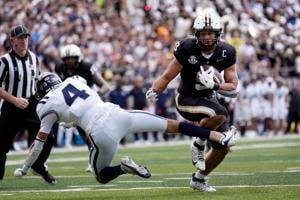
The defense under first-year head coach Bronco Mendenhall and his longtime defensive coordinator, Nick Howell, gives off good vibes. It’s a unit that swarms to the ball fairly well, tackles fairly well and has some solid playmakers. In two previous Monday Cooldown articles, we’ve looked to varying degrees at the success the team has had in stopping the run.
On top of all that, members of the Aggies’ defensive unit have spoken optimistically about their potential, depth and overall ability to win games through their efforts.
The only problem is that vibes do not stop opposing offenses. And outside of one game, Utah State has not consistently stopped any FBS offense.
Utah State’s defense entered the 2025 as the unit that would hopefully put a woeful 2024 defensive performance a long ways in the rearview mirror. The 2024 Aggies allowed the second-most points ever in program history (453 points, or 37.8 per game) and the second-most total yards (5,641, or 470.1 per game). An uncomfortable fact is that 2023 wasn’t too far behind 2024 in terms of lacking defense. So how are the 2025 Aggies doing in pulling off an about-face on the defensive competence trend?
They are worryingly close in too many ways.
By just raw numbers, the difference is an acceptable improvement. Last year’s 37.8 points allowed per game is down to just 30.4 and the yards per game is down from 470.1 to 413.0. But advanced metrics don’t paint as optimistic picture. KFord ranks Utah State’s defense 122nd in FBS with SP+ (123rd) viewing thing similarly. FEI rankings haven’t been updated through Week 5, but had the Aggies 119th through Week 4 and that rankings isn’t exactly likely to move up. Those rankings are very similar to where USU was at least year, FEI ranking USU’s defense 125th in 2024 (I couldn’t track down KFord or SP+ end-of-season 2024 defensive rankings).
That’s not the kind of improvement Aggie fans wanted to see.
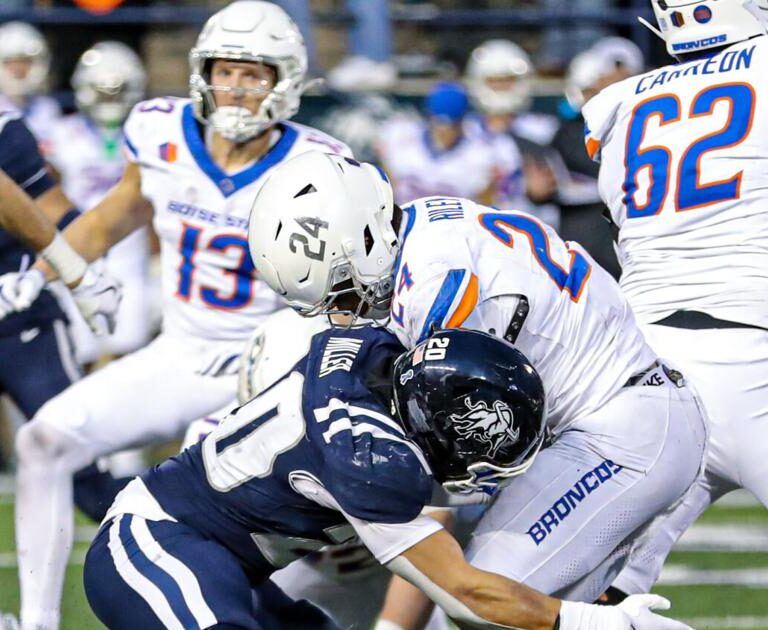
One might be inclined to point out Utah State’s strength of schedule, especially the caliber of offense it’s faced this season. But not only do these advanced metrics account for strength of opponent, you can also see that this year’s schedule difficulty isn’t all that different from last year. Yes, Texas A&M ranks 23rd in yards per game this year, and Vanderbilt is even higher at 14th and, heck, Air Force is 20th. But the 2024 USU defense also faced elite offenses, such as New Mexico (fourth in yards per game), Boise State (eighth), Washington State (17th) and USC (23rd). Against top 25 offenses, the 2024 Utah State defense allowed 544.3 yards per game. The 2025 defense has given up 514.0 yards per game in matchups with the same criteria.
There are more top-tier offenses on Utah State’s schedule — Boise State is ninth in total offense so far this year and UNLV is 30th — so this isn’t something that will go away. At some point the Aggies must stand up for themselves and slow down good offenses.
The biggest hope for Utah State comes in how they’ve performed against non-P4 teams. Against Vanderbilt and Texas A&M, the Aggies did relatively worse. Vanderbilt had its second-best offensive showing of the year (only behind the 70 points it put up against Georgia State) with A&M having what remains its best offensive output in 2025. But those games conflict with what’s gone on when USU has faced Group of Six teams, or even FCS squads. UTEP did get their third-best yardage total in five games (second-best against FBS opponents), but the 284 yards they gained against USU are a far cry from the 472 gained vs UT Martin and 442 against Louisiana-Monroe, and much more in line with the 273 and 259 against Louisiana Tech and Texas, respectively. Air Force, meanwhile, put up its lowest point total against any team and lowest yards per play average compared to its other two games against FBS teams.
So is that the secret? Is it a fact that Utah State can’t seem to hang with teams that have P4 level talent but can stand up for itself against peer teams in the G6? That’s what Aggie fans are going to have to hope for. That and for internal improvement plus some getting healthy through the upcoming bye week. If not, this may be another long season for the defense.
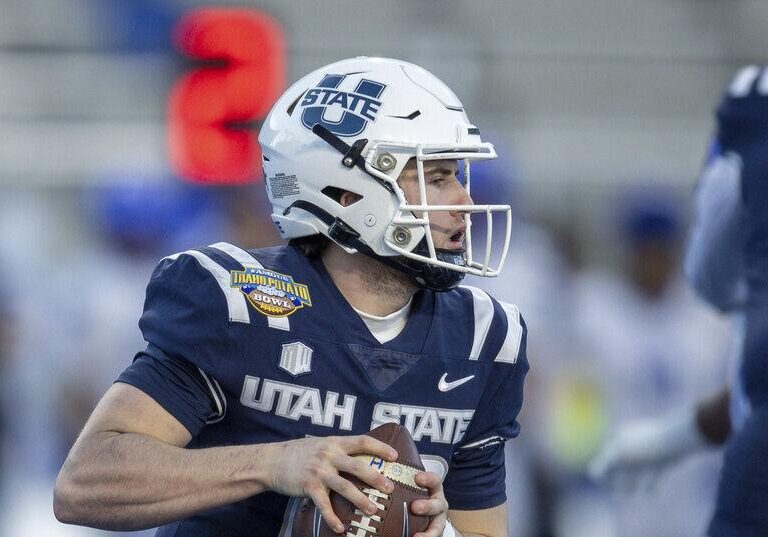
Something else that needs to be examined is how backup quarterback Jacob Conover performed against Vanderbilt and how he might end up doing so against Hawaii, if needed. Bryson Barnes left Saturday’s game early in the fourth quarter after fumbling the ball. He landed hard on his left shoulder, with a defender driving him harder into the turf. Barnes laid on the ground for several moments before pushing himself up, almost entirely with just his right arm, and cradled his left arm as he jogged back toward the sideline.
That put Conover into the game for his first serious snaps of 2025. He ended up completing 11 of 14 passes for 92 yards and a pair of touchdowns. Those are pretty solid numbers for a single quarter, even when accounting for the fact the game was pretty much already decided and these were mostly garbage-time snaps.
Grades for Conover have been surprisingly mixed. Pro Football Focus (PFF) gave Conover a 57.6 grade (out of 100) on his passing, good for 84th among QBs with at least 10 dropbacks. Meanwhile, PFSN graded Conover as the second-best quarterback for Week 5 overall with an 89.1 grade.
We’re not about to settle any disagreements between these two outlets, but we’ll look at some of the numbers and key throws for Conover in his brief time on the field.
Utah State didn’t go super aggressive or creative with Conover in the game, as eight of his eventual 14 passes didn’t travel more than nine yards past the line of scrimmage. That’s a slightly, but notably higher, percentage than Barnes had been averaging so far this year (51.6% of his throws were in that same range while Conover had 57.2% of his throws in this range). That left a few throws for Conover to be tested a bit on. His two best completions were essentially the exact same read and throw to Broc Lane on a post route.
The third and only completion Conover had when throwing the ball further than nine yards downfield was his 14-yard touchdown pass to Brady Boyd. Conover anticipated the route well as he threw it before Boyd technically got open, but the ball needed to be delivered early to fit the ball into the gap between the defense and the back of the end zone. He also threw a very accurate pass despite facing some late pressure from the interior defensive line.
Something Conover struggled with was fitting the ball into windows where he had to lift the ball over the linebackers but also keep it within the catch radius of his downfield target. He missed Lane on a throw to the sideline like this.
And later threw it a touch too high for Braden Pegan.
This isn’t the worst thing in the world for Conover, as he missed these throws in the more ideal way that avoids risk of a turnover. It’s also a throw some of his predecessors at USU also struggled with, namely Logan Bonner, who regularly placed these throws uncomfortably high (though, to Bonner’s credit, still usually within his receiver’s catch radius).
If you’re curious, Conover’s third incompletion was also a ball thrown too high, but it was a deliberate overthrow and wise move given he was being pressured and his receiver wasn’t even open.
The ideal scenario for Utah State would be for Barnes to be good enough to go in two weeks at Hawaii. He’s been absolutely stellar this season, accounting for 17 touchdowns (tied for third in the country) and being a far-improved thrower over his past seasons at USU and Utah. The good news is that injury was to his non-throwing shoulder. If the injury isn’t fully healed, Barnes might be able to power through the pain, though even if it doesn’t hurt his throwing capability, it could impact his tendency to run; either by making him (or the coaches) hesitant to leave the pocket, or make him more likely to re-aggravate the injury and take him out of the game once again.
Should Barnes not be able to go, Conover is likely able to be a solid backup. An great backup is someone that can run the offense in a similar way to the starter, so that the team doesn’t have to make major schematic adjustments. Obviously, even a great backup QB isn’t going to run it at the same caliber, or there’d be a QB controversy going on, but they can still keep the offense going in a positive direction. And Conover looks to be able to run Utah State’s offense well enough for Barnes to take time to get healthy, if he needs it, for a critical second half of the season.