
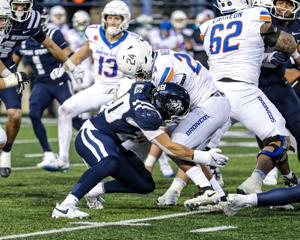
Amidst a whiplash-inducing 2025 Utah State football campaign, the Aggies’ defense provided one of the wildest swings from struggles to success. And as the program heads into its 2026 season, finding a way to build on the good stuff while sanding down the splinter-inflicting rough edges is a crucial step forward.
Utah State’s defensive coordinator Nick Howell joined the Full Court Press on 106.9 FM The FAN to discuss the Aggies’ defense, to look ahead to the 2026 season, and offer a few insights on the 2025 defense. One of the biggest was how the team simply wasn’t where it needed to be in the first half of last season.
“We didn’t have our identity exactly how we wanted it based upon a number of factors,” Howell said. “We weren’t able to play the way that we wanted to play.”
Utah State’s defense took a fair amount of lumps in the first few weeks of the season. Holding UTEP to 16 points in the season opener was OK, but then the Aggies’ defense got waxed by Texas A&M (44 points allowed) and Vanderbilt (30 points allowed).
Through the first six games of the season, the Aggies gave up an average of 34.7 points and 435.2 yards of total offense. Hardly ideal for a team whose head coach, Bronco Mendenhall, is a former defensive coordinator, aided by Howell, who boasts a quarter-century of coaching experience himself.
As the season tipped over the halfway mark, the tide shifted. Utah State improved significantly over the latter half of the season. Not perfect, but improved. Impressive defensive stands against SJSU star receiver Danny Scudero and later UNLV, the Mountain West’s top scoring offense, showed what the Aggies were capable of on defense. As a result, USU allowed just 23.8 points and 413.7 yards of total offense per game in the final six games of the regular season.
The task at hand for Howell and his players is to avoid needing a six-week runway to play well on defense this time around (or at least not to have that runway be the first two months of the season). And Howell is optimistic the team will build on the end of last year.
“That back half of the [2025] season we played really, really well, kept the points down,” Howell said. “I would see this upcoming season being a continuation and an improvement of that. Just from the mere fact that I think familiarity in the scheme, additions in the transfer portal, and guys returning that know how to play that stuff, I think we built confidence.”
Five starters return from last season’s defense — Brevin Hamblin (DB), Chris Joe (LB), Bronson Olevao Jr. (LB), Tyree Morris (DT) and Carson Tujague (DT) — which is more than last year’s team (just three, or two depending on how you apply Ike Larsen’s half-season suspension to that calculation. With a small handful of returners that saw consistent snaps as reserve players, like Bobby Arnold and D’Angelo Mayes, the Aggies return a total of 55% of defensive production, compared to just 50% last year.
Those increases may seem small, but the team is banking on this year’s returners actually having familiarity with the scheme, unlike last year, when there were newcomers more familiar with Mendenhall, Howell, and the 3-3-5 defense the Aggies now run. So not only has the amount of returning production increased, but the value of those returners goes up because of the continuity between players and staff.
In addition to having more returners and more familiarity, the Aggies brought in more experience through the transfer portal than they did last offseason. Throughout the entire winter and spring portal cycle in 2024-25, Utah State added seven players who had logged at least 200 career snaps on defense. One of those seven, Nu’uletau Sellesin, spent most of the season injured and did not appear in a game, with the remaining six collectively accounting for 51 starts and 3,741 snaps played.
It may not be a revolutionary idea, but the hit rate on players who already have experience is pretty high.
It should be encouraging, then, for the Aggies that for this most recent transfer recruiting period, Mendenhall added 11 players who meet the same experience criteria as those seven did entering last season. And while the trend of looking for FCS and Division II players ready to make the jump to FBS remained in place for Mendenhall, he also added several players who have true experience at the Power Four level. The 2025 portal recruits who came from P4 schools almost exclusively had less than 100 career snaps. This year, there are no fewer than four P4 transfers who played hundreds of snaps with those schools and have now signed with the Aggies. These four being BJ Diakite (517 snaps at Vanderbilt), Chapman Lewis (752 at Texas Tech), Harrison Taggart (874 at BYU, California and Oregon) and David Kabongo (216 at Oklahoma State).
Howell outlined how crucial having experience is with incoming players.
“The more experience guys have, the quicker they are,” Howell said. “[Having] experienced players matters. You can see that at all levels of college football. And so, I feel like we’ve been able to go faster, and it’s been a lot of fun.”
Experience is one target in recruiting, talent is another. Ideally, you get both. And Howell feels they’ve gotten both.
“Talent obviously trumps everything, overrides everything,” Howell said. “I do believe we’ve brought in some talented players. They have experience. And so we’re looking to play faster and better than we did before.”
These newcomers span all levels of the defense, from its defensive line to the linebackers and secondary. Though a lot of the focus ended up being placed on bringing in new edge rushers and defensive backs.
Utah State brought in six newcomers at the edge rusher position alone. Most of the players in this position group graduated or left via the transfer portal in January, but there was also a pretty big need to upgrade the unit anyway. The Aggies ranked 129th in pressure rate on opposing QBs, with nearly half of the team’s sacks coming from inside linebackers, meaning most of those sacks came on blitzes. The leading USU edge rusher, Will Holmes, recorded two sacks, both of which were accomplished in the team’s 48-7 win over an FCS team, McNeese.
Right now, three newcomers are expected to fill the two-deep roster, joining the one returner from last year’s rotation, Chris Joe. The three newcomers are Jeremiah Holmes, Adonis Jackson and James Jennette (side note: Jordan Pendleton, an edge rusher transfer from St. Thomas, is now listed as an inside linebacker).
The secondary saw a similar flood of newcomers, again due in part to production lost in the offseason. Noah Avinger, Ike Larsen, Dylan Tucker, Noah Flores and Bryson Taylor were some of the most relied-on players on the defense in terms of snaps played and starts made. Avinger, Tucker and Flores were even graded as the first, fourth and fifth-best players on USU’s defense in 2025 according to Pro Football Focus.
It means a lot of players need to step into big roles as newcomers or as breakout stars. And there are plenty of candidates.
At safety, there’s already one spot in the rotation well-accounted for with Hamblin returning to the defensive backfield. Three other players look to be potential impact guys at the position: newcomers Lewis and Kabongo, along with up-and-coming returner Charger Doty. Howell highlighted all three of those players specifically as having had a good spring.
Lewis brings a pretty obvious pedigree that fans can be excited about. He started 11 games for Texas Tech in 2024 and finished fifth on the team in tackles, with injuries holding him out of the end of 2024 and the entire 2025 season. Kabongo has also shown promise with his 200+ snaps played as a freshman and sophomore at Oklahoma State.
Doty is less obvious, though the signs of his rise have already been popping up. He played a little more than a dozen snaps in each of USU’s games against UNLV, Fresno State and Boise State (three of USU’s best defensive outings) and has received praise from leaders on the defense, such as Olevao.
“Charger has probably had the best spring of anyone on the team,” Olevao said after USU’s spring showcase. “Last year, he was getting ripped apart. He was being coached hard. It’s because we see it in him, and the coaches saw it in him. He took that personal, and throughout this spring, he has shown that he can play, he can execute, and he can stay disciplined and overall make plays and be physical. Super proud of him. Love Charger.”
Howell highlighted another improvement to the roster, which he felt was missing a bit from last year’s defense.
“Overall, we had some good players last year, some really high-end good players last year. But the overall depth right now is stronger and healthier than what we’ve had,” Howell said.
There’s even a correlation that could serve as a basis for a theory on how adding depth mid-season helped the Aggies’ defensive improvement late last season. Larsen missed the first half of the calendar, the period in which the defense struggled. Upon his return, the unit surged, showing not only how much adding one talented player can help, but also the depth he added by taking strain off other players.
Having that depth at the start would help eliminate growing pains. At least in theory.
Amidst the talk of newcomers, it’s important to highlight at least one of the crucial returners, linebacker Bronson Olevao Jr. The senior had a breakout 2025 campaign, recording 90 tackles, 7.5 TFLs and 4.0 sacks, though he was second on the team in two of those categories and third in the other.
Howell praised Olevao as a “great leader” and a “really good teammate,” while also speaking to how much better he could become this year.
“You just have a more seasoned player,” Howell said. “I think his play will be better this year. Bronson made some huge plays for us last year. He had a pick in the UNLV game. He had a pick in the Fresno State game that arguably won us that game. We’re looking forward to what he can do.”
Olevao could very well be representative of the entire Utah State defense. A lot of potential that is currently underappreciated and unproven. But if capitalized on, it won’t slide under the radar for much longer.