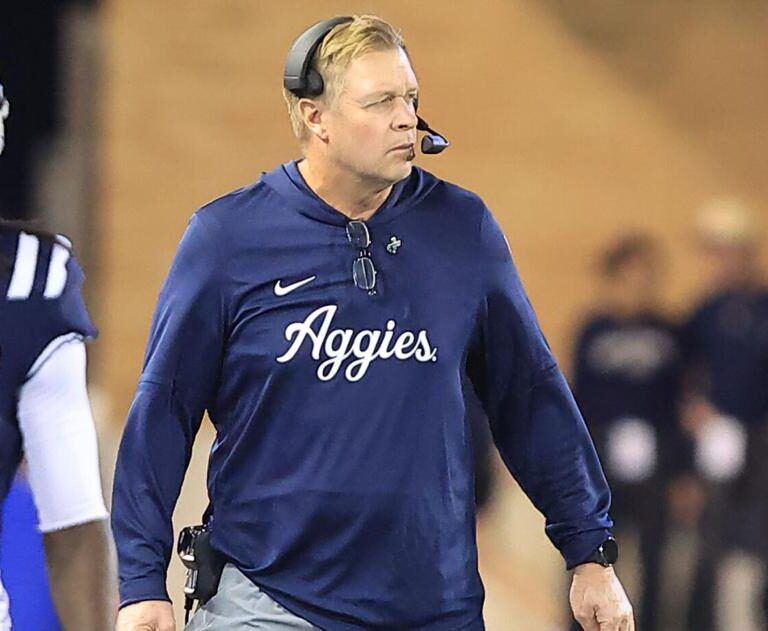


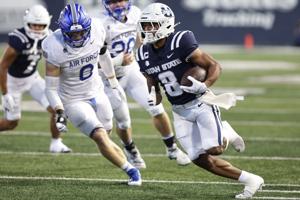
When Utah State football head coach Bronco Mendenhall stepped up to the podium after his team’s 19-point statement win over Air Force, his introductory comments lasted more than three minutes. But a lot of what he said in that time had little to do with what had just happened on Merlin Olsen Field. Not the season-high 49 points, or holding Air Force to just 266 rushing yards and 4.4 yards per attempt, not even the three turnovers his defense forced.
Instead, Mendenhall was struck by something said by linebacker William Holmes when the latter was speaking to the media. Holmes was asked about his transition from being a minor league baseball player to now playing football and he wound up talking about what Mendenhall has done for him as a coach and a teacher.
“Last year was my first year ever playing football in my life. I started to gain a lot of confidence, especially from Coach Mendenhall,” Holmes said. “How he pushes us and just the talk that he gives us. His meetings are just truly inspiring and he’s a teacher more than a coach. So a lot of my confidence comes from just the coaching staff. Just how much they believe in us and how much they push us to be great.”
Mendenhall was in the room while those comments were being made and it just about made his night.
“One of the best parts of my night was just coming in and listening to Will Holmes,” Mendenhall said. “And he was talking about practice and he was talking about preparation and he was talking about all his teammates. And he’s mature and he’s humble and he’s realistic. He knows he’s on a journey to become a football player.”
Mendenhall went on to state that “it’s great when you win, but the personal stories along the way are awesome.”
This is the culture that Mendenhall is building at Utah State. Coaches have talked the talk but Mendenhall is very much walking the walk as he teaches his players as much as he’s coaching them. And it’s been this kind of mindset and preparation that has now led Utah State to show incremental improvements through these first three games, with last Saturday being the best overall performance of the season, and by every metric the Aggies’ best offensive output of the year.
For the first two games of the season, Utah State didn’t exactly struggle on offense, but it was certainly clear that things could be tuned up a bit. In fact, that was pretty much the thesis of last week’s Monday Cooldown. Penalties and sacks, among other small issues, were holding back the offense from its true potential.
We saw that potential on Saturday against Air Force.
Utah State committed three offensive penalties for just 15 yards and yielded just as many sacks, though two of those sacks happened on one drive in the second quarter and the third late in the game with Utah State leading by 11 points (and Air Force would bail USU out with a personal foul penalty that handed the Aggies a first down). Where Utah State was once kind of its own enemy with these mistakes against UTEP and Air Force, games in which USU averaged 6.0 sacks and 37.5 yards in penalties, now the Aggies are getting in their own way much less.
“It was a point of emphasis again,” Mendenhall said. “We showed improvement. My hope is that will continue. It’ll be a continued point of emphasis. In a game like (vs Air Force) against that particular team. I think it allowed my messaging to come across maybe even more urgent than normal just because of the nature of [the] opponent.”
This is probably the development we should have expected, what with the offense having a new coordinator, returning just two starters and a majority of key players having limited experience playing FBS football. There was a steep learning curve and the players are just now really getting into the swing of things.
“I think it’s just the next step in terms of identity,” Mendenhall said of how his team improved on offense Saturday. “Coach (Kevin) McGiven and our offensive staff just become more clear about the resources we have, what fits us best, what fits Bryson (Barnes) best, and how best to manage the game. Now, every opponent is slightly different, but that doesn’t mean offensive identity drastically changes week in and week out. So I think the biggest takeaway is the clarity we’re gaining on the style of play, on the roles that our players have, and the way the ball is distributed.”
McGiven, the Aggies’ offensive coordinator, drew praise from both Mendenhall and Braden Pegan, who spoke to the media after his 147-yard performance on Saturday, and there’s a lot we could get into with McGiven’s play-calling and how he set up a lot of different big plays. But in breaking down how the offense did, we’re going to have to settle for one set of playcalls, spanning different offensive series across most of the game, to showcase how the Aggies crafted some of the biggest plays of their win.
The first play is this bubble screen to Javen Jacobs that produced a 16-yard play on 2nd & 9 which helped set up the first touchdown of the game. This was the second play the Aggies ran from scrimmage in the game itself, so it’s a play worked on with the Air Force defense specifically in mind. Utah State flashed a similar concept against Texas A&M, but never fully utilized it. And even then, USU made some tweaks to how they ran it this week which we don’t have the time to dig into.
The baseline thing to understand here is that Utah State was trying to create a blocking numbers advantage to give Jacobs more room to run after he makes the catch. They did this by motioning Broc Lane across the formation. Air Force didn’t respond by putting more defenders to account for the now three receivers, relying instead on the zone coverage they already have called (which USU probably guessed would happen based on film review). Barnes makes the easy throw and Jacobs had two blockers to cover the two defenders and he was off to the races.
Utah State ran a more vanilla version of this play later that didn’t include the tight end going in motion. They just lined up a tight end (Josh Sterzer), wide receiver (Braden Pegan) and running back (Jacobs again) in a bunched trips alignment.
For those frustrated that Utah State isn’t “getting the tight ends more involved,” this is how they actually are getting involved. McGiven is putting the tight ends in positions to block for the team’s top playmakers. These plays are designed to put guys like Jacobs or Miles Davis into space with blockers ahead of them to maximise the yardage gained. It’s worked, even if it’s not as sexy as having a tight end put up Travis Kelce numbers.
But that doesn’t mean the tight ends won’t ever get targets.
After Utah State had thrown this screen look at the Falcons multiple times, they came out of halftime and lined up once again in that vanilla bunched trips alignment. Sterzer led from the front with Jacobs behind, giving every indication that they’d try the same bubble screen again. Only they didn’t. They fake the quick throw, making the defensive backs bite and Sterzer wound up wide open for an 18-yard gain.
These three plays didn’t necessarily win the Aggies the game on their own, there were other plays that had their own massive impact and were just as, if not more, creative. But what they show is one set of plays where McGiven was earning his paycheck. All throughout the game, plays were designed well and timed even better to take advantage of a defense and later the adjustments the defense attempted. McGiven was a step ahead all night and did a very effective job of keeping the Falcons on their heels, not only through the above plays, but also via the gadget plays run using Anthony Garcia (which deserve a long-form breakdown of their own).
These passing plays helped maximize Barnes’ talents as a passer, creating consistently easy reads and throws that build his confidence for some of the more difficult throws he made on the day. Barnes came through in a massive way by completing 17 of 22 passes for 287 yards — his highest total as an Aggie and second-most in his career overall — and a pair of touchdowns. But a subtle, though very important, improvement of utilizing Barnes in the offense came in the run game.
Barnes showcased a potentially elite impact in the ground game late last season by becoming the first USU quarterback ever to have multiple 100-yard rushing games, doing so in back-to-back games with 193 vs San Diego State and 185 against Colorado State (the former being a Utah State record for rushing yards by a QB). Those kind of performances were unlikely to happen again, mainly as teams would be a little more wary of it. But Barnes was barely impactful on the ground at all in his first two games of 2025.
Even setting aside the yards Barnes lost to sacks against UTEP and Texas A&M (81 if you’re curious), his designed rush attempts weren’t yielding much in the way of results. In those two games, his designed runs averaged 3.2 yards per attempt with one touchdown and one first down. Compare that to his 54 yards on designed runs with an average of 4.9 yards gained with three touchdowns. Each of those three scoring runs were very well designed and executed plays. Get blockers going downhill and to the second level. All Barnes had to do was follow his guys to paydirt.
The execution of these plays is the more important part, though, as the design of these plays wasn’t all that different from looks the Aggies have shown in previous games. Most of what went into getting better results from Barnes in the ground game was to just block that little bit better.
“There’s a lot of things that go into touchdowns to begin with. There’s so many moving parts,” Barnes said after the game. “Everybody’s got to be executing. Everybody’s got to be on the same page. And I feel like that really kind of came into fruition with my run plays down in the low red zone. And like, I want to say on two of them, I was untouched. And so I just really feel like that’s a lot of dudes working together, executing, doing their job, and I’m just lucky to be able to be carrying the ball right there. It just happens to be me in that moment.”
As a final note, the defensive performance from Utah State was mixed as the pure numbers showed a mediocre outing. Utah State gave up 30 points and 445 total yards. But the film very much suggested an overall solid performance. Mendenhall was certainly pleased from an overall perspective.
“They played hard and I think they played well for the majority of the game,” Mendenhall said.
When it came to defending Air Force’s core triple option plays, Utah State performed very well. This defensive play right here was the epitome of covering the Falcons’ bread-and-butter triple-option play by having each of the fullback dive, QB keeper and pitch to the wing options accounted for by multiple players. Air Force had three options on where to go and exactly zero had room to roam.
With the Aggies playing like this on defense most of the night, they held the Falcons to 16 points until the first few minutes of the fourth quarter. Through the first three quarters, Air Force was averaging 4.6 yards per play, which is pretty darn good all things considered. But the Falcons wound up scoring two touchdowns in the fourth quarter after Utah State had taken a 35-16 lead. What went wrong was that everything was going right. Utah State were up by a lot more than it expected to be and far sooner.
“Those came just quite frankly on us managing the game and not anticipating possibly having that type of lead and then what it might look like to defend that lead,” Mendenhall said of the two fourth-quarter Air Force touchdowns. “Most of our preparation was on traditional type of Air Force plays. So I really was encouraged. I like the way they played a lot and then there’s some protection of lead and then end of game things that we could have played better in the fourth quarter.”
The Falcons passed the ball 18 times in the second half compared to just five in the first. Utah State were ready for all of those first-half passes, forcing both of Air Force’s QBs to go a combined 0-for-5 and throw one interception. But when the game script flipped toward throwing the ball more, the Aggies didn’t adjust quickly enough.
Even including some of that extra garbage-time yardage and points, Utah State can claim a decent night on defense. The Falcons had to run 84 plays to get its 445 yards compared to the 56 the Aggies ran to get 473. By the standard of AFA’s 2024 season, the 5.3 yards per play it averaged last Saturday would be slightly above-average (fifth among what would be 13 games). But that was Air Force’s worst offense in years. Looking at better seasons like 2023 and 2022 and the 5.3 yards per play would rank among the worst offensive performances (would be 10th in 2023 and eighth in 2022).
Was the Aggies’ defensive performance elite? No. Was it good enough? Yes, and more than good enough considering what the offense did. And the team is quite confident they’ll be even better down the road.
“I think our best defense is yet to come,” said defensive tackle Carson Tujague. “We haven’t even showed our full potential as a defense yet. And so I’m looking forward to how well we can perform in the future.”