

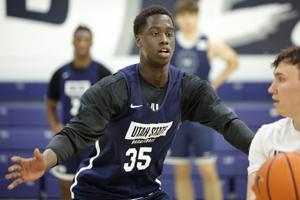
Not too long ago I wrote a bit of a brain dump article with updates on Utah State men’s basketball after head coach Jerrod Calhoun held an open practice for the media to attend last month. On Wednesday morning he invited media back again, and in the interim multiple players and coaches have done interviews on the Full Court Press on 106.9 The FAN, to get more eyes on the 2024-25 version of the Aggies.
Here’s the next update following this second open practice.
Calhoun said he’d give Wednesday’s practice a “C” grade, noting that on Tuesday the team had an amazing practice.
“I thought last night’s practice was one of the best practices I’ve seen, whether it’s during the season or it was the summer,” Calhoun said. “We played two (scrimmages) last night at the end of practice that were incredible. We’re definitely getting better. We’re making big, big strides.”
In this supposed middling-level practice, the intensity remained high. Few drills were done exclusively in the half court as Calhoun is conditioning his players to quickly get up and down the court and be ready to set up while literally on the run.
Another feature of the practice was having the newcomers on one team for scrimmages and the returning players on the other. In other practices when they’ve done this, Calhoun said competition has been even, but on Wednesday the returners were dominant. Karson Templin, in particular, had a great outing during those portions of the practice. He had one possession where he grabbed three contested offensive rebounds.
“KT [has] really picked it up the last two days, just his effort rebounding,” Calhoun said.
True freshman Adlan Elamin also showcased his skills well, proving how well he can use his 6-foot-9 frame by getting several deflections and a blocked shot in the post. Mason Falslev, as always, played with high energy and was a focal point for scoring in whatever unit he was playing with.
Throughout all practices so far, Calhoun brought up a few specific names for guys that have done exceptionally well based on how the staff has tracked performance in practices.
“Number one, of course, is Mason Falslev. He’s won 61% of every drill over the summer,” Calhoun said. “Elijah Perryman’s number two. His team’s win. I think Zach Keller has really come on this week in his own. He’s third on the team in overall wins. Garry Clark is up there.”
Rough edges remain with this group. There were sloppy and/or lazy passes, jump shooting and finishing weren’t as crisp as it should be, and plenty of small mistakes happened. Typical offseason growing pains. The only worrying point about those things isn’t that they’re happening, it’s that the Aggies will have less time this year to sand out all those rough edges. Last offseason, a trip to Europe provided an extra 10 practices (and obviously the trip itself with its three exhibition games) to accelerate the process of getting the team all on the same page.
That’s a luxury they now don’t have.
“It’s something we’ve talked about as a team. We cannot waste days,” Calhoun said. “We got to do a really, really good job with the hours we have. We don’t have 10 [extra] practices. We don’t have three exhibition games and you’re playing really good teams early. The time we have on the court or with film sessions, whatever it may be, it’s got to be really, really good. It’s got to be intentional. We got to really kind of take it in and get better from week to week. We’ve done that.”
In the roughly 40 minutes in which the Aggies played in front of the media on Wednesday, it reinforced many of the things we’ve been able to see about this team through the spring and early summer. Utah State is a longer, more versatile and more athletic team than last year. That’s not to say this season’s squad is a 2.0 version of last year. The point is that the Aggies are going to bring a slightly different flavor in 2025-26.
The theme of this year’s Aggies being a longer and more athletic team has been growing the more we see of this team in person. And assistant coach Ben Asher said it straight up in his interview on the Full Court Press on July 9.
“I think we’re a longer team. I think we’re more athletic,” Asher said.
Length relative to last year can be shown by the numbers (with the small caveat that we don’t have comprehensive wingspan numbers, which cuts out some effectiveness of the comparison) so let’s look at this year’s team vs last year’s squad, breaking them down into three position groups for further context.
Utah State Men’s Basketball Average Height Comparison (2024-25 vs 2025-26)
| Position Group | ’24-25 Average Height (Inches) | ’25-26 Average Height (Inches) |
|---|---|---|
| Point Guards | 75.0 | 75.0 |
| Wings | 77.0 | 78.3 |
| Bigs | 81.6 | 80.8 |
| All Players | 77.9 | 78.1 |
Technically, yes, the team will be taller on average though there is a small hiccup to that. Where it has extra height is at the small forward and power forward positions. Last year the Aggies routinely played Ian Martinez and Mason Falslev at the three and very often Dexter Akanno at the four. Those players being 6-foot-3 (Martinez and Falslev) and 6-foot-5 (Akanno) made USU functionally a short team, even when it had 6-foot-11 Aubin Gateretse on the floor.
However, there’s also a big possibility that the team has a starting lineup that is not really any longer than last year. Take, for example, this potential starting lineup for the Aggies from a previous analysis.
- PG – Drake Allen
- SG – Mason Falslev
- SF – MJ Collins
- PF – Garry Clark
- C – Karson Templin
This would give the Aggies the same average height for a starting lineup, mainly only swapping a 6-foot-5 power forward and 6-foot-11 center for a pair of 6-foot-8 bigs since Collins and Martinez are roughly the same height. The guard line and small forward spots would essentially be the same as last year, a trio of 6-3/6-4 guys. But the starting unit isn’t where the Aggies’ more improved length will come into play. The key will lie in something else Asher noted about the team.
“I think we’ll be able to be a little more versatile on the defensive end,” Asher said. “We’ll be able to to mix up our defenses and be able to just plug and play a lot of different guys into a lot of different pieces. I think we can play big if we need to play big. We can play small if we need to play small.”
Utah State may not open (or sometimes close) with lineups of elite length, but at any point in any game Calhoun will have units with as many as three players 6-foot-9 and taller at his disposal. That’s not something a whole lot of teams are going to be ready for.
And while the Aggies will be shorter in the frontcourt — with the tallest big on the team (Zach Keller) coming in at 6-foot-10 — Calhoun expressed confidence in his team’s ability to do the dirty work in the paint, saying “this frontline is going to be very, very physical and very imposing.” He’s also a big proponent of how much the increased quickness of this year’s crop of bigs will help the defense, a necessity he’s keyed in on after talking with Houston’s director of men’s basketball sports performance (and Aggie graduate) Alan Bishop.
“You got to get activity from the front line and from the wings that can cover ground,” Calhoun said. “If you look at David Iweze, he’s 6-8, 235. Zach Keller, probably 6-10. They’re thick. They can move. Laterally, these guys can move in pick-and-roll coverages. I think sometimes we can switch one through five, where our five is switching onto a guard. Zach moves his feet really, really well. So I think that’s the difference between last year’s bigs and this year’s bigs, is their ability to move side to side and guard. Should really help us.”
Clark, one of the bigs on the team, spoke with the media on Wednesday after practice and expressed the same confidence in his position group. He also noted he’s gained 10 pounds from his playing weight of 210 while at Texas A&M-Corpus Christi (and is hoping to get up to 230 by the start of the season). Even if their group is shorter than the team on the other side, the Aggies believe they’ll be ready.
“We’ve been hitting the way room very hard. Coach (Brandon) Buskey’s been getting us bigger, stronger, helping us move laterally,” Clark said. “We’ll be ready. Size really won’t be a factor. We’ll play play harder than a lot of teams and we’ll win.”
All of this talk about length and quickness works back toward the team’s versatility and depth (we’ll get to the latter in a minute). The Aggies’ guards will be big enough to guard many wings, its forwards able to defend bigs and some guards, and the bigs will be able to defend some forwards and hold their own occasional against guards.
And the matchup zone scheme fits like a glove onto this kind of roster construction.
At the Wednesday practice, the Aggies spent much of the time in drill work focussing on principles of the matchup zone. Most of it aimed at creating chaos with deflections, steals and fastbreak buckets at the other end of the court. With the potential for longer, more versatile lineups, USU is primed to take more full advantage of its defensive scheme than it did a year ago.
Though, for those hoping the Aggies will play more man than last year, Calhoun did say they’re going to play both man and zone defense throughout the year.
One of the most commonly commented on themes of this offseason is the roster’s depth. To be frank, claims of a team being really deep are an offseason staple. Every team is the deepest they’ve ever been in July. We heard much of the same talk last year before the team narrowed down to a nine to 10-man rotation for the majority of the season.
Is this year’s team any different?
Maybe. Maybe not. But every coach and nearly every player we’ve spoken to has said something about the depth of this team, often unbidden. Here’s a (mostly) exhaustive extraction of quotes from those who have said it in an interview either on 106.9 The FAN or with local media after a practice.
“I’ll be honest man the depth chart at every position is really good I think the strength of this team is their numbers we have great numbers every position we got one or two guys that could start.” — Jerrod Calhoun
“I know I keep saying it, but just depth. I mean, we got 15 guys that are all really skilled and can really go. And so I think that’ll really help us.” — Tucker Anderson
“Our depth is something that so far this summer that’s really excited us as the coaching staff…we’re gonna have some tough decisions to figure out how we’re going to do rotations with this group because we’ve maybe got a little bit more than we thought we’d have or we’ve got some good depth here.” — Ben Asher
“We have 15 players that can really go. It could be anybody’s game, anybody’s day. So we’re not a selfish group.” — Garry Clark
“We just have a lot of depth…We got a lot of guys that can play multiple spots. We’re very interchangeable on offense and defense.” — Drake Allen
“I think we’ve got some pretty good depth this year and I wouldn’t want to be in coach’s position right now because it’s gonna be hard to pick and choose who’s gonna play and who will end up not playing.” — Mason Falslev
Ultimately, somebody is going to have to sit. Who that will be is hard to say. The incoming freshmen are probably the first candidates. Kingston Tosi and Elijah Perryman are stuck behind very deep position groups. Even veterans or returners like Luke Kearney and Jordy Barnes will find minutes hard to earn.
As a final note, the schedule is nearing completion. A couple months ago Calhoun spoke as though the schedule were nearly complete. Complications have arisen and games on the Aggies’ schedule are still coming out piecemeal. The addition of Grand Canyon to the conference slate only adds another layer to it all. But while administrators at some of the departing Mountain West schools have raised objections to GCU’s earlier-than-expected addition, the USU coaching staff didn’t seem to be all that torn up over it.
“We’re excited. We’re very excited,” Asher said. “It’s funny, we were actually just mapping that out (July 8) as a staff in one of our meetings. We feel like that’s probably at worst, at least one Quad 2 (game),” Asher said. “If they finish, I believe it’s top 75 in the NET, and we play them at their place, that’s another Quad 1 opportunity for us. So all those all those metrics really count come Selection Sunday.”
Allen played in the same conference as Grand Canyon in his time at both Southern Utah and Utah Valley. He started four games against the Antelopes, though he didn’t see much success as his teams went 0-4 in those matchups.
“Good school. Just another team. Right now (we’re) focused on us,” Allen said. “It’ll be fun, whether we get to go there or not, or whether they come here or not. Excited to play whoever it is, but I think it’s just an exciting year for the conference.”
The full Mountain West schedule has yet to be released, and it’s going to be a 20-game schedule but with a hint of how the old 18-game conference schedule worked. Teams will face nine of 11 conference foes in a home-and-home series and face the two other teams just once with one of those as a home game and the other on the road. That will add more intrigue to the conference schedule which wasn’t present last year when all teams played a true round-robin.
As for Utah State’s non-conference schedule, a total of eight games have been reported, some receiving official confirmation by way of opponents releasing their full schedule with USU on it.
- Nov. 7 vs VCU (neutral game in Frisco, TX)
- Nov. 12 vs Weber State
- Nov. 21-22, two games in Charleston Classic (against any two of Boston College, Tulane and Davidson)
- Dec. 4 at South Florida
- Dec. 7 at Charlotte
- Dec. 13 vs Illinois State (neutral game at Delta Center in Salt Lake City)
- Feb 14 vs Memphis
There are two more games left to add, excluding any exhibition games the Aggies plan on playing. Given all but one of the already announced games are road or neutral games, these final two will likely both be played in the Spectrum.