

With the formalization of Texas State joining the Pac-12, the musical chairs of western conference realignment has reached a temporary conclusion (it’s always temporary with conference realignment). No further schools are expected to be added to the Pac-12 or the Mountain West in the immediate future.
With the loss of its autonomous conference status, the Pac-12 is now a peer conference to the Mountain West. Obviously geographically speaking that’s true, but also in the two conference’s Group of Five (Group of Six?) status. Even more important is that both have the goal of being the top G5 conference in the nation. The Mountain West had been racing toward that goal in the last half decade, especially in men’s basketball, and were only missing some bounce-back seasons in football from programs like Utah State and San Diego State (among others) in order to be the clear-cut best-of-the-rest league in the two major sports.
Now, the Pac-12 is usurping the crown Gloria Nevarez was in hot pursuit of — and nearly had. Oregon State and Washington State dropped the hammer by flexing their war chest of hundreds of millions to reel in the best programs from the Mountain West and lure in Gonzaga (whom Nevarez had also been pursuing). The Mountain West has now back filled, making Hawaii a full member, and not just football-only while also adding UTEP as an all-sports member. Northern Illinois is jumping in as a football-only with UC Davis and Grand Canyon as everything-but-football members. That makes 11 institutions that are either full members or affiliate members of the Mountain West (technically 12 as Colorado College is part of the conference in women’s soccer, but we’re going to ignore that from now on for brevity) and nine for the Pac-12.
To the Pac-12 believers, the rebuilt league is a step above the Mountain West and the rest of the G5. Ask fans of the remaining Mountain West schools and the responses are a mix of the Pac-12 not really being that much ahead of the MW or deriding any notion of the Pac-12 being close to its old status as one of autonomous conferences.
Let’s fuel that talk by taking a long, hard look at the numbers. There are five key areas to look at and each will be examined in turn. As a tool for interpreting the data, a grade will be assigned to each conference in all five areas. The grades will be largely based on relation to the rest of the non-power leagues.
Athletics Revenue and Revenue Sharing Estimates
Money is the all-important driver of collegiate athletics. Those with more money win more often. In any given year you will see lower budget teams go far, but over the course of years money counts. It keeps coaches on campus and, in the NIL/Revenue-sharing era, it keeps players around too. Raw dollar amounts, and the ability to generate higher numbers, absolutely matter.
That makes a comparison of revenue arguably the most important thing to do here. So that’s where we’ll start. The following is (largely) fiscal year 2024 revenue data for the Pac-12 and Mountain West schools and the conferences as a whole.
Pac-12 vs MW Revenue/Growth Comparison
| Pac-12 | Mountain West | |
|---|---|---|
| Total Revenue | $619,515,783 | $546,816,843 |
| Average Revenue | $58,835,087 | $49,983,349 |
| Median Revenue | $65,897,302 | $53,329,304 |
| Average Growth | 30.0% | 21.2% |
| Median Growth | 31.0% | 22.0% |
As a matter of full disclosure, this data is a little cobbled together. The bulk of it comes from the Knight Commission On Intercollegiate Athletics, with some (particularly private universities like Gonzaga and Grand Canyon) drawn from the Equity in Athletics Data Analysis from the U.S. Department of Education. For one or two schools, fiscal year 2023 financial data had to be used as fiscal 2024 data wasn’t available.
In comparing the new conferences, there’s a pretty well-defined gap in annual revenue, but not one that you would describe as massive — at least relative to differences in other conferences. By that I mean that the median revenue for the ACC in fiscal year 2024 was just over $152 million, making the gap between the Pac-12 and MW average revenue roughly one-tenth the gap between the Pac-12 and pretty much all Power Four conferences. Aside from Oregon State and Washington State, most of the Mountain West and Pac-12 have been pretty similar budget-wise. The biggest question about any significant separation that may or may not eventually build happen is in growth.
The Pac-12 schools are growing faster on average when it comes to revenue growth, with an average of 30% compared to the 21.2% of the Mountain West. If the Pac-12 media deal is significantly better than the Mountain West one, that gap in growth could itself grow. Programs like Utah State and Boise State, who were at the top of the MW in revenue growth, were doing so on the MW media rights payout. Hand each school more money up front and the gap between the Aggies/Broncos and the left-behind Mountain West schools would only get bigger. Programs like Fresno State and Texas State, whose growth rate has been among the lowest in FBS, could easily see those rates skyrocket relative to their MW peers.
A very important offshoot of revenue is NIL and revenue-sharing potential. A couple weeks ago I did a quick dive into the amount of money each Mountain West team could offer athletes in salary via NIL/revenue-sharing based pretty much entirely on numbers via NIL-NCAA.com. Here, we’ll look at it through the lens of a Pac-12/MW comparison. As a precursor note, data for some teams isn’t available as the source of this data focussed only on FBS teams, which precludes Gonzaga, Grand Canyon and UC Davis. Air Force is also excluded as the institution is not expected to participate in revenue sharing.
Pac-12 vs MW NIL & Revenue Sharing Comparison
| Pac-12 | Mountain West | |
|---|---|---|
| Total NIL/Rev-Share | $50,560,131 | $32,622,346 |
| Average NIL/Rev-Share | $6,320,016 | $4,082,793 |
| Median NIL/Rev-Share | $5,063,733 | $3,771,397 |

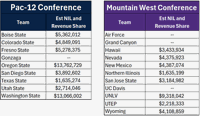
Analyzing this metric is a bit iffy because it’s based on a third-party estimate. We don’t know the amount of NIL or potential amount of revenue sharing each school will dedicate to paying athletes and nobody is sharing dollar amounts. If these values are roughly accurate, it’s a bit of a worrying gap for the Mountain West. It’s enough of a gap that Pac-12 schools could become transfer destinations based on the ability of the Pac-12 teams to offer more money. Were the Mountain West to regularly lose talent to the Pac-12 would only solidify a hierarchy with the MW on a lower rung.
Some good news for the MW, though, is that some schools, like UNLV, Nevada and New Mexico should be able to match the financial efforts of their Pac-12 rivals. It may be cold comfort for the teams at the bottom of the MW, but these three schools are likely to be gunning for membership in bigger conferences in the long run. UNLV’s ambitions for the Big 12 are certainly well-known enough. Even if the rest of the conference struggled with paying players enough money to get them to stick around, so long as UNLV, or others at the top of the Mountain West, can keep their squads around, it could make them into a new mid-major powerhouse.
Grade — Pac-12, B+ | Mountain West, B-
Football Success
While the Mountain West will not be significantly behind financially when compared to the Pac-12 (at least for now), success on the football field is where a serious gap emerges. The Pac-12 didn’t choose the schools it did by accident. It took the best football programs (and basketball, but we’re gonna get to that later) for its new league, and the numbers show that very clearly.
The following data draws on all football seasons dating back to 2013. That year was used as a cutoff since that’s when the current membership of the Mountain West was finalized. That fact makes 2013 a pretty good place to draw the line for the majority of teams under consideration here (and the rest of the teams that haven’t been involved with the Mountain West until now can just deal with it).
Pac-12 vs MW Football Success Comparison (since 2013)
| Pac-12 | Mountain West | |
|---|---|---|
| Conf Win% | 0.531 | 0.433 |
| Total Conf Titles | 11 | 4 |
| Bowl Apperances | 59 | 43 |
| Average SP+ | -0.54 | -9.95 |

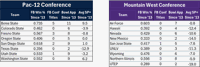
The gaps in win percentage and bowl games are one thing, but what really separates these two conferences now is the number of championships. Since 2013, only one member of the Mountain West that isn’t leaving has won a title: San Jose State in the COVID-19 season of 2020. Every other conference championship has gone to one of Boise State, Fresno State, San Diego State or Utah State. Even the spots in the title game are overwhelmingly in favor of the departing five with 18 of the 24 spots in the title game since 2013 having been filled by future Pac-12 teams.
SP+ is another metric that really solidifies the gap. Using SP+ for this comparison is largely an attempt to go beyond just winning percentage. Having a catch-all metric for teams that accounts for strength of schedule and any style points from big wins (or the opposite from bad losses) helps go beyond simple wins and losses.
To put context behind the numbers in the table, for one, the value itself is a representation of what a point differential would be in a game against an average FBS team. So, with the Pac-12 sitting at -0.54 across all teams, an average Pac-12 team over the past 12 years would expect to barely lose to an average FBS school. Meanwhile, the average Mountain West team, at -9.95, would be expected to lose by double digits. Put a different way, this past season, a -0.54 SP+ rating would rank a team about 73rd, akin to some seven or eight-win G5 teams and a couple 5-7 teams from P4 conferences. The MW’s -9.95 rating would rank a team 105th, slightly ahead of where 4-8 Utah State and 5-7 Hawaii ended up.
In a previous look at SP+ rankings, this year’s preseason rankings indicated that the new Pac-12 would rank fifth among FBS conferences by average SP+ rating (that calculation was done prior to Texas State’s addition, but it barely changes the Pac-12’s average SP+ rating). The future Mountain West, by contrast, would rank eighth, ahead of only Conference USA and the MAC. The essence of what the SP+ numbers indicate is that the average Pac-12 team will be expected to be a decent bowl team while the average Mountain West team would be a doormat in most conferences.
Of all the areas in this comparison study, these facts regarding championship numbers and relative strength to the rest of the FBS could be the most damning for the Mountain West. In the biggest money-making sport for collegiate athletics, the Mountain West projects as a bottom-tier conference. The Pac-12 will be very far off from the Power Four leagues, but will be a considerable step ahead of most of the rest.
Grade — Pac-12, B | Mountain West, D+
Basketball Success
When it comes to basketball, both conferences will see a boost in national relevance compared to how they’re both doing in football. Men’s basketball has been the strength of the Mountain West and while many of its best teams are moving to the Pac-12, not all of them are. Great mid-major basketball will still be found in the MWC.
However, much like with football, there’s still a pretty notable gap to be found, a lot of it due to Gonzaga’s addition to the Pac-12.
Pac-12 vs MW Basketball Success Comparison (since 2013)
| Pac-12 | Mountain West | |
|---|---|---|
| Conf Win% | 0.614 | 0.520 |
| Total Conf Titles | 41 | 19 |
| NCAA Tourney Games | 81 | 22 |
| Avg KenPom | 9.26 | 0.19 |

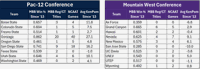
The totals in conference titles and NCAA Tournament games is heavily inflated by Gonzaga (with its 20 conference titles and 40 NCAAT games) but even excluding the Zags, things still tilt in the Pac-12’s favor. Of the 26 MW championships awarded since 2013 (note on the math, there are two titles each year with the conference tournament and regular season, plus the regular season titles can be shared), the tally is 18 for the future Pac-12 teams and eight for the rest. That’s closer than football, but still not much of a fair fight.
To get an idea on average strength of conference, we can use KenPom in a similar way to how SP+ was used in the football comparison. The Pac-12’s average team (by KenPom rating) since 2013 would rank 81st in last year’s KenPom rankings. Meanwhile the average MW team would sit at 162nd. For further context, the 81st-ranked team in KenPom last year was 21-14 Stanford and the 162nd-ranked team was UTEP (nice coincidence) with a record of 18-15.
Basketball will remain the strength of the Mountain West, but it’s very likely that the conference will go from a 4-5 bid league to something more akin to the West Coast Conference or A-10. Namely, a conference that can be a multi-bid league, but there will be plenty of years with just one team in the Big Dance. New Mexico and Nevada will remain solid programs and UNLV may manage to finally make the jump to conference contender. It just won’t be enough to match what the conference currently is, with as many as seven teams having contended for the regular season championship — and NCAA Tournament bids — in a single season. Instead, it’ll be the Pac-12 that has a deep and competitive league with a conference strength of schedule to rival even some power conferences.
Grade — Pac-12, A | Mountain West, B
TV Ratings/Media Market
In a modern sports landscape where TV viewership is everything, we need to take at least a small dive into market ranks and TV ratings for each team. Basketball viewership is increasingly tricky to cobble together so for TV ratings we’ll stick to football using data from medium.com, which has reported viewership on an annual basis going back to 2021. And alongside these ratings we’ll compare media markets and the rankings for the DMA (Designated Market Area) each university is in.
Pac-12 vs MW Media Market and Football TV Ratings Comparison
| Pac-12 | Mountain West | |
|---|---|---|
| Average Media Market Rank | 56.6 | 61.3 |
| Median Media Market Rank | 52 | 48 |
| Average 4-Year Football TV Ratings | 373,728 | 135,917 |
| Median 4-Year Football TV Ratings | 313,625 | 116,500 |

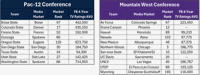
One shouldn’t take these viewership numbers as gospel because there are some flaws with the methodology behind the data. Not in the sense that the person that put it together omitted critical data, it’s just that some data isn’t publicly available and can really hurt some teams’ ratings, particularly those that are more often on streaming like ESPN+ and other platforms (such as the Mountain West Network). But it’s pretty much the best that Google can find.
Assuming some semblance of accuracy, the Pac-12 pulls off another big win, with borderline three times as much TV viewership as the Mountain West. This kind of gap is what could end up troubling the Mountain West as it attempts to secure a viable media rights deal while competing directly against the Pac-12 for many of the same western time zone evening slots.
The viewership data mars what might have otherwise been a win for the Mountain West in the realm of media market ranks. While technically, the average media market ranking for the Pac-12 is better, the Mountain West’s average is hurt a lot by the outlier of Wyoming, whose 193rd ranked DMA of Cheyenne-Scottsbluff drives down the overall average. This is where looking at the median instead of average helps us a bit more. Looking closer at the numbers and we can see the Mountain West has a foothold in three top-15 DMAs — Chicago (3rd), San Francisco-Oakland-San Jose (10th) and Phoenix (12th). The Pac-12 has zero teams in top-15 markets, the best being Denver (via Colorado State), the 17th-ranked market.
The thing that kind of throws a wrench in looking at these media markets, though, is that relatively few of the Pac-12 or Mountain West teams are the dominant power in said market. But, in another win for the Mountain West, most of the teams that are one of the top dogs in their market come from their conference. New Mexico, Wyoming, Air Force, Nevada, UTEP, and kind of UNLV (at least for college sports) all have a really good hold on the market they’re in. Boise State and Fresno State are probably the only teams that (again, just looking at college sports) don’t have a significant competitor in their market.
Grade — Pac-12, B | Mountain West, C
Stadium/Arena Size and Attendance
Although TV and media markets are all the rage, putting butts in seats remains at the center of what sports are for, especially for collegiate athletics where being at the heart of a community is key. So how do each of the conferences fare in attendance for the two money-making sports? We’ll start with football:
Pac-12 vs MW Football Attendance Comparison
| Pac-12 | Mountain West | |
|---|---|---|
| Average Stadium Capacity | 34,281 | 37,483 |
| Median Stadium Capacity | 35,274 | 34,840 |
| Average Attendance Since 2013 | 28,956 | 20,099 |
| Average Attendance Since 2021 | 28,296 | 19,037 |

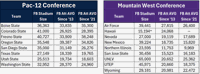
There’s some necessary context to these numbers as it isn’t completely raw data. For one, 2020 attendance was removed entirely due to the impact of COVID-19 on in-person attendance. Also, Hawaii’s post-2020 and San Diego State’s 2021 attendance numbers are also not included because of teams playing smaller temporary venues (Hawaii still plays in the 15,194-seat Clarence T. C. Ching Athletics Complex as it awaits the completion of a new stadium and SDSU played the 2021 season at Dignity Health Sports Park, a venue two hours away from San Diego, before the opening of Snapdragon Stadium in 2022).
Even with those considerations out of the way, this data still gets noisy in places. Changes in home venue have occurred for several teams (San Diego State and UNLV among them) with renovations for others have had some impact on these numbers. A similar look at the attendance numbers between the new Pac-12 and Mountain West was done by Chris Murray of Nevada Sportsnet using a three-year sample size that largely avoids those issues, but it largely comes to the same conclusion we will in a just a few paragraphs.
For once, though, there’s an area where the Mountain West has something of an advantage (kind of). Based on raw average, the Mountain West has a slight edge in stadium capacity, though a lot of that has to do with UNLV as an outlier by playing in the Las Vegas Raiders’ 65,000-seat Allegiant Stadium. Even if you were to include Hawaii’s current stadium size, the average is still higher for the Mountain West. Though, for the Pac-12 supporters, if you go by median size in an attempt to account for outliers the Pac-12 has the edge with a median of 35,274 next to the Mountain West’s 34,840.
Then, of course, there’s the number of people to show up at games. And that is in favor of the Pac-12.
The 12-year data is slightly better for the Mountain West than the most recent four years, but neither is particularly close. The Pac-12 schools have averaged anywhere between 6,000 and 11,000 more fans in attendance in any given year since 2013, with the average falling just shy of 9,000 since 2013 and just shy of 10,000 since 2021.
Moving on to basketball, the numbers are (thankfully) less muddy, with little need to make significant adjustments aside from removing the COVID-19 impacted season of 2020-21.
Pac-12 vs MW Men’s Basketball Attendance Comparison
| Pac-12 | Mountain West | |
|---|---|---|
| Average Arena Capacity | 10,741 | 10,494 |
| Median Arena Capacity | 10,270 | 10,918 |
| Average Attendance Since 2013 | 5,945 | 5,650 |
| Average Attendance Since 2021 | 6,152 | 4,972 |

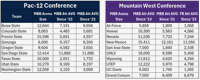
This is as even as it gets for the Mountain West and Pac-12. The only thing worth noting in terms of a gap is that the Pac-12 appears to be building a larger edge in its attendance. The since-2013 gap in per-game attendance is a mere 295 but since 2021 it’s grown to 1,180. If that trend continues, there will be a notable gap in the near future. Something to keep in mind is that the departure of most of the best teams from the Mountain West will likely drive down attendance for the remaining schools. Meanwhile, the Pac-12 could see a boost now that the overall strength of the conference will be higher and a big-name brand like Gonzaga will be coming to town at least once per year.
Grade — Pac-12, B+ | Mountain West, C+