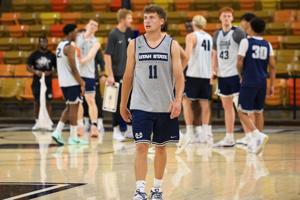


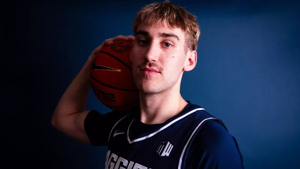
Utah State’s second addition via the transfer portal marked the Aggies’ first foray into directly recruiting junior college players since 2023. Ben Jacobson also went local with this recruit, signing Crimson Cliffs graduate and Snow College center Sean Felts, who ranks 19th among junior college prospects according to jucorecruiting.com.
The St. George native had previously noted he went to Snow College because of its proximity to his hometown, and while Logan is a little further up the road, being able to stay in-state and within drivable distance and play in the upper end of Division I was something Felts wasn’t exactly going to pass up. And neither would Jacobson pass up bringing in a center with more length than any of last year’s players could boast.
Let’s get into the details on the newest center on Utah State’s roster.
Biographical Info/Stats
- Height: 6’11” (6’11” wingspan)
- Weight: 220 lbs
- Class: Junior (2 years of eligibility)
- Hometown: St. George, UT
- High School: Crimson Cliffs
- Previous College: Snow College
Sean Felts Career Per-Game Averages
| Season | Team | GP / GS | Points | Rebounds | Assists | Steals | Blocks | FG% | 3P% | FT% |
|---|---|---|---|---|---|---|---|---|---|---|
| 2024-25 | Snow College | 32 / 10 | 5.1 | 3.6 | 0.6 | 0.4 | 0.8 | 61.2% | 0 / 2 | 63.6% |
| 2025-26 | Snow College | 33 / 21 | 13.1 | 6.7 | 1.2 | 0.6 | 0.8 | 58.9% | 14 / 33 (42%) | 62.7% |
Felts graduated from Crimson Cliffs as one of its all-time great players, having set school records for single-game points, single-season points and career blocks. As a senior, he earned All-State honors after averaging 20.5 points, 7.2 rebounds, 2.2 assists and 1.8 blocks per game. His first year at Snow College, Felts mostly played a reserve role and then upgrading his role as a sophomore. Snow College has been a junior college powerhouse for a while and Felts aided in that dominance. The Badgers went 29-5 last year, spending a lot of time ranked inside the top ten, with their season ending in the second round of the NJCAA Tournament.
Scouting Report
Strengths
- Great shooting touch at multiples levels of court
- Can stretch the floor with a 3-point shot
- Good pick-and-roll target, including lobs
- Consistently boxes out and fights for rebound positioning
Weaknesses
- Not a high level rim protector
- Limited post scoring ability
- May lack bulk to defend/rebound against bigger centers
It’s not very often that you find a center capable of scoring at three levels. Sean Felts can be listed among that rare breed. Mind you, he’s not a three-level scorer in the same way that great off-the-bounce scorers are. Felts rarely dribbles and is just as often attempting to score in isolation. And yet he finds ways to score around the rim, in the mid-range and even from 3-point range.
Let’s dive into how he is able to do so.
A full shot profile of Felts isn’t publicly available beyond manually charting every single game. And given only some of Snow College’s games are archived online, the shot profile here is going to have an asterisk due to an incomplete and smaller sample size.
The following is a breakdown of shot attempts and percentages in four games that were charted from Felts’ sophomore year at Snow College — against Butler CC (March 24), College of Southern Idaho (Jan. 15), Indian Hills CC (Nov. 15) and Lamar CC (Dec. 5). One minor note is that despite reviewing every possession, often multiple times, my numbers were off. I only accounted for 34 of Felts’ official 37 attempts, which may come down to attempted tip-ins or similar subjective views on what constituted a shot. But the following are my numbers:
- Shots Near Rim – 14 of 17 (82.3%)
- In Paint Non-Layups – 4 of 9 (44.4%)
- Mid-Range Jump Shot – 4 of 6 (66.7%)
- 3-Pointer – 1 of 2 (50%)
- All FGA Combined – 23 of 34 (67.6%)
Just by looking at the overall field goal percentage, we can see this sample size is above Felts’ shooting percentage by a pretty significant margin. He shot a hair under 59% this past season and in these four games he was just under 68%. My guess is that most of the regression to the mean in other games comes from his mid-range jumpers and shots near the rim. But the more important part of this exercise was to get an idea for which types of shots Felts has in his bag and at least get an idea for his ability in each area.
If you want my personal estimation on his 2-point percentages based on this sample size and some napkin math based on his actual shooting percentages, it’d be this this: Felts likely shot close to 75% around the rim, in the range of 44-48% on non-restricted area paint shots, and around 35% on mid-range jumpers.
An overarching theme of Felts’ scoring is that he has incredibly nice touch on his shots. Even when shots look somewhat rushed, he doesn’t let it impact his release and his shots are able to roll softly around the cup and usually go through. This is most apparent on his shots in the paint. We’ll start with a compilation of his shots in the restricted area.
As noted, in our film sample size, Felts shot 82% in the restricted area, and two of his misses were followed up shortly after by makes so he only had one empty trip in 15 goes at making a shot near the rim. His actual shooting percentage is almost certainly lower, but you can see his ability to finish around the rim, even with some unusual angles he’s attempting shots at and/or with a defender draped all over him.
Moving out a few feet, Felts brings the same soft touch around the rim to his short-range floaters. He breaks this out for any attempt where he’s not at point blank range but also not at a distance where a jump shot becomes necessary. Basically, it’s anywhere in the paint but outside the restricted are. You could even argue some of the attempts from the earlier compilation of at-the-rim shots were more similar to his floater than a layup.
This kind of shot, which is also in the bag of Felts’ new teammate Will Hornseth, is an incredibly versatile shot to have in your bag. As seen in those clips, it’s a shot that becomes useful in chaos. Most of these cases on film were random situations where Felts suddenly got the ball in the paint, be it a dump-off pass or something even more random. It’s also his go-to in a post situation (it’s also pretty much his only shot in the post that came up on film. The floater also works well in the pick-and-roll in cases where Felts might get a pass on the short role. This is something that was showcased in the Hornseth newcomer breakdown.
Moving even further from the basket and we’re getting into the range that begins to separate Felts from other centers. He really can hit a shot from anywhere in the half court. He’s not limited to the paint as he can break out mid-range jumpers, largely from the elbow or the baseline. Felts took these with great confidence and, as we’ve examined earlier, likely hit them at a rate viable enough to give him the green light to take these whenever the defense leaves him open.
And, late last season, Felts added a 3-point shot to his repertoire. An interesting development because through his first 42 appearances for Snow College he attempted only three 3-pointers (making just one). However, in the last 23 games of his time with the Badgers, he evolved into a true stretch five.
Over those final two dozen games, he shot 13-for-32 from three. Felts went from averaging 0.07 3-point attempts per game into a stretch center averaging 1.4 attempts per game. In other words, his 3-point volume went up nearly 2,000%.
Let’s shift away from offense toward two important areas for Felts in his role as a center, especially in his move from playing at the junior college level all the way to the upper end of mid-major ball. These areas being defense and rebounding.
As a rebounder, Felts is very fundamentally sound. He habitually seeks boxouts while also tracking the ball well on its trajectory toward the basket. He possesses great hands in terms of catching the ball (probably an overlap in the soft touch he has in scoring). In the four games analyzed, there wasn’t really a single case of a bobbled rebound. His worst cases of not grabbing a rebound that was theoretically within reach were in situations where the ball was on the very edge of his catch radius (i.e. not times where you’re blaming him much for not making a literal fingertip catch on a rebound).
Overall, his rebounding numbers back up what’s seen on film. He averaged 12.1 rebounds per 40 minutes which, for reference, is a rate that would have ranked fourth in the Mountain West last year.
The one negative seen from his rebounding comes from his lack of bulk, which is also relevant to his soon-to-be-discussed defense. Felts lacks good bulk, i.e. weight. He’s listed at 220 pounds, which is already on the low end for a center, but I also somewhat doubt he even weighs that much anyway.
There were multiple cases of Felts getting pushed a little too easily and it resulted in him not being able to get a rebound. This is also something that limited him in post-up situations where he couldn’t really back down any defenders.
This is a problem that will only get worse at the D1 level unless there’s some pretty serious work put in by Felts to add weight. There’s an upper limit to the amount of weight you can add in one offseason, but adding 10-15 pounds would help mitigate some of the issues that can and very much could crop up without preparation in the offseason.
Felts’ lack of bulk/strength didn’t really manifest as a problem on defense (outside of some rebounding) on film, though part of that is because he wasn’t going up against D1 centers that are going to weight between 240-270 pounds. So there isn’t much more to dive into in that regard. But we are going to look at one his more notable weaknesses as a center, which is that he isn’t really much good at blocking or contesting shots at the rim.
Being 6-foot-11 and spending a lot of time around the rim on defense ended up resulting in some blocks for Felts. He led his team in total blocks with 28. But that was also less than one per game and only 1.5 per 40 minutes, a rate lower than the 6-foot-8 Karson Templin managed in the Mountain West and not against junior college players.
When Felts had to face challengers around the rim, his ability to get big and vertical was too inconsistent. When everything comes together, his 6-foot-11 frame becomes quite the obstacle. But there were too many times where it didn’t come together. Here’s a compilation mixing the good and bad.
There is more to Felts’ defense than just his rim protection. But those aspects of his game and their relevance to his role at USU is coming up in the next section of this breakdown (and it’ll be more positive).
Fit with Utah State
Ben Jacobson really seems to be going all in on having an elite pick-and-roll scoring team. First he brought in Hornseth, and now Felts comes in with both being great options for manufacturing points in these situation thanks to their respective abilities. There’s also the recent addition of AJ Bates, a point guard who excels in attacking defenses, especially with his passing, out of pick-and-roll actions.
Furthermore, with Felts having the ability to stretch the floor to both the mid-range and 3-point line, he will be able to create spacing for the offense and can even be utilized as a distributor. His touch on a floater isn’t good for just shooting. He’s also a dab hand at dropping in lofted passes to fellow frontcourt teammates who are being fronted by defenders. Jacobson’s offense gives ample opportunity for bigs to read the defense from the top of the arc and make plays from there. Felts won’t exactly be a point center on the floor, but the Aggies are going to generate more than a few baskets this season by setting up Hornseth or Templin in the paint and then having Felts lob a pass in for an easy lay-in.
A good sign for Felts is that one of his weaknesses, a lack of great rim protection/deterrence on defense, isn’t something that will get exposed within Jacobson’s pack-line defensive system. The defense focusses much more on denying driving lanes and packing the paint with defenders than having a single rim protector jump in to help whenever dribble penetration happens on defense. Felts fits much better within this style of defense. He possesses good lateral speed to help with hedging defenders in ball screen situations and can recover to his own man quickly. And in drop coverage, Felts utilizes his lateral speed and length to manage the very tricky dance of defending the ball handler and trying to shield a pass to the rolling big.
There’s definitely some polish that needs to be added to Felts’ defensive game, but a lot of it is the kind of stuff that can be coached into him and built in the weight room. And with months to go until the season, Jacobson is going to have plenty of time to whip him into shape.
Felts isn’t just a good junior college recruit with solid numbers. He’s a player whose skills, and even weaknesses, line up with what Utah State needs from its players. It shows that Jacobson isn’t just trying to stack players that look good on a recruiting website. The players on the 2026-27 Aggie roster are players that have the capability to excel once they get on the court and not just on paper during the offseason.