

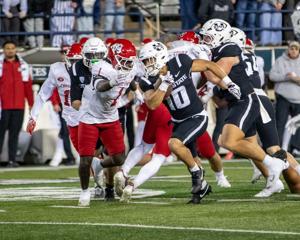
The version of Utah State that appeared on the field Saturday night is perhaps the idealized version of what the 2026 Aggies are capable of. Their “final form,” so to speak. A team that is slowly mastering the art of ball-control offense and pairing it with a defense that has become a terror to opposing teams.
That isn’t to say that Utah State was perfect. They were far from that. Nor is that to say that this final form is even necessarily a good thing. What this Utah State team is, however, is one that is finally capable of getting wins. Something that is never a guarantee. In the words of USU head coach Bronco Mendenhall: “Winning’s hard.”
The Aggies are now showing the capability to get wins. Saturday’s victory put the final touches on their first winning streak of the 2026 season. On top of that, Utah State has won three of its last four games (and are a handful of special teams miscues away from a Wendy’s special, 4-for-4). Mendenhall is becoming vindicated in what he’s been preaching all season long: that with time his team would put things together and make it work.
In pulling this off, Utah State hasn’t engineered some kind of massive reverse course on the weaknesses that have plagued the team all year. The Aggies are still most of what they were in August. It’s just more refined, and they’ve leaned into a distinct identity. They know this offense isn’t going to magically morph mid-season into a unit capable of throwing down 35 points. So, instead, they focus on what they know they’re capable of.
“The identity of the offense is matching and fulfilling the identity of the team to deliver a style of play that gives us our best chance to have success,” Mendenhall said. “We’ve adapted and adopted, and kind of shifted to where, while it might not be 40 points a game and setting fireworks off, it’s doing enough to manage the game, to move the ball, to score enough points to help our team win. Which is the ultimate goal.”
McCae Hillstead is perhaps the best exemplar of how Utah State has adapted to playing as well as possible within a limited scope. Hillstead has thrown just 36 passes in the last two games, but he’s been the ninth-best quarterback in the nation within that timeframe according to Pro Football Focus and its grading system. Hillstead has earned a grade of 89.6 across Week 9 and Week 10. Most of the players around and above Hillstead have either thrown way more passes or thrown a similar number of passes but only played one game between the last two weeks.
“He’s doing what he needs to do within what he’s given within the plan, and he’s just doing that with confidence and certainty, and I think he’s having fun,” Mendenhall said.
Hillstead threw for only 117 yards, but on 14 attempts, that put him at 8.4 yards per attempt. By that average, it’s the third-best passing game of the season behind Colorado State (9.4) and Troy (8.6). And he’s adding value as a rusher as well. Altogether, Hillstead is averaging 8.3 yards per touch across his passes, rush attempts, and the one reception he had against Colorado State (57 total touches, 476 yards).
The volume isn’t there, as Hillstead has combined for just 476 total yards in two games, but as Mendenhall said, he is doing what is asked of him; both with his arm and his legs, and doing so efficiently. His decision-making is greatly improved. No longer is he putting the ball in harm’s way, as when he threw four interceptions in his first two appearances this season. Rather, he’s getting the ball where it needs to go. Sometimes that’s by throwing the ball. In many cases, he has done so by running it there instead.
The formula for Utah State these last few weeks — and now going forward — is pretty simple. First, play elite defense and bog the opponent down. Second, get some early points and be able to play ahead. Repeat step one and have the offense do as much as it can to keep the ball out of the opponent’s hands. And when the opposing team does have the ball, make sure it takes them a long time to get to the end zone.
Utah State hit on all of those points against Fresno State, and marched to a similar beat in the win over Colorado State (with the same skeleton being visible in the Texas State game, though the positive result didn’t materialize).
After the Aggies took a 14-0 lead into halftime against the Bulldogs, they did a solid job of making the game speed by so that there simply wouldn’t be enough time for an adequate rally. Fresno State’s first scoring drive took nearly eight minutes off the third-quarter clock, and resulted in only a field goal. The Bulldogs’ next drive burned five minutes and didn’t even result in points as they had to punt from midfield. Then they took three more minutes and got turned over on downs. And while their lone touchdown drive took just 2:46 off the clock, they started with only 4:16 and had zero timeouts left.
The reason the Bulldogs had zero timeouts was due to the one productive drive by the Utah State offense in the entire second half. The Aggies had only three real drives in the third and fourth quarters. And while there was very little in the way of great production, it did just enough. But it did just enough. And crucially, they burned some clock. At the 9:15 mark of the fourth, Utah State took the ball and took five minutes to drive down the field and kick a field goal. During that drive, Fresno State used all three of its timeouts. When USU kicked off, the Bulldogs had four minutes to reach the end zone twice after having failed to do so during the previous 3.75 periods.
This style of football isn’t going to wow a lot of fans, and it’s far from foolproof. Every game, Utah State will be riding a very thin line that can’t allow any sort of breakthrough by the opposing offense or special teams. The loss to Texas State is an excellent example of how one slip-up at the start of the game completely threw things off. Take away the Bobcats’ early kick return touchdown and the game flow might have played out incredibly similarly to how Saturday’s meeting with Fresno State went. The Aggies had three early drives that produced points, and could have been able to work with that theoretical 9-0 lead and turn it into a victory on similar terms to this past weekend.
The most worrying fact is that history doesn’t favor teams that rely on being able to win by scoring just 17 points every week. Even though there’s a style Utah State has repeated for a few wins, not being able to score more than that on a regular basis is not good, no matter how you spin it in a press conference. Utah State is on pace to score roughly 200 points this season. And in the BCS/CFP era (since 1998), the maximum number of wins for a team that scored less than 210 points is six. It’s been done three times, and not since 2006.
Utah State is not only fighting against three more teams this season, but it’s also fighting against the most well-known truth in all of sports. That being, you have to score points to win games. The Aggies will engage in that same two-front fight the rest of the year. They’ve defied the odds and won with this style in three of the last four games. They only need to make two out of the next three to secure a bowl game. And if they go 2-for-2 these next couple of weeks, they would only need a little bit of help from Texas State’s opponents to end up in the Pac-12 championship game.