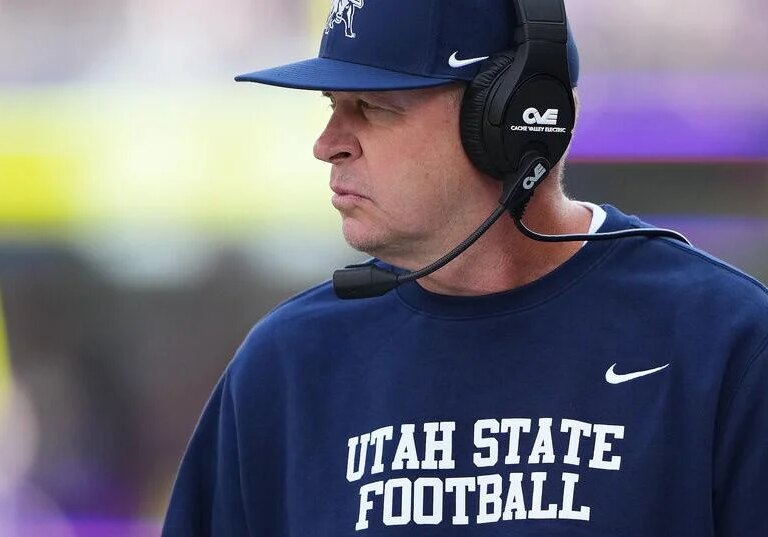

During the post-game press conference for Utah State Football following its 20-17 loss at Texas State, safety David Kabongo fielded a pair of questions, the latter of which has been lobbed toward several players and coaches of the 2-5 Aggies over the last month or so.
1. How good can this team be if you can put all three aspects of the game together, and
2. How close to doing so do you feel this team is?
Kabongo answered with optimism that belies the situation Utah State currently finds itself in.
“I feel like we’re right there,” Kabongo said. “We’re just scratching the surface. We’re right there. It’s just a couple pieces. We all got to click at the same time. We can’t have one facet or one unit just slip up. We need all three units, whether it’s defense, offense, and special teams. We need them all clicking at the same time so we can be a complete team.”
There’s not much, if anything, wrong in what Kabongo said in that moment. But he didn’t acknowledge the elephant in the room. That being that his side of the ball has been taking care of business in every game this year. But week in and week out, the offense and special teams have bungled things to the point where the only thing left to ask the defense to do is score the points themselves.
For those not quite fully aware of the disparity, you can picture it through the lens of one statistical ranking, FEI. According to that analytical model’s rankings, Utah State’s defense ranks 48th nationally, with its offense 104th and special teams 117th. The Aggies hold the dubious distinction of being the only team in the country with a top-50 defense, while ranking 95th or worse in both offense and special teams. Though they have some statistical siblings that mirror USU by meeting those same criteria, but swap offense for defense. Those teams being North Texas, Air Force and Colorado State (you could also include Delaware in this, a team that ranks well on special teams but has a weak offense and defense).
You can even go game-by-game and find ways in which the defense did its job while the offense and special teams mucked things up.
- IDAHO STATE — The defense held a high-powered Idaho State passing offense (292.3 pass yards per game to date) to a mere 54.5 completion percentage and 152 yards through the air. Utah State’s offense turned the ball over four times, including handing ISU the ball multiple times in the red zone.
- WASHINGTON — The defense held the Huskies to what is still a season-low 16 points. Utah State’s offense only mustered 14 points, half of which came on a one-off explosive play. Due credit to the special teams in this game, though. Great field position play from the punt team.
- UTAH — No one on Utah State really performed well in that game.
- TROY — For the first time all year, Utah State’s offense does enough to take advantage of the defense holding a team to virtually no offense
- BOISE STATE — The 30 points scored by Boise State’s offense was their fewest outside of the loss to Oregon. The Aggie offense not only scored just two touchdowns and a field goal, but also handed the Broncos an extra seven points via a pick-six
- WASHINGTON STATE — Utah State’s offense once again did enough (even if barely), but that was despite the special teams handing a free field goal to Washington State’s offense thanks to a fumble on the opening kickoff. And the offense’s only touchdowns came after the defense got takeaways and handed the offense a short field.
- TEXAS STATE — Go read my recap and you’ll see how much special teams and offense struggled with specific detail
Bronco Mendenhall not only has to find a way to fix the offense, he also needs to keep his team from being divided over the chasm that is the performance of the defense and literally everybody else.
“At a really early age, we distinguish what’s fair and what’s not fair. It’s not fair I’m doing this. Someone’s doing that,” Mendenhall said. “And I think that’s common throughout the world of sports. And I think it divides teams. And our approach is the exact opposite of that. (It’s) contribution to benefit the team and use your strengths to benefit the team.”
At least outwardly, the team is living up to Mendenhall’s approach of not letting perceived differences in contributions divide the locker room. Kabongo navigated that dynamic well in his response on Saturday. And on Monday, one of the leaders of the team, linebacker Broncon Olevao Jr., addressed the issue when asked more directly as to whether it was disheartening to see the offense perform poorly while the defense excels.
“We’re a family, a brotherhood, offense, defense, special teams. We’re all one. So when a brother’s down, you just got to pick him up,” Olevao said. “You just got to keep encouraging our offense, and our special teams will get it right. I play on special teams. I play a big role on special teams, and that’s on me as well. We got to get that right on both punt and kickoff and just do everything that we can to make sure that we can play a whole game, both all three phases, and also complement each other. So I’m not super disheartened. I’m just excited on when we do put it all together.”
One can only hope that what Olevao said is what’s really happening at ground level. Discontent and resentment could turn a group project to turn the offense around into a late-season disaster-class.
One of the biggest issues with Utah State’s lackluster offense at Texas State is that the team had an entire bye week to work on their issues. They could address things that didn’t have time to be addressed in the week-to-week grind to prepare for and scout each opponent. Yet the only thing the Aggies really seemed to change was to send offensive coordinator Robert Anae back up to the press box to call plays from there.
According to Mendenhall, the offense did make some improvements, saying he “like(d) the consistency of the drives” and that for quarterback Grady Brosterhous, it “was his best game in terms of managing the team.” But if 285 yards of total offense and having half of your possessions go for 10 yards or less is “improvement” and “consistency” in the drives, that’s not OK. And while it is probably fair to say Brosterhous had one of his better games, but across 36 pass attempts and 13 rushes (49 total touches), the Aggies gained 233 yards, or 4.8 yards per play.
As much as you want to record improvements, if that is the pace at which Utah State’s offense is going to improve, then fans are going to turn their backs and tune out until they can see change happening at a quicker pace.