

There isn’t a way to sugarcoat Utah State’s 1-4 start to the season. The best you can do is cite the fact that the Aggies have played three ranked opponents, two of which remain ranked in the latest AP Poll.
But in the end, good teams will win these games.
The Aggies set expectations of contending for a Pac-12 championship game, and a team of that caliber wouldn’t have lost 33-0 to Utah, or gone down 21-0 to Boise State, wouldn’t have lost to Idaho State at home, and probably would have managed to figure out a way to win at Washington (a team now ranked outside the top 40 in SP+).
Put another way, per FEI ratings, an above-average team would have roughly one loss against Utah State’s schedule. An average team would have two losses, and a below-average team would have three losses. The Aggies have four losses and everything that number in the loss column implies.
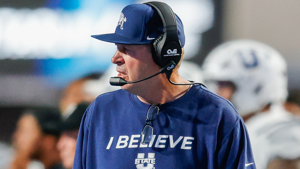
The balance between the reality of Utah State’s strength of schedule and the reality of being 1-4 is not easy to figure out. And it’s not just the fans and media that need to thread that needle. Head coach Bronco Mendenhall is trying to figure that out as well as he continues to evaluate, teach and motivate his players.
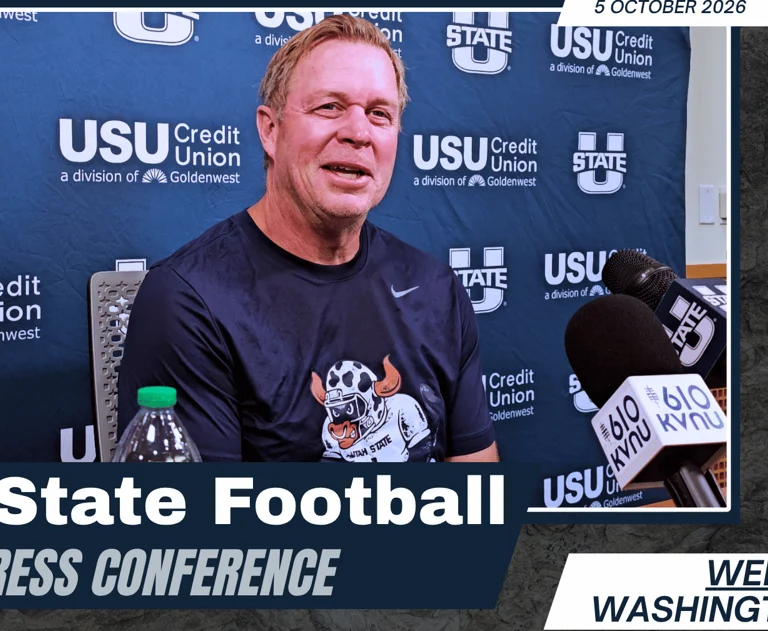
“I’m trying to be realistic. I’m trying to see our team in a way where it continues to grow,” Mendenhall said. “Do the outcomes still matter? Yeah, they do. Do they sting? It almost makes it hard to breathe sometimes. And yet, that’s part of moving the program forward against fierce competition and a good league in a new setting.”
Mendenhall came into Monday’s weekly press conference with a lot more energy than he presented in the post-game presser after the Boise State loss. Some of that may have been because he walked in fresh off a workout in the stadium, but also because he seemed to see things on film that encouraged him. Overall, he seemed to feel pretty good about Utah State’s ability to figure things out eventually.
Can Mendenhall actually salvage the season? That’s a question that is difficult to answer. The first issue is what would constitute “salvaging” the season in the first place. Getting to the Pac-12 title game? A bowl appearance? Would the Aggies need to win either/both? Answers would probably vary from fan to fan. Many have grown weary of seemingly endless 6-7 campaigns that end in bowl game blowouts. But at this stage, you can hardly be picky.
Let’s settle on the notion that making a bowl game would satisfy most of the criteria for fans to consider the season to be not a complete failure. And we’ll go from there.
We ran an exercise a couple of weeks ago examining how likely it was for a team that started 0-3, as Utah State did, to make a bowl game. Long story short, since 1998, a mere 8% of teams who started the year with three straight losses made it to bowl games. Just for fun, let’s run the same study but this time with 1-4 teams.
Unfortunately for the Aggies, the percentage is even lower this time, dropping to just over 7%, or 48 out of 662 teams. Utah State has its own sample size within that range, with 12 seasons where the team started 1-5, and the 2022 season being the only time the Aggies managed a bowl game despite that slow start (if you want to stretch back a little further than our arbitrary cut-off, you could also throw in USU’s 1993 season, which also started 1-5 and then rattled off six straight wins to end the season, including a win in the Las Vegas Bowl).
Still, that’s roughly two teams per season that manage to pull off the unlikely. And since there’s little reason to be overtly pessimistic, let’s see how Utah State is planning on trying to become one of those two this year.
One of the things Mendenhall is convinced of is that the offense is still improving.
“I thought our offense improved,” Mendenhall said. “I think we’re more dynamic. I think we’re more balanced. I think we’re more explosive.”
While the Aggies didn’t match their output against Troy in either yards (413 to 345) or points (21 to 18), you can certainly see where the USU coach is coming from with his point. Utah State averaged more yards per play (5.9) this past Saturday than the week prior (4.9). The Aggies also had just as many drives get inside the opposing 40-yard line against Boise as it did against Troy (both had five), meaning a similar number of scoring chances, just not the same execution in the end. And, for the first time this season, Utah State eclipsed 200 yards in sack-adjusted rushing (201 to be exact), with a per-attempt average of 7.4.
The main thing that held the Aggies back on offense turned out to be the two-QB system that seemed to come out of left field and threw off what little groove the unit had managed to settle into. Mendenhall said after the game that it was a pre-planned move. Still, it came as a jarring decision since Brosterhous completed each of his first six pass attempts for 56 yards and a touchdown. That sixth pass, which was also the touchdown, even came during a drive where Hillstead had been the primary quarterback, but was unable to break through the goal line after Javen Jacobs set the Aggies up with goal-to-go after a 64-yard run.
Hillstead just wasn’t able to muster any sort of momentum-shifting playmaking with his arm or legs. Brosterhous often struggles to do so with his arm, but has been able to substitute his running ability to keep drives alive. But even with some of Brosterhous’ struggles, the graduate senior has shown improvement. Over the last two games, he’s completed 65% of his passes for 371 yards, four touchdowns and just one interception while rushing for 130 yards (adjusted for sacks).
Utah State has certainly had to scheme the offense around Brosterhous’ limitations as a thrower, but his success within that system has proved an adequate improvement from the combined QB play from him and Hillstead in Weeks 1-3. For reference, their combined passing stats for that time feature a 52% completion rate, 571 yards (190 per game), four touchdowns and eight interceptions.
Even though you can argue Hillstead has more arm talent and potential as a thrower, at this stage, four weeks into the Brosterhous era, the passing offense with him has simply been better. The best showcase of this is how each quarterback did against Boise State when they had a clean pocket. Brosterhous completed 73% of his passes in 17 dropbacks and threw a pair of touchdowns. Hillstead completed 40% of his throws under the same clean-pocket criteria in 10 dropbacks and threw an interception. And while that pick was a tipped ball at the line, if you watch the replay, the linebacker who eventually got the interception was already jumping the route, and it was shaping up to be a replay of an interception Hillstead threw against Idaho State.
If there’s one thing that would make me hesitate to put McCae Hillstead back in at QB going forward, it’s that in a crucial situation, he threw basically the same interception against the Broncos as one he threw vs Idaho State.
Yes, the ball was tipped at the line, but watch the… pic.twitter.com/u7zeSiACte
— Jason Walker (@jwalker_sports) October 6, 2026
In dividing time between the two quarterbacks, Utah State couldn’t find a rhythm. Brosterhous’ 53 yards on the first drive of the game was basically the only effective passing yards the offense had for three quarters. From the 11:08 mark of the first quarter to the end of the third, Utah State had 10 total passing yards. That’s 41 minutes of game time with less than a dozen yards through the air. After 53 in less than four minutes. And while there are multiple factors in why, swapping out quarterbacks and having Hillstead — who is much more of a throwing QB than a rushing one — doing read-option run plays certainly didn’t help prime the pass attack.
The good news is that a two-quarterback system, notorious for how poorly they go 99.99999% of the time, is not the long-term plan for Mendenhall. Any swapping of QBs from Saturday, and any seen this Friday against Washington State, will be aimed at determining a long-term QB1.
“I’ve never really felt comfortable when there isn’t a starter and a backup. I think it’s better for the team. I think it’s clearer for the individuals, and to practice repetitions,” Mendenhall said. “Their repetitions have to go to the starter for him to keep developing.
And once they’re split, quite frankly, the growth is split. And then you don’t really have a quarterback. You have two that are partially prepared and not completely prepared.”
Once Utah State has settled on a single quarterback to take nearly all snaps (ideally before Friday), the next important step can take place. It’s one offensive coordinator Robert Anae already had figured out by the second half of the win over Troy, and even at the start of the Boise State game.
Get the ball to your best players.
In the two third-quarter scoring drives that helped hand Utah State the win against Troy, wide receiver Eli Wood was targeted a combined six times. Wood ended that game with career-highs in receptions (seven) and receiving yards (96). On the Aggies’ opening drive against Boise State, Wood caught three passes for 36 yards, but didn’t see another target until the final two minutes of the first half. He was also only targeted once in the entire third quarter. It wasn’t until the third quarter that Wood got involved again and — surprise, surprise — he made two key catches that set the Aggies up in scoring position. He reeled in one pass for 25 yards that got USU deep into Boise State territory, and on the next drive he caught a 31-yard touchdown from Brosterhous.
Wood now leads the entire Pac-12 in total receptions (30), is second in receiving yards (388), and is tied for second in receiving touchdowns (four); the latter two only trailing Oregon State’s wunderkind Jesse Legree. It makes a little too much sense to keep him involved all game, rather than be inconsistent about it.
As for the run game, the combination of Brosterhous and running back Javen Jacobs has proved to be effective when allowed room to breathe. Brosterhous and Jacobs have combined for 115 rush attempts for 639 rushing yards (excluding sacks), which includes an average of 5.6 yards per rush. Literally everybody else on the team has a combined 84 yards with a 2.9-yard-per-carry average.
It’s pretty clear who has emerged as the playmakers in this offense. Wood secures key catches through the air, with Javon Robinson (and maybe at some point Demick Starling) as a deep threat. Then, in the run game, Brosterhous and Jacobs can move the rock.
Football can never really be that simple. But it might kind of be that simple for Utah State. Their best drives of the season have invariably involved one, usually multiple, of those three players.
Should Utah State manage to implement these improvements on offense, there would only be one game left on the schedule where the Aggies don’t have a good chance at winning. Even now, ESPN’s matchup predictor gives Utah State no worse than 30% odds to win in every game the rest of the way, save for at Oregon State. Most of the teams in the Pac-12, for better or worse, don’t appear to be leagues ahead of the Aggies. And it’s something Mendenhall may be capable of taking advantage of to salvage something out of what’s been a disappointing season for him and Aggie Nation at large.