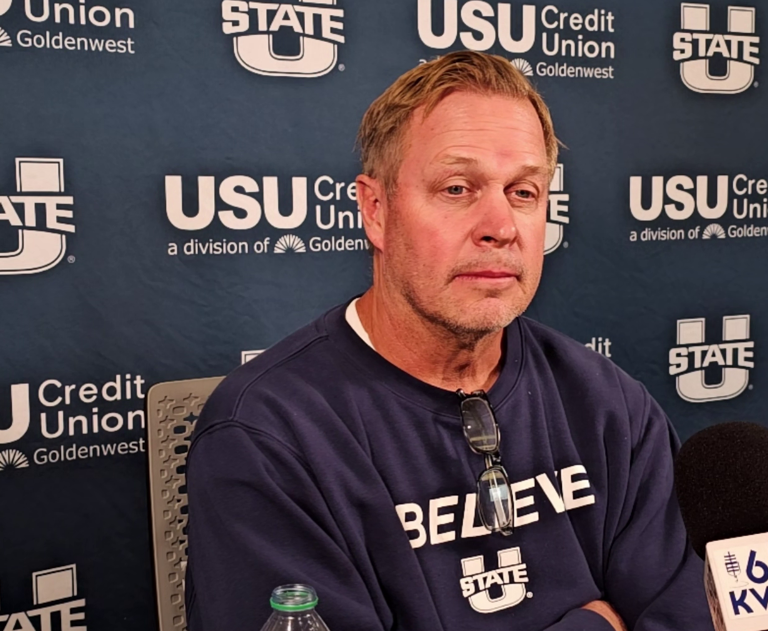

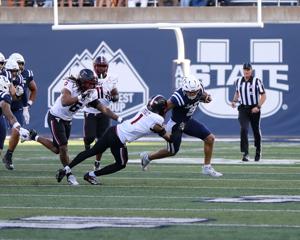
As Bronco Mendenhall walked away from the post-game press conference podium on Saturday following Utah State’s 21-10 win over Troy, he offered one last quip to the media he’d spent the last dozen minutes speaking to.
“I like talking to you guys better like this.”
Winning makes everything better, even down to conversations and press conferences. Three weeks prior to that moment, Mendenhall was having to explain a loss to Idaho State (with the raucous celebrations of the Bengals below audible through the floor). The mood was somber then, and just as much for the following two weeks in the wake of defeats against Washington and Utah.
Instead of another week asking about the struggles of the run game, quarterback play, clock management, penalties, or failing to score any points against an in-state rival, Mendenhall gave honest, well-earned, and unforced praise to his team.
“Really proud of my team. Gritty and tough and united,” Mendenhall said on Saturday. “They’ve remained hopeful, hardworking, optimistic, and yeah, I think steadily improving. And I think that’s the case each week, including last week, is my takeaway. I love their resolve. I love their determination. I like their unity. But most importantly, I just like the kind of kids they are.”
While Utah State’s win could be chalked up to playing a significantly easier opponent (Troy currently ranked 104th in SP+ compared to ninth for Utah and Washington’s 29th), there is still plenty of merit to be found for the Aggies. And even where the arguments of an easier opponent are true, the Trojans are much closer to the rest of the Pac-12 than the Pac-12 is to either the Utes or Huskies.
To put it simply, Saturday’s game will be more representative of the quality of competition Utah State will face, and the kind of games most fans can expect when the Aggies play from here on out. The fact that Utah State looked competent in this game, and really solid in others, is at least not a bad sign with Pac-12 play just down the street.
Of all the issues plaguing the Aggies through three weeks, most were on offense. So, naturally, that’s where most of the improvements can be found. The most crucial one came in the ground game.
Troy entered Week 4 as the proud owners of the 27th-best run defense by yards allowed per game. And while there can be something said about how real that ranking should be (they faced a pass-heavy Sam Houston team, an FCS Alabama State, and then a Missouri team currently 78th in rushing yards per game), there was at least actual competence from the Trojans’ defense. They also ranked ninth nationally in tackles for loss as a defense and 24th in sacks. That was a front seven capable of doing real damage to a depleted Utah State offensive line.
Only, the Aggie O-line put forward its best game, both in terms of pass blocking and run blocking.
The dominance in pass blocking was plain to see. Troy had previously pressured opponents on nearly 40% of dropbacks and managed eight total sacks. Grady Brosterhous was kept clean on 74% of his dropbacks against the Trojans, a season-best rate for the Aggies. This season-high clean pocket rate even came against the second-highest percentage of blitzes Utah State has faced this year. Troy brought an extra rusher on more than half of Brosterhous’ dropbacks, only coming in just behind Utah’s blitz rate. Less than a quarter of those blitz packages produced a quarterback hurry for the Trojans, and they resulted in only one sack, their lone QB takedown of the evening.
Giving Brosterhous all the time he needed to throw turned out to be a genius move. On those dropbacks when he had a clean pocket, Brosterhous completed 74% of his passes, averaged 10.3 yards per attempt, and threw both of his touchdowns. It’s a pretty dramatic difference from the QB who leads the FBS in interceptions, thanks in large part to struggles in previous weeks.
On the run-blocking side of things, the rushing totals tell part of the story but not all. Utah State ran for 176 yards, excluding sacks and the kneel-downs at the end of the game. That alone is worth noting, as it became the new season high (under the same criteria, USU’s next-best was 173 against Idaho State). Digging further into the stats, we can see the improvements made by the offensive line to make the job of the runners easier.
A major problem for Utah State’s run game was an inability to generate anything on designed run attempts. Mendenhall bluntly said following the Washington game that the QB scramble was their only run game. And it was spot-on analysis. Utah State ran 18 designed runs in that game and gained just 22 yards. Even more damning was how hard the Aggie rushers worked just to get that yardage. According to data from Pro Football Focus, Utah State gained 40 yards after contact on rush attempts against Washington. That meant that the average first contact from the Huskies’ defense on any given designed run was one yard behind the line of scrimmage.
Yards before and after contact are a decent measure for an offensive line, since it isolates the performance of the line from the impact of the running back. And there’s a stark difference for the Aggies between the first three weeks and Saturday against Troy. For the opening three games, Utah State averaged 0.89 yards before contact on designed runs. On homecoming night vs Troy, that number rocketed to 2.7.
A big part of that was getting their running backs into space on the outside. Again, here’s a bunch of numbers all at once, comparing the first three weeks to last Saturday: Utah State went from averaging 8.3 rush attempts outside the tackles for 18.0 yards per game to rushing 14 times outside the tackles for 90 yards.
Utah State’s two longest designed runs of the night were ones in which the offensive line crashed down on the defensive line from one side, put a lead blocker (either a pulling guard or a running back leading the QB) ahead of the rusher in space on the outside.
Mendenhall has stressed in basically all of his press conferences over the last couple of weeks that the coaching staff was working on getting the run game to function. This (admittedly minor) shift in tendency toward running the ball to the outside could be part of that. At the very least, he spoke of improvements in the foundations of the ground game.
“There’s been improved design and an improved focus now that it’s becoming more clear who we have and what we can do and what might be the strength of this particular offensive unit,” Mendenhall said.
Not all improvement came from innovation as Utah State went back to the well with one particular run. The Aggies’ first rushing touchdown of the season came on a draw play that gained 27 yards across two attempts against Utah (which accounted for 47% of USU’s total rushing yards that day).
Here’s that play against Utah:
And here it is on Saturday, near the goal line.
All of these improvements on the offensive line and the run game have come even amidst what is still a bit of a health crisis for the unit. Jackson Nelson, Tavo Motu’apuaka and John Randle each missed Saturday’s game. Randle has yet to play this season, and Nelson is currently nursing an injury to his left foot/ankle (he’s been wearing a walking boot since he left the Idaho State game with that injury). But the Aggies managed to settle on a five-man group who could get the job done. Four linemen played all 65 offensive snaps — K’Iyone Iosua (left tackle), Kadin Lynch (left guard), Jimmy Liston (center), and George Maile (right guard). Seth Wilfred started the game at right tackle, but freshman Easton Hammond came in and played the final 36 snaps of the game, with PFF grading him as the best-performing lineman for the Aggies.
Mendenhall said it’s “a credit to the players [and] to the coaches” that the offense was able to get the unit ready, adding that he “saw improvement” from the O-line. The results and numbers both stand firmly behind those statements.