
The second week of Utah State football ended the same as the first: with a loss. The Aggies fell 16-14 against a formerly ranked Washington Huskies team on Saturday.
However, the feeling after the second loss is certainly different than the first. Utah State’s Week 1 loss to Idaho State brought the fanbase to the point of panicking over a falling sky. The Week 2 loss at Washington provided an oddly encouraging feeling (to at least some aspects of the team).
The difference is pretty easy to figure out. Losing to an FCS team is something that shouldn’t happen for any respectable FBS program. It’s a humiliation usually reserved for the worst programs at the top division, and one Utah State had avoided fairly well in the first two decades of the 21st century.
In short, losing to Idaho State defied expectations as the Aggies severely underperformed. Losing to Washington by two points when the Aggies were nearly 30-point underdogs subverted expectations in the other direction.
These two weeks put Utah State in a puzzling position, vastly different from the spot most people assumed the Aggies would be in at this stage of the season. The consensus prediction for the first two games was a comfortable win over Idaho State and a blowout loss to Washington. One positive result, the other simply a write-off loss to a top-tier team.
Instead, the positive and negative results are flipped, though both games were still losses. Had Utah State pulled off a win against Washington, things might feel a little clearer. You could more easily play the “They turned things around” card and chalk up the Week 1 loss to the Bengals as a one-off bad game.
Since the Aggies still lost against Washington and displayed several crucial weaknesses, the situation is a much more complicated ball of yarn to untangle. Let’s start the Cooldown with the positive aspects of the game, and then we’ll dive into the negative.
Utah State’s defense had a very good game overall. Washington certainly has issues that it’s currently working through, but the unit still possesses dynamic players and incredibly promising young players. And the Aggies held their own throughout the game.
Demond Williams averaged 8.7 yards per attempt as a sophomore, which put him in the top 15 nationally in that category. He also completed 69.5% of his passes, good for 10th nationally among quarterbacks. Against the Aggies, Williams completed 63.4% of his throws and averaged just 6.1 yards per attempt. Both of those are the fourth-worst marks of his career for a game in which he threw more than 10 passes.
Utah State made a really solid quarterback look like a middling one. And what’s more, the Aggies didn’t need to do anything particularly special in doing so. They generated a decent amount of pressure, hurrying Williams on about a third of his dropbacks. But even when USU didn’t draw up a blitz, they still generated occasional pressure and defended well on the back end. According to Pro Football Focus data, on plays where Utah State didn’t blitz, Williams completed just 15 of 27 passes.
As for the run game, it’s hard to give Utah State too much credit given the Huskies were down their top two running backs in what was already a bit of a thin room. Still, the Aggies did what they needed to, holding Washington’s running backs to just 51 total rushing yards. The only breakaway run of the whole day, a 36-yarder, came on a Williams scramble on a passing play.
The Aggies’ special teams also deserve a shoutout. Punter Landon Rehkow had six punts, five of which were pinned inside the 20-yard line and two of which went 50-plus yards.
Alright, so that was the good. Now we get to everything that doesn’t look good for Utah State.
By virtually every measuring tool you can find, Utah State’s offense — and especially its run game — is a mess. At the basic level, the Aggies rank 109th in total offense for the season so far, and 132nd (out of 138) in points per game. Utah State ranks 77th in passing yards per game, but then comes in ranked 124th in sacks allowed, 134th in team passer rating, and 137th in interceptions thrown.
The run game statistics almost require a parental advisory warning. Utah State is one of 17 teams nationally to not yet have a run of at least 20 yards. The Aggies only have nine rushes that made it 10 yards (81st nationally), and seven of those attempts weren’t designed runs, but rather QB scrambles on pass dropbacks. In fact, Utah State has been tackled for a loss (14) more times than it has made it 10-plus yards on a run.
If you remove scrambling yards and sacks from USU’s run game totals, the numbers add up to 51 attempts for 128 yards. That’s good for a whopping 2.5 rushing yards per attempt. Mendenhall aptly pointed out the reality of the run game on Saturday after the loss when he said “Our quarterback scramble is our only running game.”
In regard to the run game, much has been made of the slow mesh play Utah State rolled out against Idaho State, featuring a delayed handoff to the running back. It’s a unique, and admittedly odd-looking, play. The quarterback and running back seem to stand almost frozen in the backfield, as if waiting for yards to be handed to them on a silver platter, before the handoff occurs and the rush attempt truly begins.
In reality, this is just a delayed RPO look. It’s a counter to how defense began evolving to cover the initial wave of RPO offenses, and there are examples of this style working to a high degree. Mendenhall made note of one such case he came into contact with: the Wake Forest offense of the early 2020s. The best-performing instance of this style was in 2021 when the Demon Deacons ranked fourth nationally in points per game and 11th in total offense.
Mendenhall was coaching at Virginia at the time and got stomped by Wake Forest, giving up 37 points in a game back on Sept. 21, 2021. It’s also worth noting that USU’s current coordinators, DC Nick Howell and OC Robert Anae, were also at Virginia at the time, holding the same jobs. That offense left a good enough impression that this same staff brought it back half a decade later.
Talk about this odd-looking play made the rounds on social media, with some blaming Utah State’s lack of a run game on the Aggies’ use of this style. In reality, it’s been a fairly solid play. By my count, Utah State has run it 17 times in two games (granted, it’s a bit subjective because I excluded RPO plays that didn’t manifest the slow-moving handoff, but were still clearly RPO or read-option actions). Across those plays, Utah State has averaged 9.9 yards per snap (10.2 if you include one the yardage from a defensive pass interference drawn by the offense). The most notable of these plays was Javon Robinson’s 78-yard touchdown reception.
The other 129 snaps on offense have produced only 4.0 yards per play. Mind you, even if you exclude Robinson’s outlier, this slow mesh play would still sit at 5.4 yards per snap. And if you want to isolate just the runs out of this mesh, the Aggies are averaging 4.0 yards per carry on this call to just 2.2 on all other designed runs.
No, the slow mesh, as unaesthetic as it may seem, is not the issue. It all comes down to execution, plain and simple.
We’re not going to dive deep into film, since explaining run blocking in text is excruciatingly difficult, but some screenshots of plays should do the trick. Here’s one from moments after the snap during the Idaho State game. It was 4th & Goal; the Aggies needed half a yard to score a touchdown, which would have given them the lead. Count the number of orange jerseys in the USU backfield, especially compared to the white kits.

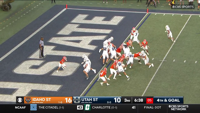
Eight Bengals defenders were in the Aggie backfield, including four playside. There were two different sets of Utah State offensive linemen preoccupied with one ISU defender while no less than two other defenders were running free toward the ball-carrier.
That’s not a scheme problem. It’s not a play-calling problem. At some point, the players need to just block.
Take this next screenshot. It’s also from a fourth down, a 4th & 2 play during the Washington game. Mendenhall opted to be aggressive in this moment with the ball just inside Husky territory with a makeable fourth and short. The Aggies ran a typical read-option, and just needed some good blocking up front.
But, once again, count the wrong-colored shirts in the backfield. Or, better yet, observe which side of the line of scrimmage every USU offensive lineman is on for this crucial run play.

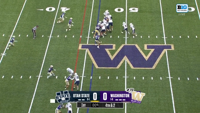
Like a broken record, one more time. At some point, the players need to block.
This isn’t 100% on the offensive line. There are examples of the wide receivers, tight ends, fullbacks, and even running backs not executing on their blocks. But this is primarily their responsibility. Something needs to change with them. Will it?
It depends on how optimistic you are about two things.
1) Will players like John Randle Jr., Jackson Nelson and Jimmy Liston get healthy enough to play consistently?
2) Would their return make a substantial difference?
Randle, a transfer from Purdue, has yet to log a snap this season. He’s one of the key newcomers on the O-line, and Mendenhall has lamented his absence. Nelson played very well in Week 1, but left the game early and was out for Week 2. Liston played out of position in Week 1, subsequently playing the worst game of his career. The coaching staff backed off that erroneous choice and moved Liston back to center for Week 2, but he played just 14 snaps and spent most of the game on the sideline in pads but without his helmet.
So there are possibly some reinforcements on the way, and Mendenhall believes competition between all of these players will improve the unit as a whole.
“Competition in every position ends up driving execution and the urgency that we want, and the depth so we can practice in the manner that we want,” Mendenhall said.
At any rate, getting those players back can hardly hurt. It may also be the last hope of rescuing the run game after a paltry start to the season. The Aggies will need that run game to be successful on offense. We’ve seen the passing game try and fail to carry the offense. So someone in the running back room has to start making a big impact.