

Utah State came up short in many ways in a Saturday gridiron matinee against 19th-ranked Washington. The Aggies were outgained 356 to 271 by the Huskies. They lost the turnover battle 3-0. And for most of the afternoon, the only play that made it inside the Washington 40-yard line was a one-off explosive play.
Despite all that, in the final seconds of the contest, Utah State was lining up for a potential game-winning play.
It would all come to naught. Grady Brosterhous — who made the start at quarterback on Saturday in place of an injured McCae Hillstead — had his Hail Mary heave into the end zone intercepted (and nearly returned for an entirely unnecessary pick-six), and the Huskies escaped with a 16-14 victory over the Aggies.
But given the fact that Utah State entered the game as four-touchdown underdogs, being a stone’s throw away from a walk-off touchdown showed how hard the team fought.
“I love my football team, love their resiliency, love their heart, love their commitment, their dedication, representing their team, their school, and the principles of our program,” USU head coach Bronco Mendenhall said. “They came here with every intent to win the game, and we’re disappointed we didn’t. But there’s no chance that I’m going to be faulting of their effort or their preparation that they put in all week to give us a chance right to the very end.”
Two of the three phases of football ran smoothly the entire game — defense and special teams — and it was the effort from those units which laid the foundation for the near-upset.
Five of the Huskies’ drives began inside their own 20-yard line, two of those inside their own six. Utah State punter Landon Rehkow recorded a career-best five punts pinned inside the 20 and had two kicks of 50-plus yards.
“(Rehkow) might have been the MVP of the game, as well as our punt return team,” Mendenhall said.
Most of Washington’s 356 yards came from digging itself out of poor field position. Huskies’ quarterback Demond Williams had to put in a full day of work, tying his career-high of 41 pass attempts, but gaining only 249 yards (his ninth-highest total since the start of last season). He ran for 56 yards, but 36 of those came on a single rush attempt, a scramble in the second half.
As a result, the Aggie defense was able to limit the scoring opportunities from the Huskies. Washington punted on half of its drives and settled for field goals on four other possessions. Twelve drives in total yielded just 16 points for Washington. This from an offense just one season removed from ranking 17th nationally in scoring and which entered the season ranked top 30 by preseason projections.
“The defense, specifically, really battled today,” Brosterhous said. “They kept us in it.”
All that remained was for the offense to make just a few big plays or string together a couple of drives to escape with what could have been the first Utah State victory over a ranked power conference opponent in program history.
In the end, the offense simply couldn’t deliver. Turnovers and a complete lack of a run game sapped any semblance of consistency from the offense.
Utah State’s best play of the day came after it limped through its first three offensive possessions, with two drives ending in punts and another a turnover on downs. Washington turned the latter into the first score of the game, a field goal in the opening minutes of the second quarter.
The Aggies responded with the most explosive moment for the entire afternoon on either side.
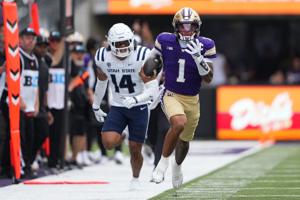
Brosterhous faked a handoff to running back Javen Jacobs, pulling the ball at the last moment and rifling a pass to wide receiver Javon Robinson. The Georgia State transfer reeled in the pass right at midfield, but then sprinted through and away from the defense to claim a career-long 78-yard touchdown.
.@gbrosterhous12 ✈️ @JavonR10 for 78 yards to pay dirt!#ShowMe | @pac12 pic.twitter.com/iiY61YMVAC
— USU Football (@USUFootball) September 12, 2026
“We knew (Washington) were going to come out in that Tampa 2 look. We had practiced that all week,” Brosterhous said of his read on that play. “I signaled the play to the receivers, where Javon just takes the middle of the field. We knew that their Tampa player who plays in the middle of the field is going to want to play down in the run. So as soon as we meshed with the running back, (the safety) plays down, Javon replaces him in the middle of the field, and then he did the rest.”
The Aggies’ newly-built 7-3 lead only lasted another four minutes of game time, however. Washington got its first and only touchdown of the game on the ensuing drive. The 10-7 lead would hold until halftime, even after a Brosterhous interception helped the Huskies get a 48-yard field goal attempt. But their kicker, Tyler Robles, missed wide right and the three-point lead remained static.
Neither team scored in the third quarter. Utah State’s defense desperately clung to the success rate they’d curated in the first half while the offense failed to find any sort of footing. The Aggies ran nine plays in three possessions the entire third quarter — each drive a three-and-out — with a net total of two yards gained when they had the ball.
The biggest culprit in Utah State’s struggles on offense was a complete lack of a run game. The Aggie running backs carried the ball eight times, seven of which failed to gain positive yards. Jacobs had six carries and never made it past the line of scrimmage once.
Brosterhous ended up having a positive night in the run game, statistically and in terms of impact. Excluding sacks, he gained 98 yards on 18 attempts. Most of those, however, were scrambles. The designed run game simply was not present in Husky Stadium for the Aggies.
“Our quarterback scramble is our only running game, just to be blunt,” Mendenhall said. “Lots of work to do in the run game.”
Gradually, Washington pushed further and further ahead. Robles kicked a pair of field goals, the latter of which put the Huskies up 16-7 with just under six-and-a-half minutes to go in the fourth quarter. With time running out, an inept Utah State offense had to find something.
That something turned out to be the one example of sustained offense Utah State put forward all game. The Aggies went 75 yards in 13 plays and scored a touchdown, a seven-yard pass from Brosterhous to Eli Wood.
Zero quit from GB9!@gbrosterhous12 x @Eli_wood_14 pic.twitter.com/faV8lz2uNi
— USU Football (@USUFootball) September 12, 2026
As welcome as the touchdown was, Utah State failed to manage the clock as well as it could have. After making it to the Washington seven-yard line after a 12-yard scramble by Brosterhous, there was 2:38 left on the clock, and it had stopped since Brosterhous had run out of bounds (plus there was a defensive penalty). But Mendenhall still had to burn a timeout due to a mistake that was going to result in an illegal formation penalty.
In the end, after making it to the seven-yard line, the Aggies burned through a timeout, the two-minute warning, and 48 seconds of game clock before Wood’s touchdown. But Mendenhall didn’t see this sequence in a negative light.
“I felt good about our clock management,” Mendenhall said. “The book, the statistics, the advice. There’s clear communication.”
Washington made its own mistakes on clock management. After recovering Utah State’s onside kick attempt, the Huskies dialed up a pass on first down, which was dropped by the receiver. That gave the Aggies a chance to make two stops against the run, which they did, and field a punt with 48 seconds left.
With no timeouts, and against all odds, the offense advanced the ball into Washington territory. Brosterhous scrambled for gains of 12 and 13 yards — crucially gaining first downs on each rush to temporarily stop the clock — and connected with Demick Starling for a 21-yard gain.
Those plays only got Utah State to the Huskies’ 39-yard line with four seconds remaining. With a roughly 56-yard field goal being outside of kicker Kian Afrookhteh’s range, Brosterhous had to try the Hail Mary that ended with a tipped ball and his third interception of the contest. His first career start in college football ended with 17 completions on 28 passes for 196 yards, two touchdowns and three interceptions.
Sitting now at 0-2, with failures in two straight games to make plays in the clutch. There’s only one thing to do as the team turns toward next Saturday’s game against the University of Utah in Salt Lake City: get better. And that’s what the players are already keying in on.
“We’re going to continue to improve,” Brosterhous said, adding that they need to have the “mindset of moving on, and learning what we can and taking that into next week.”