
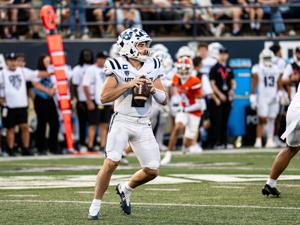
Almost exactly three years ago, McCae Hillstead was subbed in at quarterback for Utah State during the fourth quarter in what was eventually a 78-28 win for the Aggies over Idaho State. He would take the final snaps in a victory he played little role in. This past Saturday, Hillstead was subbed out during the fourth quarter of USU’s loss to the same Idaho State team. He would watch from the sidelines as his teammates tried to salvage a victory after it became clear Hillstead couldn’t deliver that.
Long story short, it would be an understatement to say that Hillstead did not perform to expectations in his return debut for Utah State.
It’s almost never fair nor prudent to pin the blame of a loss in gridiron football onto one person. More than 60 Aggies stepped onto the field at some point for a live snap. Every one of them, plus all of the coaches on the sidelines, took a share of the shame for Saturday home with them that night.
Hillstead’s share feels larger for a couple of reasons. For one, he plays quarterback. It’s a position that takes an extra portion of the credit when things go well but also has to deal with more fingers being pointed at them when things aren’t going swimmingly.
Secondly, Hillstead just didn’t play well. He completed 15 of 30 passes for 178 yards, two touchdowns and three interceptions. That last number is ultimately the most important. In the Stathead game log database (goes back to 1995), there have been 30 instances of an Aggie quarterback throwing three interceptions. Utah State is 1-29 in those game. And that includes the two most recent losses to FCS teams, Idaho State on Saturday and Weber State in 2022.
The puzzle of Hillstead’s poor performance is one that is still being put together. There’s an explanation out there for why he had such a radically poor performance, but without good performances in the future it won’t stand up to scruitiny.
After the game, head coach Bronco Mendenhall was asked about something many people had noticed during the game. Hillstead had repeatedly shook his right arm and flexed his hand, as if to dispel pain. He also had some substance — either liquid chalk or resin — on his throwing hand, caked on the inside of his forefinger and likely all over his palm. Hillstead was dealing with some kind of injury, with Mendenhall initially saying “there was a kind of a forearm, a gripping issue.”
Given Hillstead was sporting a grip-aid substance from the very first snap of the game, this was a known issue heading into Saturday evening. But it doesn’t seem to have been an issue to start things off.
Mendenhall downplayed the impact of the injury in his post-game comments, but after a weekend of evaluation and a chance to speak more with Hillstead about it, he had a better picture of events. And on Monday he provided a more clear answer than he did Saturday night.
“His arm was bothering him. Yes, it was bothering him increasingly as the game went. Yes, it was affecting his throws,” Mendenhall said. “And I think (Hillstead) was hesitant to tell us to the magnitude of which it was kind of hurting him, but it did have an effect.”
Mendenhall added later that he and his staff observed that “some of the throws [were] losing velocity and [were] not quite as accurate downfield.” Running back Javen Jacobs was asked if he saw the same lack of velocity that the coaches did.
“I didn’t know that it was bothering him until after the game. But yeah, that’s not usual from the way we’ve been playing in camp and the scrimmages and things like that to this past weekend,” Jacobs said.
If you assume the injury was something that grew in severity and significance in terms of impact on Hillstead’s performance, it lines up pretty well with the sequence of events. When you compare Hillstead’s first quarter to the rest of the game, there is a gaping chasm between the quality of play that shows up on the stat sheet and in the game. Here’s the quick stats:
First Quarter: 7 of 9 for 98 yards, 1 TD (0 INT)
Rest of Game: 8 of 21 for 80 yards, 1 TD, 3 INT
One of those stat lines is the kind of numbers a Heisman candidate would put up. The other is from a guy that gets benched and creates a mid-season QB controversy. Had Hillstead maintained his first quarter numbers for all four periods, he would have completed 28 of 36 passes for 392 yards and four touchdowns.
The first-quarter film backs up the stats on Hillstead’s performance. His very first throw took advantage of a corner blitz and he lofted the ball perfectly over the leaping defender and put it right in stride for Rex Haynes to maximize yards after the catch and gain 23 in total.
That’s not a throw to get too excited about though, and neither was his next completion for Anthony Garcia for eight yards, though it was still an accurate pass that helped the receiver get the most YAC.
Hillstead’s next two throws were incompletions, the first was called back because Demick Starling was held, which also makes it hard to determine whether the throw was accurate without getting to see how close a full-speed Starling would get to the ball. But even if it would have been incomplete anyway, Hillstead would have missed long, which is what you’re supposed to do on the sideline route he threw.
The fourth throw of the day was Hillstead’s first official incompletion. He threw the ball a little early as the pass rush was closing in, but it appeared to be on target for Nikko Boncore. However, the ball was tipped by another Aggie receiver, Javon Robinson. The two players were running converging crossing routes and Robinson saw the ball arriving on the edge of his catch radius and thought the throw was to him. Had Robinson not tipped the pass, Boncore would likely have reeled it in for around a 15-yard gain (provided he survived a more commited hit from the safety).
It’s the kind of incompletion that isn’t really a quarterback problem, but a rushed throw because the O-line didn’t block all that well and also maybe because Hillstead and his wide receivers have never played live snaps together.
Two plays after that incompletion, though, and Hillstead drops back for a fifth time and delivers an outside-the-numbers throw on the dot to Starling 11 yards and a conversion on 3rd & 8.
Hillstead then delivered one of his strongest throws of the day. A nigh-on perfect back-shoulder throw to Eli Wood. The catch wasn’t easy, but it was dropped exactly where it should be: in a spot where only Wood can catch it, and where a skilled WR should be able to come down with it. And since Wood possessed the necessary skill, he reeled it in and got his foot down just barely inbounds.
We’re not going to go pass by pass for the entire game. This part is to mainly show that Hillstead was perfectly fine early in the game. His throws had enough zip on them to reach their target, and accuracy wasn’t really an issue. Here’s just one more throw where Hillstead shows off his arm talent by delivering a great throw downfield while rolling to his left.
So that’s early-game Hillstead. He was accurate and poised under pressure. His final throw of the period was a check-down pass to Colin Remenosky for a 14-yard gain. In all that time, he threw one, maybe two, inaccurate passes out of 11 dropbacks.
But after that, everything started to go wrong.
Idaho State scored its first touchdown with just over eight minutes left in the second quarter. Hillstead and the offense went out to respond with some optimism. Their first drive scored a touchdown fairly easily and their second ended in a missed field goal, largely because of a third-down sack and a penalty that made things more difficult for Kian Afrookhteh.
Utah State ran two plays on this drive. Both passes, and both were bad plays from Hillstead.
On the first, he rolled right after seeing pressure out of the corner of his eye. He had loads of empty turf in front of him for what would probably have been a seven-yard gain, maybe more if he could juke the quickly closing linebacker. But he saw Robinson standing wide-open for what would have been a 14-yard gain before any YAC went into consideration.
Except Hillstead undercooked the ball so hard that Robinson didn’t even try to catch it. Watching for a few seconds after the incompletion, you can see Hillstead shaking his right hand.
The very next throw was Hillstead’s first interception of the evening.
This one doesn’t seem to be attributable to any injury that limits accuracy or throwing power. Hillstead just didn’t see the linebacker. He saw the defensive back standing to the right/behind Robinson, which is why he put the ball inside. But that’s where the linebacker was and the throw was easily undercut for the near-pick-six. Mendenhall alluded to throws like this when he said that, in addition to Hillstead’s arm bothering him, the coaches did note that he was “trying to do a little bit too much” at times.
Hillstead’s first throw after the interception actually mirrored one of the earlier incompletions we went over. He rolled to his right and had an easy pass to a wide-open receiver, but just missed the throw. And, again, we can see Hillstead shaking his hand afterward.
Hillstead’s ability to be accurate didn’t dissapear, though. It was his consistency. Dig through the film and you still find great throws thoughout the third quarter. Specifically, you can find several during the Aggies’ scoring drive to go up 17-16, which Hillstead capped on a great pitch-and-catch to Starling.
But the poor passes were still stacking up.
Once again, when Utah State needed to respond to an Idaho State scoring drive, Hillstead threw a terrible pass. Starling was in the process of cooking his defender to a crisp on a go route. An accurate pass would have been a guaranteed touchdown. A 75-yard stab to Idaho State’s heart in the dying moments of the third quarter.
Instead, the Bengals took over within smelling distance of the end zone.
The final staw came from an effectively identical mistake. Hillstead was once again targeting Starling, and once again just didn’t put nearly enough on his pass.
For context, this throw as intended is supposed to be at the back of the end zone, four to five yards in from the corner. Essentially, let Starling run under it and see if he can get to it before he runs out of the end zone. At worst, you miss long. An underthrow in this situation is the singular cardinal sin in this situation. Miss wide, miss long, do whatever, but you can’t miss short.
It’s because of throws like these that Mendenhall decided Hillstead not only wasn’t getting it done, but that he probably physically couldn’t. And if you don’t believe Hillstead could ever make this throw, here’s him doing it in 2023 in an even tighter window than he had on Saturday (granted, it required less distance on the throw).
With all of that now said, one question remains: What happens now?
The short answer is that Hillstead is going to start this Saturday in Seattle when the Aggies take on Washington. Mendenhall danced around questions in his post-game presser about whether Grady Brosterhous might be in line to start, but was ultimately pinned down to where he said “I anticipate (Hillstead) starting, and I anticipate him being our starting quarterback.”
And when Utah State released an official depth chart Monday afternoon, Hillstead was listed as QB1.
Hillstead’s coaches and teammates still very much believe in him. Jacobs’ quote from earlier, where he noted that Hillstead’s performance was not normal to what he saw in camp, included an confirmation of belief in his QB.
“I know that he’ll be able to turn it around going into these next games,” said Jacobs.
Wood affirmed after the game that “there’s been zero confidence loss” in Hillstead. And Mendenhall said he “still love(s) who he is” and believes “he’s a very capable football player, and a good leader.”
If Hillstead is able to get his arm back to full health and recover his grip strength, that should help him be the talented quarterback everyone assumes he can be. But what happens if Hillstead’s injury doesn’t get better? Should he remain in his current state, with a nagging injury to his hand/forearm, he would remain unplayable. There wouldn’t be any consistency in his game and even less ability to deliver all of the passes necessary to have a quality pass attack.
In that case, Brosterhous, the clear QB2, is set to become the top man. But it’s hard to be all that confident in him either. He threw 13 passes and Pro Football Focus graded three of them as turnover-worthy throws. And that doesn’t include the interception Brosterhous actually had on a hail mary at the end of the game (which, fair enough, wasn’t really his fault, nor did it matter all that much).
So does Kaleb Maryland become an option? The highly-touted freshman quarterback has a rocket arm and track speed. But from the brief glimpse in spring camp we got, Maryland seemed to share the same issues Hillstead is currently having: putting the ball consistently on target. He also lost the backup quarterback race to Brosterhous, so that doesn’t bode well for Maryland’s readiness.
Even if you throw those two factors out the window, there’s the fact Maryland hasn’t even received a jersey number yet. That isn’t a coaching decision, it comes from Maryland’s peers. For whatever reason, the player leadership council doesn’t feel Maryland is ready. So any scenario where he ends up playing is at least several weeks into the future.