

LOGAN — Utah State University’s football stadium will have a new name beginning next year, honoring a family whose ties to the university and Cache Valley stretch across generations.
USU announced Monday that Maverik Stadium will become Jim Laub Family Stadium effective Jan. 1, 2027, recognizing Jim and Carol Laub and their family’s decades of support for Utah State athletics and the university.
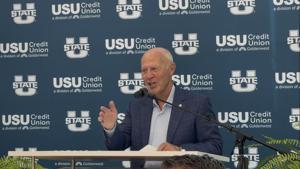
“This is a great honor, something that I would have never envisioned or never anticipated,” Jim Laub said during the announcement. “When Athletic Director Walker came to me with this proposal of the name change, I wasn’t quite prepared for it. I was kind of taken back a little bit, but I’m so humbled and so honored.”
Several luminaries were in attendance for the announcement, including former Utah State directors of athletics Scott Barnes, Randy Spettman and Chuck Bell, former coaches Craig Smith and Matt Wells, and former Utah State President Stan Albrecht.
For Laub, the connection to the stadium goes back almost as far as the facility itself. He was a freshman at Utah State when the stadium opened in September 1968 and attended its first football game.
“I do remember my first football game here,” Laub said. “It was in September of 1968. I was a freshman at Utah State.”
The stadium looked considerably different then.
“It really was not what you would call an architectural feat,” Laub said. “It was pretty basic, no bells and whistles. But because of a lot of the people in this room that rolled up their sleeves and went to work, this stadium has now become a beautiful facility.”
Laub said one aspect of the new name was particularly important to him: He wanted the stadium to recognize his family rather than himself alone.
“One of the things that I really enjoy about the name, the administration allowed me to, instead of just calling it Jim Laub Stadium, they allowed me to put Jim Laub Family Stadium on it,” Laub said.
That family connection spans generations, from Laub’s grandfather and father to his wife, Carol, their children and grandchildren.
Utah State Vice President and Director of Athletics Cam Walker said there is no expiration date attached to the new name and no single donation specifically tied to the naming.
“There are not terms to this other than starting January of 2027,” Walker said after the announcement. “There is not an end date to this. This is to honor Jim and Carol and their legacy of what they’ve contributed and built here.”
Walker described Laub as the largest donor in the history of Utah State athletics and said the naming recognizes the family’s past contributions, what it continues to provide and its expected support in the future.
The Laub family’s influence is visible throughout Utah State’s Logan campus. Their support includes the Laub Athletics-Academics Complex in the north end zone of the football stadium, the Stan Laub Indoor Training Center, Chuck and Gloria Bell Soccer Field, Wayne Estes Center and renovations to the Dee Glen Smith Spectrum, along with scholarships for student-athletes.
Their involvement also extends beyond athletics and into the broader university and Cache Valley. Jim and Carol Laub have supported other university programs, while Carol Laub has been involved with local education and the arts. The family name is also attached to Carol and Jim Laub Plaza in downtown Logan.
Utah State President Brad Mortensen said that breadth of involvement made the family particularly appropriate for the stadium honor.
“They just contribute to Utah State in a way that makes them uniquely deserving of seeing them recognized with their name on the football facility,” Mortensen said.
Mortensen said putting a family name on the university’s largest venue also carries a different significance than another corporate naming-rights agreement.
“I think it speaks really well to the nature of what Utah State University is and who we are as Aggies to have a family name on our stadium,” Mortensen said. “It’s about being an Aggie family. To have the Laub family name be on the stadium, it really reinforces that for the university, and I just think it’s a perfect fit.”
Head football coach Bronco Mendenhall said the family provides an example for his program as Utah State begins its new era in the Pac-12.
“No one more fitting to have their name on the stadium,” Mendenhall said. “And no one that’s created more impact for the folks in this valley, but also young people.”
The change will end more than a decade with Maverik’s name on the stadium. The venue opened in 1968 as Romney Stadium and became Maverik Stadium in 2015 as part of an agreement that helped fund major renovations, including the west-side press box and premium seating facility.
Walker said Maverik approached Utah State about ending its naming-rights agreement early. Discussions began in the spring and were formalized in late spring or early summer.
“Maverik reached out to us, and they had the ability to kind of cut ties early, which they elected to do,” Walker said. “It was perfectly understandable from my perspective on their part and made sense for both of us.”
Walker said there was no buyout involved, with the two sides instead agreeing on an end date.
He also emphasized that Maverik’s financial support was important to completing the stadium project at the time the agreement was reached.
“I think that Maverik deal was exactly probably what was needed to get this project for the space we’re sitting in now over the finish line,” Walker said.
Walker said the approximately $300,000 annual value of the existing agreement is no longer at market rate in 2026.
Utah State explored several options for a replacement before approaching the Laubs. Walker said that as discussions progressed, naming the stadium for the family increasingly made sense because of its history with the university.
“We also have to do right by the people that give the most and that do the most,” Walker said. “And they’re in that category far and away by themselves.”
The move away from a corporate stadium name does not mean Utah State is abandoning corporate sponsorships. Walker said naming the stadium for the Laub family frees other assets within the venue — including the field, scoreboards and signage — for potential sponsorship agreements.
“It just opens up a whole variety of sponsors and assets that we haven’t had available to us up until now,” Walker said.
The 2026 season, Utah State’s first as a member of the Pac-12, will be the final season played under the Maverik Stadium name.
For Laub, that means the stadium he first entered as a USU freshman nearly six decades ago will soon carry his family’s name.
“I’m just trying to think how it’s going to feel the first time I come here and see my name on there,” Laub said. “Especially driving down, what is it, 8th East? That’s going to be weird.”