

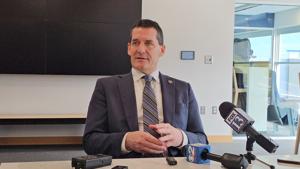
In the West Stadium Center of Maverik Stadium, a group of Utah State Aggie faithful gathered and quickly filled up the seating of the decently-sized room. With 10 minutes until the scheduled 9 a.m. start time, the size of the crowd overflowed into standing room only areas.
The man everyone gathered to see, the newly-hired men’s basketball head coach Ben Jacobson, arrived in due time. He sported a suit and tie he’s become far more familiar with in the last few days as he’s attended far more meetings, interviews, photoshoots and press conferences.
“I’ve had this suit on three times in the last six days in this same tie,” Jacobson quipped. “I haven’t had it on that many times in the last six years.”
Jacobson’s opening comments took up nearly a quarter of an hour, offering his thanks to family, friends, former coaches and administrators. But chief among the topics he covered in that span was the simple question. A question he put well in his own words.
“Why? After 20 years, 25 years, what is it? What are we so excited about and why am I standing here right now?”
At 55 years old, with more than half of his life dedicated just to coaching basketball, you can say Jacobson has been around the block. Except that he also kind of hasn’t. You only need one hand to count the stops in his coaching journey and, even then, you’ll only need three fingers. One for his time at North Dakota (1993-2000), another for North Dakota State (2000-01) and then Northern Iowa where he started as an assistant in 2001 and then became head coach in 2006.
Jacobson didn’t just put down roots. Those roots grew long and deep into the farmlands or Iowa.
So, again. Why?
In answering that questions, Jacobson gestured to the second row of seats which housed the sitting forms of the players in attendance. Among them were Mason Falslev and Karson Templin, two players who offered feedback in the search conducted by USU.
“It’s row two. To be able to take on this challenge with you guys and the way in which you’ve done it already,” Jacobson said.
A mere nine days ago, Jacobson, in person, watched the challenges that group of players had taken on and overcome. When Utah State was celebrating its NCAA Tournament first-round victory over Villanova, Jacobson stood in the tunnel waiting and watching. His Northern Iowa team was up next on the court in Viejas Arena with their matchup against St. John’s.
“You could feel the camaraderie and feel the excitement,” Jacobson said of watching the Aggies after their win. “I wanted to be part of that.”
Utah State Director of Athletics Cam Walker echoed that sentiment when asked about why he felt Jacobson left his two-decade home for Logan.
“I think he’s hungry to chase championships,” Walker said.
On its face, such comments don’t align with the past for Jacobson and Utah State. Northern Iowa, under Jacobson, been further in the NCAA Tournament than Utah State has ever managed since the expansion to 64 teams. Since the tournament made that leap in 1985, the Aggies have never made it to the second weekend. They’ve only won three games period in the modern era of the Big Dance. Jacobson, on the other hand, has a Sweet 16 appearance under his belt and more wins in the NCAA Tournament across two decades than Utah State has as a program in that same span.
Behind that one view of the situation, though, is a deeper and more complex issue. Northern Iowa’s progress has stalled as its league, the Missouri Valley Conference, has declined from a multi-bid, mid-major haven into a one-bid, low-major conference. Utah State is moving up, taking on the challenge of joining the new Pac-12.
It’s a move that carries with it the hope that Utah State can break through the glass ceiling that is its NCAA Tournament seeding. Despite recent seasons where they’ve been projected as high as a six seed, the Aggies have never managed better than an eight seed. This year, they were handed a nine seed. An almost cruel fate given it led to facing the seemingly unbeatable powerhouse of Arizona in the second round.
Addressing that very topic, Jacobson again looked toward his new players and spoke about watching the Aggies and seeing a clip of them during the selection show.
“I haven’t seen a group not smile and clap,” Jacobson said of the USU player’s reaction to being a nine seed.
It’s a feeling Jacobson certainly knows well. His very own 28-win UNI team in 2010 were given the ninth seed and had to face Kansas, the top-ranked team in the nation, in the second round. Though, unlike the Aggies against Arizona this year, UNI pulled off the improbable upset.
For Utah State, this kind of treatment from the selection committee is something that it believes is in the past. Speaking with media after the initial press conference, Jacobson spoke about how the Pac-12 would provide opportunities for good seeds in the NCAA Tournament that the Mountain West and Missouri Valley couldn’t provide.
“If it’s the league we’re going into and our team does what we did this past year. It’s not a nine seed. The numbers change,” Jacobson said. “If we do the things that we are capable of and pointing towards. When the selection show happens, we’re just in a better position because our numbers are different. And now you’re looking at a five, six, seven seed instead of an eight, nine, 10 seed.”
Navigating the path beyond the first weekend of March Madness is the driving force behind both why Jacobson left his post at Northern Iowa, but also what made him the choice for Walker. The logic fit too well. There’s a wall between the Aggies and the Sweet 16, so go and find a coach that has burst through that wall.
It’s why Jacobson was one of the names on Walker’s wish list of candidates. But while Walker “didn’t think (Jacobson) was movable,” he got an assist from the coach’s agent.
“His agent was talking to me about the position, his agent represents several people. And it worked out that when I described the job to the agent, he said ‘I might have some other people that are interested,'” Walker recounted. “And he called me back, I think the next day, and said ‘What do you think of Ben Jacobson?’ And I was kind of like, ‘OK, now we’re talking.'”
With the match made by the agent, the two sides ironed out a deal. Cache Valley Daily received a copy, via a public records request, of the offer sheet USU sent to Jacobson, which included the total salary for the Aggies’ new coach in his five-year contract. The initial annual salary will be $1.2 million, increasing by $50,000 every year until it reaches $1.4 million by the final year of his contract. The buyout for Jacobson — an ever-increasingly important element for Utah State’s head coaches in this era — amounts to 75% of the remaining salary. That equals $4.875 million as of signing, going down to $3.975 million after the first year of the contract.
Annual Salary
- Year 1 – $1,200,000
- Year 2 – $1,250,000
- Year 3 – $1,300,000
- Year 4 – $1,350,000
- Year 5 – $1,400,000
Buyout amount as of:
- Initial Signing – $4,875,000
- April 1, 2027 – $3,975,000
- April 1, 2028 – $3,037,500
- April 1, 2029 – $2,062,500
- April 1, 2030 – $1,050,000
For reference, former head coach Jerrod Calhoun’s contract extension signed last spring handed him a $1.85 million salary which doubled his previous total compensation of $925,000. His buyout on that extension went up from 60% of remaining salary to 70%. And again, Jacobson’s buyout is 75%.