

SAN DIEGO — There’s been a lot for Utah State to face and overcome this season. Tough opponents like VCU, South Florida, New Mexico, San Diego State. Then add on some self-inflicted struggles like losing twice to UNLV, or mini losing streaks in the early and late parts of conference play. All of those things the Aggies have ultimately overcome, with their current form culminating in a 10-point victory over Villanova in the first round of the NCAA Tournament.
But none of that compares to what comes next.

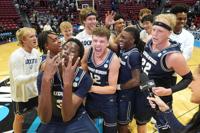
Utah State players celebrate after the first round of the NCAA college basketball tournament against Villanova, Friday, March 20, 2026, in San Diego. (AP Photo/Marcio Jose Sanchez)
Utah State has faced teams that rank in the top 20 of offense or defense, and plenty that have ranked top 50 in both. However, the Aggies have not faced a team that ranks top 10 in either offense or defense.
Arizona is top five in both. Fifth in KenPom’s adjusted offensive efficiency in third in the defensive equivalent.
Going down the team stat sheet very quickly reveals why the Wildcats have lost only two games all year and were the second-highest seeded team in the whole tournament field according to the selection committee. Only Duke was ranked higher.
“They’ve got a lot of talent. They’ve got at least two to four NBA guys. They’ve got size at every position,” USU head coach Jerrod Calhoun said. “I would say the only other team right now in today’s college basketball is University of Michigan that looks anything like them, with their size.”
Utah State is fighting against a long historical trend of one seeds advancing a vast majority of the time to the Sweet Sixteen. Since the tournament moved to 64 teams in 1985, teams 8-9 seeds have won just 22 games against one seeds. From 2010 to 2023, there was a small surge in upsets by the 8-9 seeds where they won 10 times in that 13-year span. Though, more recently, the tides have turned in favor of the one seeds as none have lost before the Sweet Sixteen since 2023, and only two have failed to make the Final Four.
Utah State beating 1-seed Arizona would be a monumental push against recent trends for the top seed line. Since 2024 (and including this tournament through the first round), one seeds are 34-2 against all other seeds, with the average score being 83-64.
— Jason Walker (@jwalker_sports) March 21, 2026
Arizona is a team that the Aggies, especially Calhoun, have watched plenty of this season. Calhoun remarked on Friday that the Wildcats were “one of the five teams I really enjoy watching.”
On the other hand, Arizona knew essentially nothing about their neighbors to the north of their state’s border.
“Before (Friday’s) game, I didn’t watch a lot of them,” Wildcats forward Motiejus Krivas said.
“To be honest, I haven’t watched them play much until this preparation,” Arizona head coach Tommy Lloyd said.
For Arizona, this is part of the first stage toward trying to win the program’s second-ever national title, and first since 1997. The Wildcats have been a one or two seed four times on Lloyd’s five-year tenure, but haven’t gotten over the hump to even get to the Final Four.
For the Aggies, this a game where they have to be throwing their full weight behind it and pulling out all the stops. The motivation behind the season ending is something that has driven senior like Garry Clark to play their very best in March.
“I don’t want it to end. We lose, we go home. This means the world to me. Come out, give my team everything I’ve got every night and go from there.”
Calhoun has spent the last few weeks drinking a rather unhealthy amount of coffee, averaging more than half a dozen cups per day (and was up to four by the mid-afternoon press conference on Saturday). He’s not leaving anything on the table either.
“We’ll throw out the whole deal. We’re going to do whatever we’ve got to do from a defense standpoint, offense standpoint,” Calhoun said. “It’s win or go home.”
One of Utah State’s biggest challenges, in a literal sense, is Arizona’s frontcourt. The Wildcats boast five players in their regular rotation that stand 6-foot-7 or taller, ranging from Ivan Kharchenkov on the *short* end all the way up to the 7-foot-2 Motiejus Krivas. All five of those players weighs at least 220 pounds, combining length with bulk and athleticism.
“They’re a very big and physical team. Our job is to match that,” said USU forward Zach Keller. “And they’re obviously a top five rebounding team, that’s on our plate as well.”
Rebounding not the only thing the Wildcats are near the top of the country in due to their size. You can added free throw rate, defensive 2-point field goal percentage and points in the paint to things that Arizona ranks top 20 nationally in. And the ability to get into the paint at an elite-of-the-elite level has led to the Wildcats not really relying on the 3-point shot much this season. They rank 358th in 3-point attempts per game. Though, perhaps fitting for one of the top teams in the nation, Arizona is still pretty good at 3-pointers when they do take them, ranking 50th nationally with its 36.3 percentage.
It’s a tough battle, but one Utah State is not backing down from.
“There’s going to be so much made of Arizona, rightfully so. But we have 29 wins for a reason,” Calhoun said. “Our guys need to understand that. They need to lock in on the details of this scout and play our game. I think the teams that are successful this time of year have an identity. We have a true identity on both sides.”
The challenge of Arizona’s size is at the forefront of Calhoun’s mind, and that of his players. The solution to him lies in the Aggies’ ability to use their talented guards.
“We need MJ and Mason and Drake and all these guys. We’ve got to use our quickness against their size,” Calhoun said.
Utah State has a few things it can look to use against Arizona, most revolving around the fact that the Aggies run more atypical styles of offense and defense, things Lloyd gave credit to in his press conference. He called USU’s offense calling it a “unique system” that would “present a lot of challenges.” Said offense utilizes more off-ball actions to get stars like Collins and Falslev open, something Lloyd said isn’t the norm in college basketball.
“There’s a lot of people that are doing dribble-drive stuff or ball-screen centric. And (Utah State is) a team that’s kind of breaking the mold. And they’re doing a great job with their off-ball actions and in multiple screening actions.”
On defense, Utah State’s matchup zone is one that is difficult to unravel without plenty of time to break it down in the film room and have time to experience it in person.
“We’re going to have to get out there and get a feel for it on the court tomorrow on how we can get comfortable moving the ball and moving our bodies and playing against it,” Lloyd said. Obviously it’s got our full attention.”