

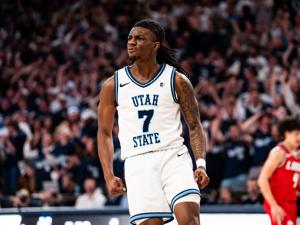
LAS VEGAS – Twice Utah State faced UNLV in the regular season. Twice the Aggies were defeated, accounting for two of the only five losses USU suffered in all of conference play en route to its Mountain West regular season title.
Now, a third meeting is in place between Utah State and UNLV, set for Thursday at 1 p.m. MDT in the quarterfinals of the Mountain West Tournament.
The Aggies got a bye to the quarterfinal round but UNLV had to advance by way of beating Wyoming. The Rebels nearly led the win get away from them, allowing the Cowboys to rally from down by as much as 16 and get back into the game. UNLV trailed by two points in the final 30 seconds, going back up on the strength of an and-one bucket and conversion from Kimani Hamilton who led UNLV with 23 points. Tyrin Jones then recorded his sixth block of the game to seal what became a 73-70 victory.
The win is the first by UNLV in the conference tournament against a team other than Air Force since 2015. Rebels head coach Josh Pastner mentioned that fact unprompted in his post-game press conference.
“The Mountain West Conference Tournament has just been really hard for UNLV,” Pastner said, later adding, “that was really great to be able to (win). And proud of our guys to do that. Really proud of our guys on that.”
Two of those losses in the conference tournament in the last decade have been against Utah State. The Aggies are 2-0 all-time vs the Rebels in the MWT, winning 74-53 in 2021 and 70-58 in 2025.
The Runnin Rebels have been a curious stumbling block for the Aggies this season. Of Utah State’s six losses all year, four were Quad 1 losses and all were on the road. But the two losses against UNLV include a Quad 2 and even Quad 3 loss. UNLV is the only team to defeat the Aggies in the Spectrum, winning 86-76 on Jan. 20. And just eight days ago the Rebels laid a smackdown on Utah State 92-67.
“Two totally different games,” USU head coach Jerrod Calhoun said. “At home, I thought we got off to a really good start. We were up 14 late in the game and just didn’t get the stops. Certainly the last game was not good at all. But, there’s just points in games where there’s momentum swings. I feel like every time we’ve played them, they’ve had those.”
Utah State will have a lot of motivation to make the third game work. Though, from the UNLV perspective, the prospect of being able to make it 3-0 against the Aggies had UNLV guard Dra Gibbs-Lawhorn grinning ear-to-ear.
“I’m stoked,” Gibbs-Lawhorn said. “That’s all I’m going to say. That’s all I can say. I’m stoked.”
Most eyes will probably turn toward Gibbs-Lawhorn in this matchup. After all, the recently named Mountain West Newcomer of the Year and First Team All-MW guard has averaged 28.1 points per game since the end of January. But his impact hasn’t been the most dynamic in the two losses UNLV handed to Utah State. He scored a solid 21 points in the first game but only 10 in the 27-point blowout a week ago. Instead, it’s been two other players that have vexed the Aggies: Hamilton and Jones.
The two forwards combined for 71 points in the two games, shooting a collective 63.6% from the field and going 14 of 16 on free throws. Both players have created matchup problems for the Aggies. Hamilton stands 6-foot-7 and Jones is 6-foot-9. But it’s not just the length of those players, it’s also the athleticism and ability to get to their spots for quality shots.
Hamilton was virtually unstoppable against Utah State in the second half of the March 3 meeting. He scored all 24 of his points in that second half alone, making 10 of 11 field goal attempts. His specialty was the very same thing that led to his game-winning bucket vs Wyoming on Wednesday — a post-up where he works his way to the middle of the paint and pulls up from short range.
Rebels take the lead with 15 seconds to play📺MWN pic.twitter.com/e6tToWLW1m
— Mountain West (@MountainWest) March 11, 2026
Hamilton’s ability to manufacture baskets without lots of player movement, screens or other sets makes him a difficult player to guard. And if he’s hitting those mid-range shots
“We got to push him off the block. We got to play more physical” Calhoun said of defending Hamilton in those post-up situations. “We can’t let him get the ball so low. Every time he gets the ball low on the block, it’s either a foul or a basket, right? So we’ve got to extend his catches. You can do that a couple different ways, either three-quarter, front it. But he’s playing at a high level. I thought he put the team on his back today. Played really, really well.”
Jones can be plenty deadly on offense (he’s had more points against the Aggies this season than Hamilton) but his defense is part of what has hurt USU the most in the previous games. The freshman forward led the league in blocked shots and was named to the All-Defensive team this week.
“Tyrin Jones is one of the best shot blockers in the country, one of the best I’ve ever seen for a freshman,” Calhoun said. “Whenever he’s on the floor, he presents a lot of problems for the offense with his ability to — he blocks all his shots off the ball, right? So as he’s coming in to block shots, we’ve got to either re-space or relocate with a cut.”
Pastner has repeatedly made critiques of his team’s defensive prowess, including after Wednesday’s win over Wyoming. But against the Aggies, the defense has been on point, much more than against any other team. UNLV held Utah State to its sixth-lowest home scoring total on Jan. 20 and its second-lowest scoring total in any game on March 3. The Rebels’ 3-point defense has been particularly effecive, holding Utah State to 12 of 54 (22.2%) from distance in the two games combined.
“We took a lot of contested shots where we need to read the closeout better,” Calhoun said. “If we don’t have a step in three, we need to read space. We need to create the advantage and keep it.”
With all of those struggles Utah State has had against UNLV laid out, one question remains. What has Utah State done to find something within itself to throw the UNLV-shaped monkey off its back?
Nothing that Calhoun was willing to divulge just yet.
“We’ll still stick to our principles, but, we’ll give them different looks,” Calhoun said. “Whether it’s a pick and roll, whether it’s on the block. We’ve got to make some changes. And if we win, I’ll give you those after the game.”
One simple thing on offense will be getting MJ Collins involved and hitting shots early would be a massive difference from the previous two games. Collins combined for just 18 points on 26.1% shooting, which included going 2-for-14 from three. His performance in the latter game (four points on 2-for-10 shooting) led him to vocally take accountability in front of his teammates.
“I addressed the team [after the loss to UNLV] and told them that it starts with me. I got to play better,” Collins said last week.
Collins gave his word to his fellow Aggies he would play better against New Mexico and he did just that. On senior night, Collins scored 27 points, the most he had in any Mountain West game this season. It was also his first 20-point conference game in a month.
Taking that momentum into this latest rematch with UNLV and pairing it with co-star Mason Falslev — who scored 20-plus points in both USU-UNLV contests and had a double-double in the latter — would go a long way to helping the Aggies settle the score.
“He’s going to be a critical piece. He has been all year,” Calhoun said. “His defensive activity in these next two tournaments are going to be critical. When he’s active in the zone, it really, really helps us. When he gets out and gets basketsoff of his defense or his teammates’ defense, getting to the free throw line will be critical for him. But he’s coming off a great game. He carried us in the second half, and confidence and momentum for him in particular should be really high.”
An eternal debate in basketball, along with some other sports, is the “rest vs rust” argument. Will a more rested team have an advantage or will the team that more recently played have momentum and beat the rested, and rusty, opponent?
It’s relevant to Thursday’s meeting between USU and UNLV since the Aggies haven’t played since Saturday evening while the Rebels played a tightly-contested game and will have less than 24 hours to prepare for their next game. Furthermore, UNLV played just seven players throughout the entire game, meaning every single player logged at least 21 minutes. Gibbs-Lawhorn played the entire game, not sitting for a single second.
While Calhoun has valued making sure his team is rested, but his experience has led him to not underestimate a team that can build momentum with a win the day before a game.
“I’ve always said sometimes the advantage is to the team that played a game,” Calhoun said. “So I can’t really predict that. I think every game will be different. Every player is different. Some guys are running on adrenaline.”