
The regular season has concluded, leaving us with a lot to look back on even as the premiere moment of the year, March Madness, is fully descending upon us. Yet to come is the magic of the Mountain West Conference Championships (for the men at least, the women’s basketball tournament is already delivering with its upsets and buzzer-beaters) and the Big Dance itself, the NCAA Tournament.
Before all that gets underway, it’s time for one last edition of Mountain West Watch. Although it wasn’t as frequent of a series as I would have liked, it is worth noting that it will come to an end. As a beat writer for Utah State, my focus will shift toward the Pac-12 and coverage of that conference.
So, let’s get started on the final entry of Mountain West Watch with a look at my final regular season power rankings, a note on Utah State’s impressive navigation of the toughest possible path to the MW title, and a review of my official All-MW ballot.
Final Power Rankings
These are my final power rankings for the season. I won’t go into any significant detail team-by-team, but this is a reflection of who I believe are the best teams 1-12 right now, though full-season accomplishments aren’t counted for nothing. If it were fully reflective of current form, Colorado State, Boise State and UNLV would probably be a bit higher. If it were more of a full-season calculation, Grand Canyon and Nevada would leapfrog 2-3 teams each.
- Utah State
- New Mexico
- San Diego State
- Colorado State
- Boise State
- Grand Canyon
- UNLV
- Nevada
- Wyoming
- Fresno State
- San Jose State
- Air Force
I released twice-weekly rankings for just about every week of conference play and I went back to chart how the week-by-week progression looked for the entire conference. Here’s that visualization.

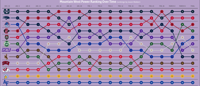
You can see the volatility of several teams, most notably Colorado State. The Rams spent time in both the bottom three and top three of the conference. Grand Canyon and Nevada were a couple of teams to get as high as second but also dive as low as seventh or even eighth. It’s a wild world in the Mountain West and this is just another way to recognize that.
Utah State’s impressive MW Title Run
Something that caught my eye in the final weeks of the Mountain West regular season was the difficulty of Utah State’s overall strength of schedule. KenPom ranks the conference strength of schedule on its website (that portion is behind a paywall). And while I normally don’t put much thought into that number amidst the host of other stats and analytics that KenPom provides, this year it stood out. A lot.
You see, normally the conference strength of schedule ranks are an almost exact reverse order of the final standings. First place ranks at or near the bottom and last place ranks near the top in toughest schedule faced. And there’s a very simple logic behind that. The first place team doesn’t play itself during conference play, meaning it has two very tough games not on its schedule while the rest of the conference does. The inverse happens for the worst teams.
But this year didn’t quite reflect that reality. Utah State, the regular season champion, had the fourth-hardest conference strength of schedule in the conference (as of Sunday, KenPom’s website has since changed it to third, which may reflect the opening round opponents in the conference tournament). Only one other regular season title winner in MW history has ranked harder than sixth relative to the rest of the conference. That team is the 2021-22 Boise State Broncos who also had the fourth-toughest schedule.
Utah State only got to face San Jose State and Air Force once each, teams that went a combined 1-35 in games aside from when they faced each other. That’s two essentially free wins the Aggies missed out on in favor of playing more difficult opponents. Of course, USU wasn’t alone in missing the bottom teams in the conference as second-place San Diego State skipped a game against the Spartans and 10th-place Fresno State. But it was the Aggies who found a way to pull things out.
Another impressive aspect to Utah State’s run was that they were the only team that didn’t get a bye. The Aggies used their off week to play Memphis, a game that when scheduled was believed to be a potential marquee win for their non-conference schedule. In the end, playing a game against the now 13-18 Tigers was essentially just a hinderance to the team. Everyone else got to rest down the stretch while the Aggies did not.
All-Mountain West Ballot
I was given the honor of submitting a ballot for the upcoming All-Mountain West awards and I waited until almost the last moment (ballots were due Sunday morning) to make sure I had the full picture. And I did end up changing a couple of my selections after the Friday/Saturday games based on what I saw.
There wasn’t much in the way of criteria or direction for many of these awards (the only sorting I did was alphabetical by last name on the All-MW teams). No requirements were given for a certain number of backcourt or frontcourt players on the All-MW teams and no restrictions for putting “Of the Year” players on all-conference teams. The only specific criteria for awards came for the awards for Newcomer of the Year, Freshman of the Year and Sixth Man of the year. Newcomer was for non-freshmen players in their first year with their current team, Sixth Man was for players who started five or fewer games in conference play, and Freshman was exactly what you think it is.
I was given pretty much free reign to select the 15 best players in the league for all-conference teams and pick from a nearly unrestricted candidate pool for the major individual awards, doing so by my personal assessment. The only directive I did receive were that only conference games and stats were to be considered. I obliged and only considered conference play and ensured that the stats I reviewed were isolated to Mountain West play alone.
But what factors into my “personal assessment?” It’s a mix of my own experiences watching these players combined with reliance on impact metrics since I couldn’t watch every game for every team. I got to watch every team in the range of a half dozen times at minimum over the course of the season, but that still means I could have missed three quarters of a player’s games in Mountain West play. As such, stats and impact metrics — mainly ones like Box Plus-Minus and Bayesian Performance Rating — become helpful fill-ins along the way.
Player of the Year — Mason Falslev
- 16.1 points | 51.6 FG%, 43.3 3P%, 77.8 FT% | 5.8 rebounds | 3.2 assists | 1.5 steals
As much as I refuse to be part of the “best player, best team” voting crowd, I ultimately went with that party’s pick. Falslev is not only one of the better offensive players, he’s among the best on defense as well. There really aren’t any players in the conference that can claim to be as all-around as Falslev. He recorded five games of 20+points, four games of 5+ assists and two games of 10+ rebounds. No other player in the league could match all three. And if they did, you could add in Falslev’s steals numbers to once again put him in lonely company.
Whatever Utah State needed Falslev to be, a rebounder, scorer, defender, passer, he was able to do it at a high level. And the impact of his play is plainly evident as the Aggies were able to secure the outright conference title. And that certainly counts for something.
One other player received notable consideration, that being UNLV guard Dra Gibbs-Lawhorn. I’ll detail his case later, but Falslev’s ended up being narrowly better in my mind due to overall impact and how it led to success. Even though Gibbs-Lawhorn’s point totals and offensive efficiency were downright absurd at times, UNLV still only went 6-5 in his final 11 games. And for those who want to use head-to-head (because apparently team success only matters in those two specific games) Falslev outplayed Gibbs-Lawhorn in their two matchups. Falslev scored 41 points with 17 rebounds, six assists and four steals while Lawhorn scored 31 with eight rebounds, three steals and zero assists.
Defensive Player of the Year — Miles Byrd (Jr, G)
- 2.2 steals | 1.5 blocks | 1st in Defensive Box Plus-Minus (6.3)
There were several players who received pretty heavy consideration for this award as it was the most hotly contested in my mind behind Player of the Year. Byrd obviously led the candidates but only narrowly ahead of Nana Owusu-Anane and Elijah Price. Both Owusu-Anane and Price ranked well in defensive metrics and are very impressive on film as well.
These thin hairs had to be split, though, and Byrd is simply one of the best overall defenders I’ve seen in my time covering the Mountain West. On the one hand he’s able to get a lot of stocks (steals/blocks) as he led the conference in steals percentage (4.4) and was third in block percentage (7.5), the only player to be top three in both categories. But he’s also just a menace on defense. Whoever has the unfortunate task of being defended by him cannot rest for a moment. And the instant you think you’ve escaped Byrd, that’s when he’s swatting your shot or picking your pocket.
Newcomer of the Year — Dra Gibbs-Lawhorn (Jr, G)
- 23.6 points | 53.5 FG%, 47.7 3P%, 84.4 FT% | 3.1 rebounds | 2.5 assists | 1.6 steals
There simply wasn’t a better offensive player in the Mountain West this season than Gibbs-Lawhorn. His volume, efficiency and offensive impact dwarf anyone else who even attempts to compare themselves. The gap between Gibbs-Lawhorn’s Offensive Box Plus-Minus and second place in the conference is larger than the gap between second and sixth. Gibbs-Lawhorn scored 20 or more points in 14 of his 20 games, went for 30 on six of those occasions and had the season-high scoring mark of 42 (which was also the only 40-point game by anyone in a MW game). And over his last 11 games of the season, Gibbs-Lawhorn averaged 28.1 points per game on 55/51/95 shooting splits.
It will be a while before we see an offensive player of this caliber in the league again.
Freshman of the Year — Jake Hall (Fr, G)
- 17.5 points | 49.6 FG%, 46.5 3P%, 76.7 FT% | 3.8 rebounds | 1.7 assists
When you watch Jake Hall, you don’t feel like you’re watching a freshman play. He is a very savvy ball player with one of the smoothest shooting strokes I saw this year. I got to bear witness to his 32-point game against the Aggies in person, but had plenty of chances to see him dominate other games as well even when not physically present. Hall hit more than one clutch shot that led his team to victory and it’s those kind of plays, along with consistent solid performances, that seperates him from other great freshmen players in this conference and even many of his more experienced peers.
Sixth Man of the Year — Karson Templin (Jr, F)
- 9.3 points | 54.2 FG%, 41.7 3P%, 58.1 FT% | 4.6 rebounds | 1.0 assists | 0.9 steals | 0.9 blocks
Templin didn’t start a single game in conference play, but he was the best big on the Aggies. He was third on the team in points per minute, scoring 18.8 per 40 minutes. Templin was second on the team in rebounds per game behind Falslev, but again his per-minute rebounding outpaced his teammates as he led USU with 9.3 rebounds per 40 minutes.
There was one other player I gave serious consideration, that being San Diego State forward Pharaoh Compton. He led all players that qualified for this award in Box Plus-Minus (Templin was sixth) and was very efficient in shooting 72% for the season (albeit as a non 3-point shooter, which helped keep that number up). In the end I opted for Templin for having double Compton’s rebounds, triple his assists, plus more steals, blocks and points.
As noted above, there was a strict criteria for this in that any player that started six or more games during Mountain West play was not eligible for this award. This notably disqualified San Diego State guard B.J. Davis, who started seven games in conference play. And while Templin started eight games this season, all were in non-conference play which does not count toward this.
Coach of the Year — Eric Olen
There’s been a longstanding precedent for pretty much any coaching award that the criteria is mainly “How well did you perform based on preseason expectations?” This year didn’t have a runaway candidate that led a team from being picked eighth or ninth to finishing top three, but Olen did take a team picked fifth all the way to being one win shy of a Mountain West title. Doing so as a first-year coach with an entirely new roster and three freshmen as crucial parts of his rotation is icing on the cake.
First Team All-MW
- Corey Camper (Sr, G, Nevada)
- Mason Falslev (Jr, G, Utah State)
- Jake Hall (Fr, G, New Mexico)
- Jaden Henley (Sr, F, Grand Canyon)
- Dra Gibbs-Lawhorn (Jr, G, UNLV)
I’ve already explained my thoughts behind three of these players so I’ll stick to my thoughts on Camper and Henley here.
I might be one of the few who opts to put Camper on their first team. Anyone inclined to put anyone from Nevada at the top of their ballot would probably have opted for Elijah Price. And while I would have zero issue with that, I leaned toward Camper in part due to impact metrics. Camper ranked fifth in Box Plus-Minus and his overall efficiency as a high-volume guard was impressive. On top of that, less than a month ago I ran a blind poll of potential POY candidates with Camper’s stat line next to that of Mason Falslev and Dra Gibbs-Lawhorn. And Camper took a very narrow second in that poll with 42% of the votes.
As for Henley, aside from Falslev, Henley is probably my favorite two-way impact player. He’s a virtually unstoppable athlete and an incredibly underrated defender. Henley had one of the highest usage rates in the league on offense, and averaged a very solid 17.6 points and 3.3 assists on that end, but didn’t let his high usage impact his defense as many in his position might.
Second Team All-MW
- Tomislav Buljan (Fr, F, New Mexico)
- Miles Byrd (Jr, G, San Diego State)
- MJ Collins (Sr, G, Utah State)
- Reese Dixon-Waters (Sr, G, San Diego State)
- Elijah Price (So, F, Nevada)
I could probably make a case for First Team for every single one of these players. And a couple of them were First Team in my initial drafts of my ballot before I ended up changing my mind. You’ve got the best rebounder in the conference in Buljan and my pick for DPOY in Byrd. You’ve also Collins and Dixon-Waters who were the best scoring players on the top two teams in the standings. Then there’s Price who was a great two-way player with rebounding, scoring and was a steals/blocks machine for most of conference play.
Sadly, there aren’t enough spots for me to put these very deserving players higher than I already have on my ballot.
Third Team All-MW
- Drew Fielder (Jr, F, Boise State)
- Colby Garland (Jr, G, San Jose State)
- Jake Heidbreder (Sr, G, Fresno State)
- Nana Owusu-Anane (Gr, F, Grand Canyon)
- Leland Walker (Sr, G, Wyoming)
My Third Team selections consist of about half players I wanted to put on Second Team but couldn’t fit them and half players who were individually impressive to me but were on teams that finished lower in the standings. Fielder was a bit too up-and-down to put any higher and Nana Owusu-Anane just didn’t have the offensive impact to put him on par with some of the players ahead of him. Regardless, both were among the top bigs in the conference and deserve that recognition.
Walker’s selection is probably 95% the result of the “eye test.” His stats do not stand out particularly well among several other potential selections like Colorado State guards Jevin Muniz or Brandon Rechsteiner. But when I watched Walker he always seemed to look like one of the better playmakers, such as his 24 points at Utah State and 30 points against Boise State. He had a ton placed on his shoulders, which did drag down his efficiency numbers, but he came though in a major way in several games.
Heidbreder and Garland make my Third Team for similar reasons to Walker. Their team’s success was not particularly great, but it wasn’t for a lack of effort from them.
It was only at the end of all this that I found I hadn’t included anyone from Colorado State among my All-MW picks, which feels like a terrible oversight. But while I love several players from the Rams, such as Kyle Jorgensen, Carey Booth, and both Muniz and Rechsteiner are worth of consideration none ended up standing out enough in my analysis.