
The teams in Mountain West Conference men’s basketball have officially begun league play, with San Diego State and Air Force squaring off yesterday. More teams will get into the swing of things this weekend, including a key matchup between Utah State and Colorado State, arguably the top two teams in the conference.
Let’s take a look at how the teams stand after the end of non-conference play. There are still a few non-league games to be played (SDSU faces No. 1 Arizona on Saturday and USU has a February matchup with Memphis) but this week essentially marks the beginning of the conference grind. So let’s look at how the teams stack up as said grind begins.
Here’s this weeks Average Computer Ranks for the Mountain West.Utah State is still hanging on to its spot at the top, with only a slight drop after a less-than-impressive win over Illinois State.Boise State is rising fast. In two weeks their average ranking has gone from 93.6… pic.twitter.com/hCJ2V1BRjq
— Jason Walker (@jwalker_sports) December 15, 2025
Walker’s Power Rankings
1. Utah State
- Record: 9-1
- Best Win: 80-77 vs VCU
- Worst Loss:
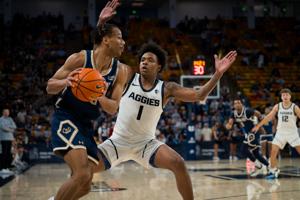
The Aggies are, at least for now, holding on to the top spot. I’ve seen some shift to other teams at the top of their power rankings because Utah State’s form in the last couple weeks hasn’t quite lived up to what it was doing in mid-November. But a 9-1 record is a 9-1 record and there’s no passing that up until someone knocks them off. That can happen real quick, though, as the Aggies get to host Colorado State this Saturday.
2. Colorado State
- Record: 9-2
- Best Win: 91-86 vs Colorado
- Worst Loss: 81-83 vs Denver
So far, the Rams look to be doing very, very well to start the Ali Farokhmanesh era. They possess the top offense in the conference and it’s not particularly close as Colorado State is 17th in KenPom’s offensive efficiency and the next closest is Utah State at 49th. CSU is averaging 85.7 points per game, despite playing at one of the slowest paces in the country. The one downside so far appears to be a lackluster defense, which ranks third-worst in the conference. If there’s a game where the Rams’ hyper-efficient offense goes cold, it could get ugly fast.
3. Boise State
- Record: 8-3
- Best Win: 68-67 vs Saint Mary’s
- Worst Loss: 78-79 vs Hawaii Pacific
If you ignore (as many computer metrics do) the loss to Hawaii Pacific, you could make an argument for the Broncos to be the best team in the conference. They’ve faced six teams that are currently top-100 in KenPom and are 4-2 in those games. Boise State is a very solid team defensively and they rebound well. That will carry them pretty far. The ceiling will be determined by how well they manufacture offense, which has been a semi-consistent struggle against both good and mediocre teams.
4. San Diego State
- Record: 6-3
- Best Win: 77-66 vs Utah Valley
- Worst Loss: 107-108 vs Troy
This is a really odd Aztecs team because the modus operandi of the Steve Fisher/Brian Dutcher era has been elite defense with good or great offenses. This year the offense is averaging 81.9 points, which would be the second-highest ever in SDSU history, but is also giving up 76.5, which is the most since the 1998-99 season in which the team went 4-22. A lot of that defensive struggle, though, could be chalked up to playing teams like Michigan and Baylor, teams that put up 94 and 91 on the Aztecs. Outside of those two games, the only major blip in SDSU’s defense was the 108 points allowed in double-overtime (89 in regulation) to Troy. As Mountain West play starts, we may see the return of the Aztecs’ vaunted defense.
5. New Mexico
- Record: 9-2
- Best Win: 81-78 at VCU
- Worst Loss: 68-76 at New Mexico State
Eric Olen has stepped in and, with a completely brand-new roster, made a solid team out of the Lobos. In addition to winning at VCU, they also beat the tar out of a really solid Santa Clara team in the Pit, 98-71, showcasing that it will be very hard for teams to win in Albuquerque this season.
6. Wyoming
- Record: 9-2
- Best Win: 87-72 vs South Dakota State
- Worst Loss: 70-78 at Sam Houston
The Cowboys have set a pretty good groundwork for a bounce-back season. Their 9-2 start is the program’s best since 2021-22 when Wyoming went 25-9 and made it to the NCAA Tournament. There are some minor strength of schedule concerns, as the Cowboys have not won a single game above Quad 3, but they were competitive in the Quad 2 loss at Sam Houston and put quite the scare into Texas Tech, losing by just four in Lubbock. Even though Wyoming has lost the only Quad 1/2 games they’ve played, they were very competitive in both and should be a threat in conference play.
7. Nevada
- Record: 8-3
- Best Win: 81-65 vs San Francisco
- Worst Loss: 71-75 vs UC Davis
Nevada has shown its a solid team with good offense and good defense, but not enough of both to beat great teams. Their two highest rated opponents resulted in two double-digit losses (98-83 to Santa Clara and 83-66 vs Washington) and then there’s the loss to UC Davis at home on top of that. The Wolf Pack should be able to be close to or above .500 in conference play, but they might not be capable of too much more unless they’re hiding something over in Reno.
8. Grand Canyon
- Record: 6-4
- Best Win: 68-58 vs Utah
- Worst Loss: 81-90 vs Youngstown State
Last year, Grand Canyon started the season with an identical 6-4 record, complete with some good wins and tough losses. The Lopes went on to finish the year 26-8 and made the NCAA Tournament. There will be a key difference, however, in Grand Canyon’s strength of schedule going forward compared to what it faced last year. I’m reminded of the quick historical study I did in the offseason about teams making the jump to the Mountain West in basketball. Many Lopes fans were rather confident their team would step in and run the league, much like they had in the WAC. But no team has ever made the quick transition from the WAC and it’s not for a shortage of teams (or even good teams) to attempt it. Grand Canyon has a steep hill to climb to prove it can contend in the top mid-major conference as opposed to the lowly WAC.
9. UNLV
- Record: 4-6
- Best Win: 92-78 at Memphis
- Worst Loss: 81-86 vs UT Martin
The Rebels are, as usual, an incredibly frustrating and inconsistent team to follow. Wins over Memphis and Stanford suggest a team capable of hanging with some of the better teams in the mid-major ranks, if not the country. Then there’s the losses to teams like UT Martin, Montana and Tennessee State. Wrap it all up and you have a team that is 2-0 in Quad 2 games but 2-3 in Quad 4 games. UNLV went and got itself a new coach and new roster, but it’s the same old story as years past.
10. Fresno State
- Record: 6-5
- Best Win: 75-74 vs Utah Valley
- Worst Loss: 71-76 vs Cal State Bakersfield
Right now it seems like Fresno State is UNLV but without the preseason expectations. The Bulldogs, have a Quad 2 win (a 75-74 victory over Utah Valley), but also multiple Quad 4 losses. Jake Heidbreder and Zaon Collins are good players, and if they go off in any given game, there’s a chance Fresno State could catch some good teams off guard. But this roster has a long way to go to be competitive.
11. San Jose State
- Record: 5-6
- Best Win: 80-66 vs Southern)
- Worst Loss: 74-85 at UC Santa Barbara
Colby Garland is nice. He’s second in the Mountain West in scoring per game (and technically leads in total points, though it’s partly because he’s played in more games). With his scoring punch, the Spartans have a passable offense. Most of the games they’ve lost haven’t been because the offense couldn’t muster anything. But their defense is borderline bottom-100 in Division I and that’s been a huge problem.
12. Air Force
- Record: 3-9
- Best Win: 77-63 vs SIUE
- Worst Loss: 60-80 vs South Dakota
The Falcons have some unique struggles, what with being unable to used the transfer portal but are almost constantly losing their top players and starters to said portal. Despite that, Joe Scott actually has more size than he’s probably used to having on his roster, with a pair of 6-foot-8 forwards as his top two producers and a 7-footer in his starting lineup as well. The problem is that Air Force now lacks the guard play it used to enjoy with previous teams. The Falcons have one of the worst assist-to-turnover ratios in the country, averaging more turnovers (14.2) than assists (12.9). And the size they do have isn’t really that effective as they are still mediocre (or worse) in rebounding and blocked shots. All of those numbers came against a very easy non-conference schedule, so things could still get a lot uglier as they head into league play.
Non-Conference Awards
With non-conference play wrapping up, here’s who I would put on my ballot for each of the end-of-season awards.
PLAYER OF THE YEAR — MJ Collins (Utah State)
The best player on the best team has almost always taken home this award and right now that designation would go to MJ Collins. And it’s not as though he wouldn’t be deserving if you set aside voting convention. Collins leads the Mountain West in scoring, sitting at 20.6 points per game, and his efficiency in that scoring has been very solid, shooting 57% from the field, 49% from three and 89% on free throws. He’s not the all-around playmaker, dominant rebounder or elite defender we’ve seen other POY candidates pair with high-level scoring. But for now, he’s pretty clearly the top scorer and is leading an Aggies team currently sitting at the top of the league.
DEFENSIVE PLAYER OF THE YEAR — Mason Falslev (Utah State)
Honestly, you should probably be penciling in a San Diego State player for this award given an Aztec has won it each of the last four years and five of the last six. But so far, Falslev leads the league in steals and defensive win shares along with being top three in other defensive metrics like Defensive Bayesian Performance Rating, Sports Reference’s Defensive Rating and Defensive Box Plus/Minus.
FRESHMAN OF THE YEAR — Nasir Meyer (Wyoming)
It’ll probably be a two-man race for this award, between Nasir Meyer and UNLV’s Tyrin Jones. The latter leads the conference in blocks (2.0 per game) and is averaging a pretty solid 9.3 points, 5.5 rebounds to go with that in just over 24 minutes per game. Meyer, however, is looking like engine of Wyoming’s surprise start. He’s coming off back-to-back games of 25+ points as he’s now entered the starting lineup for the Cowboys. With that expanded role, he might moved further beyond his averages of 13.5 points, 4.8 rebounds and 2.4 assists.
SIXTH MAN OF THE YEAR — BJ Davis (San Diego State)
BJ Davis might come off the bench, but there’s plenty of argument to be made that he’s been the Aztecs’ best player so far this year. He’s made big play after big player and put up crucial performances in the wins SDSU has so far. We’ll see if he continues to come off the bench during conference play as that will impact whether he’ll even be eligible for this award by season’s end. He was still the sixth man in the conference opener against Air Force, and he led the team in both minutes (27) and points (19).
COACH OF THE YEAR — Sundance Wicks (Wyoming)
Due credit to Farokhmanesh and Olen, but when looking at this award, preference is usually given to the coach that does the best against their preseason expectations. The Cowboys were picked ninth in the preseason poll and were a coin flip to be a top-200 team by most preseason metrics. As things stand right now, Wyoming is a top-100 team, being 53rd in the NET and looking like they could be a team that finishes much closer to the top of the conference standings than the bottom.