

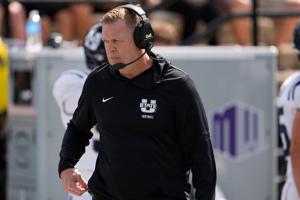
Heartbreaking, Gut-wrenching, heartrending, harrowing, excruciating. Along with all being synonyms of each other according to Merriam-Webster, each share the quality of being able to describe Utah State’s loss to UNLV on Saturday. The Aggies twice lined up for walk-off field goal attempts, only to have one pushed wide right and the other pulled wide left.
Safe to say, Tanner Rinker probably didn’t get much quality sleep each of the last two nights.
And let’s get the elephant in the room out of the way quickly. Rinker’s troubles were headline-worthy. It’s the kind of thing that degenerates will send hate-filled DMs to a kid over. It also evoked memories of Dominik Eberle’s performance in the 2017 Arizona Bowl against New Mexico State. The man who would go on to set virtually every Aggie kicking record and have a brief NFL career went 2-for-6 on his kicks in what was also an overtime loss for Utah State.
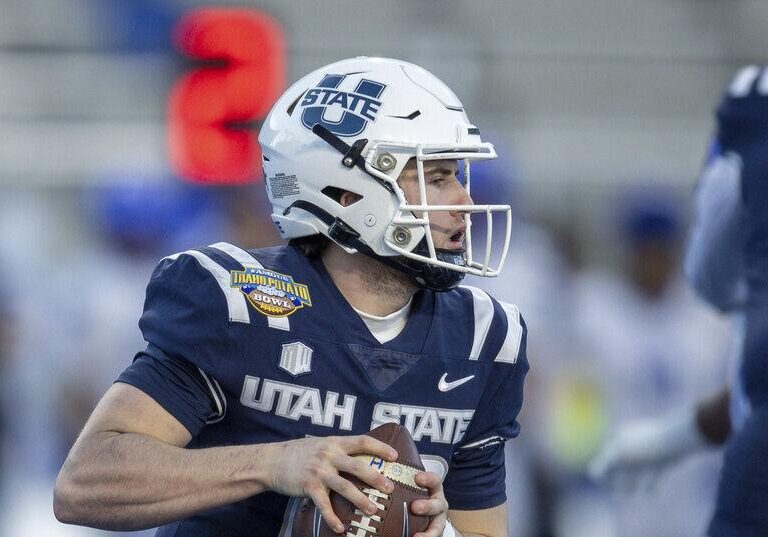
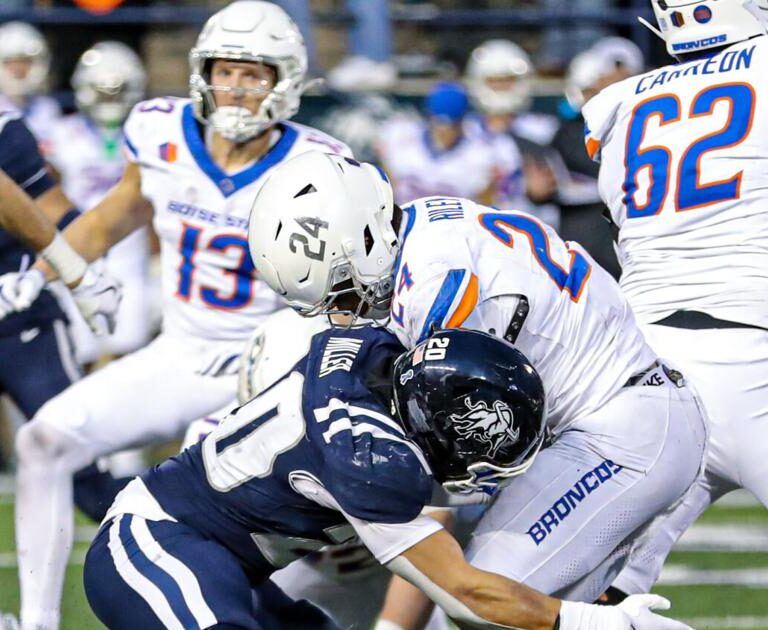
But while the missed field goals were the most visible and talked about, there are plenty of other ways in which the Aggies lost that game aside from missed kicks. On USU’s first offensive play of overtime, Bryson Barnes and Braden Pegan were out of sync on a pass that, if connected on, would have been a walk-in TD for a walk-off win. Missed tackles on the 25-yard TD that did prove to be the game-winner by UNLV could also come up. Sacks allowed in multiple crucial situations might also come up. Every player from every position group probably saw one play that they themselves didn’t make that might have turned the tide in such a close game.
What the missed field goals — and the botched fake field goal attempt — do represent is yet another way in which Utah State has found a way to struggle in special teams. In each of the last three outings, the Aggies have had some aspect of special teams bottom out. Against New Mexico, they allowed a punt return touchdown and also had a poor decision on a kickoff that helped lead to a safety. Against Nevada, they had several kickoffs go out of bounds. And against UNLV, well, the field goal/PAT unit left 13 points off the board through various means.
All of these things have left head coach Bronco Mendenhall playing whack-a-mole with special teams errors.
“I can address it and have each time. And then seems to go away,” Mendenhall said about tackling each of those previous special teams issues. “I wish I could see it in advance and address it beforehand, maybe at a different level, hat is my job. And, going in reverse, not many kicks out of bounds the entire year, and then four or five in a game. 10 for 10 on field goals throughout the course of the year. And then that shows up. And hadn’t given up a punt return all year, but we were also punting out of our end zone. So that one in particular, I felt like I didn’t train our team. We didn’t practice enough, punting, backed up, heels on the goal line. And I think that was an emphasis one for sure that manifests, unfortunately. As I look back at the training, the others, hard to say we haven’t emphasized it enough. It just sometimes performances just don’t hold.”
Beyond the feelings of [insert another synonym for heartbreak here] from this game, there’s the very real truth that Utah State is showing improvement. And this week it doesn’t come with the caveat of playing a lesser opponent. Two weekends ago, Utah State held Nevada to what remains its second-worst offensive output of the season. Even in the context of playing a team that was 1-7 at the time, the Aggies’ defensive performance was good. Then, this past weekend, Utah State held UNLV to 23 points in regulation and 29 points total, the only time this season the Rebels have failed to eclipse the 30-point mark. It was also just the third time all year UNLV has been held under 400 yards in regulation (the Rebels finished the game with 423, but 29 of those came in overtime).
Utah State slowed down what has been one of the best offenses in the country, let alone the Mountain West. Anthony Colandrea entered the game with a completion percentage of 69.0 and had a 8-0 TD/INT ratio in home games. The Aggies held him to a 56.8 completion percentage and picked him off once while allowing only one passing TD. Colandrea also only averaged 2.7 yards per rush, well below his season average of 5.1.
Immediately after the game, Mendenhall was asked about the play of his defense against UNLV and Nevada, which have been the more obvious showcases of improved defense. However, Mendenhall expanded the scope of what constituted recent improvement to the last four games, encompassing the San Jose State and New Mexico games as well.
Using the 20/20 vision of hindsight, the game against San Jose State certainly seems to be the herald of improvement for the defense. The Aggies held Walker Eget to what at the time was his second-worst completion percentage of the season. Eget may have thrown for 340 yards, but much of that was empty calories and produced just 25 points. Utah State followed up that solid defensive performance against the Spartans by holding its next three opponents to an average of 193.7 pass yards per game, a 57.3 completion percentage and just four touchdowns with three interceptions. For reference, the Aggies’ six FBS opponents prior to the most recent three averaged 292.2 passing yards per game, completed 61.3 percent of their passes and threw 15 touchdowns to six interceptions.
In his Monday press conference, Mendenhall attributed recent improvements to a couple of different things, the first being good ‘ol fashioned time and development.
“It’s just taking time to season a group of players,” Mendenhall said. “We’re just building through the processes of becoming not only a strong football team, but a strong defense. And it’s just taken time. I wish I could have expedited that. I wish I could have rushed it. Wish I could have short-cutted it. It just wasn’t the case.”
Time was one thing, but it also took the coaching staff taking a long look at its own processes and play-calling to figure out what was working, what was not, and how to move forward. The bye week between the Hawaii and Nevada games proved to be a pretty good time for that introspection.
“The second bye week as well, Coach [Nick] Howell, the defensive staff, just like our offensive staff, lots of analysis of ourselves,” Mendenhall said. “Some of the ideas and some of the calls that have been best and some that hadn’t been, we were able to refocus on that.”
A sub-plot of Utah State’s defense has included poor execution toward the end of the first half throughout the entire season. Here’s a quick overview of what they’ve allowed this season in the final minute or so of the second quarter in 2025.
- vs UTEP — FG with 0:02 left
- @ Texas A&M — TD with 0:16 left
- @ Vanderbilt — FG with 0:00 left
- @ Hawaii — TD with 2:27 left
- vs San Jose State — TD with 0:59 left
- @ New Mexico — TD with 2:44 left
That’s 34 points scored by Utah State opponents in the final three minutes of the first half across six games, with 24 of those coming in the final minute of the half. You’ll also notice the frequency in which it happened on the road. Literally every road game prior to UNLV had seen at least one last-first-half score (three of them touchdowns).
The Rebels were certainly poised to add to those woes when they had two possessions late in the second quarter, once with four minutes left and another with one minute to go. Only, the Aggies pretty much stopped UNLV dead in its tracks. The first possession went four-and-out as the Rebels tried to convert a fourth down but were stuffed at the line. And in the latter possession, USU bent a little, but held UNLV to a 59-yard attempt. And while NFL kickers make those easily these days, college kickers are far less capable and the kick fell well short.
“Improving in two-minute defense, given previous games, has become a major point of emphasis,” Mendenhall said. “And Utah State’s performance on Saturday reflected as much. We’ve increased our emphasis from about week four or five in practice, making sure we have multiple repetitions every Wednesday in two-minute situations. And we’ve just continued to get better and better and better.”
That there seems to be a continued upward trend with the defense, even against better competition, bodes well for Utah State’s remaining games. That it took this long is certainly a disappointment, similar in caliber to this most recent loss. Mendenhall certainly expressed his wish that the team could have developed quicker. But if history has shown anything, it’s that programs under Mendenhall have not undergone immediate on-field success when he steps in and begins steering the ship. The main question to answer now is if his previous examples of eventually turning programs around will hold true at Utah State as much as it did for BYU and Virginia.