

Aggie Nation likely awaited Saturday’s gridiron meetup between Utah State and Nevada with mild trepidation. On the one hand, the Wolf Pack were 1-7 entering that matchup. There’s no way the Aggies would lose. But on the other, recent games like Hawaii, San Jose State and New Mexico lingered. Those were all anticipated as games USU could, and maybe should, win. Yet two were losses and the other an uncomfortably close win over a team that now sits at 3-6 itself.
Would the unthinkable happen? Could Utah State find a way to lose to a team vastly inferior on paper?
By the end of the first quarter, even the most pessimistic Aggie fan had put their worries to bed. Whatever faults have presented themselves amid Utah State’s 1-3 run through late September to late October were hardly present against Nevada.
Utah State’s bottom five pass protection? Bryson Barnes was pressured at the lowest rate since USU’s games against McNeese and Air Force.
A defense that had averaged 507.5 yards per game to opponents over the last four games? A mere 242, and a lot of that was in garbage time.
Slow starts on offense? A 24-point first quarter, best of the season and highest-scoring first quarter since 2018.
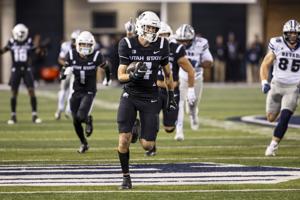
Barnes having three of his worst games of the year in the last month? He had 288 yards, three TDs, a 74.1 completion percentage and was done by the middle of the third quarter.
The first thought when it comes to a win like this is the fact that, well, Nevada isn’t very good. Computer rankings like KFord and SP+ put the Wolf Pack in the bottom 10 of FBS (SP+ even has more than 15 FCS teams ranked ahead of Nevada). And that’s an argument with a very intuitive and logical backing. Except that Nevada has had the fairly unique knack to keep games close against even the best of teams, despite its own heavily lopsided win-loss column.
Of the Wolf Pack’s now-18 losses spanning last two seasons, 10 have been by a single possession. Last year, Nevada lost by one possession to two seperate College Football Playoff teams, SMU (29-24) and Boise State (28-21). This year, the Wolf Pack have been within one possession in the fourth quarter in three games against teams that are currently bowl eligible — Western Kentucky (7-2 record), New Mexico (6-3), Fresno State (6-3) — and were within a touchdown of Boise State (6-3) late in the third quarter.
By that thought alone, Saturday’s domination surprised even Bronco Mendenhall himself.
“I didn’t see that score coming,” Mendenhall said after the game. “Nevada’s been really good on defense. They’ve played one score games in regards of who they played all year long.”
Utah State handed Nevada what is tied for its worst loss this year, at least by margin of defeat. It was worse than what any of the considerably tough teams the Wolf Pack have faced so far managed to do. Not Western Kentucky, Fresno State, New Mexico or Boise State managed to do. And those teams are a combined 28-11 this year (even Penn State, which ranks 20th in KFord despite its 3-6 overall record, won by less). The team Utah State tied with for largest margin of victory over Nevada is San Diego State, which won 44-10, matching the 34-point gap of Utah State’s 48-14 win.
Mendenhall had two different comments on how his team put together a much more impressive on-field product than has been typical of late. The first having a lot to do with the energy of the team.
“It was exceptional, the energy. They were physical. They were connected, trying hard, having fun. The energy around the building was different,” Mendenhall said. “And I’m really glad that they could see a tangible result and a win that was probably atypical, unless any of you predicted it like that. I don’t think anyone saw it coming. But our team earned that. They prepared for it. Our coaching staff put great plans together. It’s really happy for our program.”
It wasn’t just improvement from players that Mendenhall pointed out, though. He keyed in on something he did differently in terms of preparing his program for this game as opposed to some recent losses.
“Teams play as they’re prepared. And I accelerated and moved our team, pushing it too fast toward the consistency and the execution, prior to just claiming the intent. There’s not only what you do there’s the how you do it,” Mendenhall said. “My fault. I tried to expedite it and push it a little too fast toward the New Mexico game, maybe even toward the Hawaii game. And that was at the expense of how we were doing it.”
The Aggies came out this past week a different team than previous weeks. Some of that had to do with coming off a bye, though Nevada also had that luxury. Utah State made the most of it. Nevada clearly didn’t.
Two specific on-field points to cover for this week’s Monday Cooldown are two sides of Utah State’s play along the offensive line. The unit has been much maligned in recent games, not necessarily without reason. Barnes had been pressured on more than half of his dropbacks in the four games leading into Saturday’s matchup with Nevada. But this past weekend Barnes was sacked zero times — the first no-sack game of the year for USU — and pressured on less than a third of his dropbacks, one of only three times that’s happened all year. A lot of work went into that during the extra time thanks to the bye.
“We had a little more time,” Mendenhall said. “We’re just learning more about our team. And then, in this particular case, we were able to identify some things. Coaches and players addressed it to where it led to a different outcome.”
The other part of the offensive line relates to the run game. Utah State has struggled to run the ball the last few weeks after what had been a rather solid start. Over a four-week span earlier this year, including games against the likes of Vanderbilt, the Aggies averaged 6.0 yards per rush attempt. In these past three games against Nevada, New Mexico and San Jose State, they’ve averaged 4.0 (only 3.4 if you exclude one Miles Davis 64-yard run against New Mexico).
Mendenhall went into some detail about the recent drop-off in run efficiency and what may have gone into it.
“I think health and fatigue is part of it. Number of touches, number of carries, number of hits, number of tackles. That can take effect on running backs through the course of the year,” Mendenhall said. “Identity and emphasis can also kind of shift a little bit. And so as we continue to see what we’re doing how we’re doing it, and why. That’s also played in.
“But then also on the more success that you’ve had through up to the last three games, that then becomes more of an emphasis on defenses because they’ve also watched on more and more film. And possibly the emphasis or schemes to eliminate that open up other things. So I think there’s a combination of all those. What percentage of each, I don’t know, but I think they’ve all contributed.”
As Mendenhall noted, where one door might close because of the opponent’s emphasis on defense, another one opens and Utah State has seen a jump in overall passing production in two of the last three games where they’ve struggled on the ground. Barnes set a career high with 326 yards against San Jose State and the Aggies as a team passed for a season-best 377 against Nevada, those two being the team’s only 300-yard passing games this year.