

If you just looked at the yardage totals and basic efficiency metrics from Utah State’s game against San Jose State, you’d be forgiven for guessing wrong which team ended up taking home victory on Saturday.
San Jose State had 534 yards to Utah State’s 461. The Spartans averaged 6.9 yards per play to the Aggies’ 6.6. SJSJ had a far better ground game (7.2 yards per carry to 3.4), had more tackles for loss (nine to one), sacks (three to zero), and a better third down conversion rate (52.9% to 33.3%).
And yet, Utah State was the one sprinting onto the field in a victorious fervor after a batted-down Hail Mary pass from SJSU.
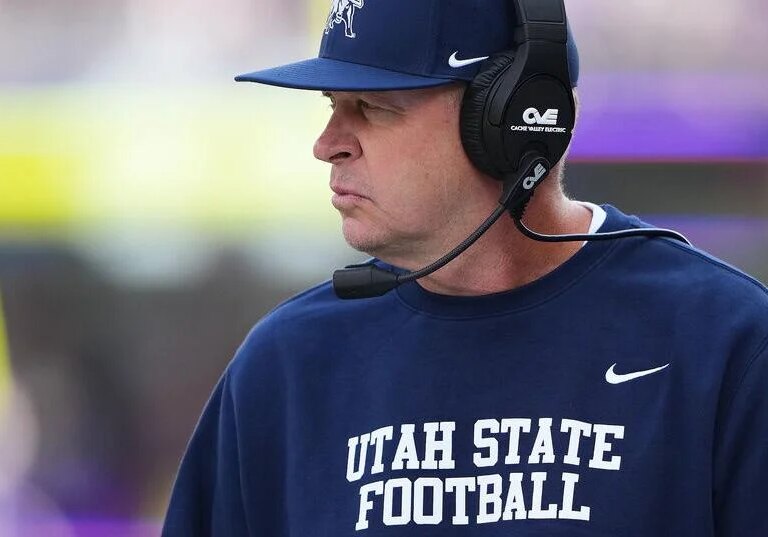
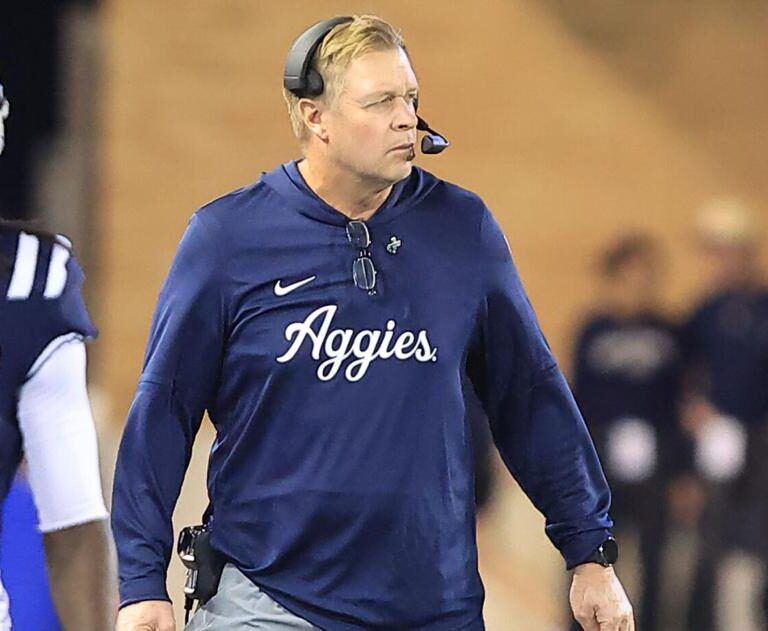
Utah State head coach Bronco Mendenhall has harped on what he calls playing “in context.” It was something Utah State didn’t do the week prior in Hawaii during the eventual 44-26 defeat.
“Going into last week, I think we were playing stretches of quality football and have from the beginning. But we also have realized that there are situations, or what I call contexts, that we weren’t playing as precisely or specifically to those contexts,” Mendenhall said. “So a context might be four minute [drill]. It might be two minute [drill]. It might be third and long. It might be fourth down. And so our execution specific to the context is what I thought needed to improve.”
Learning how to play in context, in crucial situations, is something that the team has now spent quite a bit of time trying to do. And was perhaps one of the few positives from that Hawaii game in that it gave USU an up close and personal look of how important playing in context is.
“It’s awareness, first and foremost,” Mendenhall said. “Once there’s awareness then there’s specific and tangible things and steps of what to do about it. And so once you analyze where you might be falling short, in our case, the fourth quarter versus Hawaii, there were some pretty simple things that manifest that showed. And so once you identify an area that needs to be targeted, then you’re looking at what specific things can address that, and then that becomes your focus for the week in practice. And it takes work.”
This was the key behind why Utah State was able to win the game despite not having the greatest statistical profile, at least on defense. The Aggies, by no means played a great game. What they did was play well enough at the right times to get a win. Which is what great teams are able to do, so it’s a nice thing to see developing throughout the season.
Spartans quarterback, Walker Eget, may have thrown for 340 yards, but he needed 50 passes to reach that mark and he completed just 55.1% of his passes, his lowest since completing just 50% at No. 22 Texas. It’s a pretty drastic improvement for the Aggies’ defense after Hawaii QB Micah Alejado had his way around the field with his passes. Utah State’s biggest improvement in its pass defense came from simply attacking the ball in the air more. There were nine pass breakups by the Aggies on Saturday, dang near matching the 13 they had in total in the previous six games combined.
“[It was] our focus in practice, for sure,” defensive back Bryson Taylor said. “We didn’t get the result we wanted at Hawaii, so we made an emphasis in practice to knock the balls down. Our coaches always yelled ‘Don’t let them catch the ball no matter what.’ No matter what exercise we were doing, whether that be skelly, or team, or scout. We just put emphasis on that and it reflected in the game.”
A lot of Utah State’s improved pass coverage came from a solid gameplan, one that forced SJSU to throw against eight-man coverages. The Aggies toned down the blitzes and focused on making Eget have to search hard for open windows to throw into. And it made the Spartans lean on the run more than perhaps they expected to. USU played with a five-man box most of the game and blitzed just 32.7% percent of dropbacks, down from the 65.1% rate during the Hawaii game.
“They’re explosive, they’re dynamic, and they excel in throwing the football,” Mendenhall said of SJSU. “And our thought simply is, to manage the points and to give our team our best chance to win, is to invite them to run the ball, maybe more than they would want to run the ball. And then have great leverage in the pass game and make them catch, [we] tackle. Catch, tackle. And then find the right third downs and fourth downs to get off the field. And the plan was executed really, really well by our defensive staff, Coach Howell, the defensive coaches, the defensive players.”
Maybe the most visceral example of USU’s increased aggressiveness in the secondary came from how it held the nation’s leading receiver, who had been averaging 140 yards per game, to just 25 yards on 12 targets (only six of which were caught). Scudero had been averaging 16 yards per catch, but his longest reception on Merlin Olsen Field was just nine yards. the Aggies’ defense did a very good job of narrowing throwing windows, forcing Eget to make perfect passes, which he often didn’t. More than a couple times, Eget threw a “hospital ball,” setting his star WR up for brutal hits, a couple of which jarred the ball free and resulting in an incomplete pass.
Here’s a compilation of every target Scudero got, including the one that was wiped off the stat sheet by a penalty.
“We game-planned for (Scudero) and wanted to get on him, stay on him,” USU linebacker Bronson Olevao Jr. said. “And we were able to get a lot of hits on him. Respect to him as a player. But we executed it well. And that’s how we were able to stop him, especially in the game plan and props to our back end for that.”
Aside from all of this talk of pass defense is the biggest key that Mendenhall harped on over and over. Playing in context. That includes playing in context despite any and all earlier failures, an especially relevant point given how well San Jose State played in the middle portion of the game. After being held scoreless on four of their first five drives (and just three points on the other), the Spartans began to figure things out. They scored 24 points across four drives and took a 25-24 lead early in the fourth quarter. Without some intervention by Utah State, the game was set to be eerily familiar to the Hawaii loss. A game where USU played well at times, but collapsed when things counted most.
And that’s what made this game ultimately different. Instead of allowing SJSU to continue its scoring spree, Utah State stepped up. A fantastic example of playing well despite earlier failures came on a fourth-down stop right near midfield. San Jose State faced 4th & 1 on its own 47 with 3:57 left in the game and down just two points. If Utah State gave up much more ground, it’d mean putting a lot of pressure on its offense should the Spartans manage a field goal or even a touchdown. Potentially with little time on the clock and few, if any, timeouts remaining.
In a similar short-yardage situation earlier in the game — a 3rd & 1 with a little over 12 minutes left in the third quarter — Nick Howell called up an aggressive eight-man commit with two DBs lagging only slightly behind to be the last resorts. Except the running back, Steve Chavez-Soto, broke through a gap and the tackle attempt of Noah Avinger and he cruised to the end zone.
Undeterred by previous results, Howell called up the previously unsuccessful defensive play-call. And this time it worked flawlessly.
On this try, defensive tackle Gabriel Iniguez, who had been pushed back two yards on the third-quarter touchdown play, shoved his blocker two yards into the backfield and closing down one who side of rushing lanes. Along with that, John Miller jumped his gap perfectly while Carson Tujague took the full attention of two blockers (and still managed to plug a gap despite that), and Brevin Hamblin arrived from the edge to secure the successful run stuff. With how well this version of the play went, you wouldn’t think they’d previously botched it.
The aftermath of that stop actually sets us up for an example of how the offense played well situationally. In a game where the Aggies averaged 3.4 yards per carry, they needed a couple first downs to not only get themselves in field goal range, but also make SJSU burn some of its timeout. Except the defense would be fully expecting run. No matter, though, as Utah State pulled off runs of 12 and nine yards, setting Tanner Rinker up for his clutch 44-yard field goal.
“We just had to stick with our process and just taking it one play at a time, knowing that the bigger runs would come as long as we just stuck with it and trusted our linemen,” running back Javen Jacobs said about the offense getting those clutch runs. “So it was great to close out the game that way.”
Great indeed for the Aggies, who desperately needed to perform well in the clutch to keep pushing toward a return to bowl eligibility and, perhaps, even contend for the Mountain West title itself if their play keeps improving in the coming weeks.