

LOGAN – Around 15 years ago, Cameron Walker and his wife, Heather, were making the drive through Cache Valley. As many visitors do, they stopped at Aggie Ice Cream for a quick treat of Aggie Blue Mint. Walker had been working in athletic departments for several years, with eyes on eventually finding himself at the top of the chain of command somewhere. In that moment, while enjoying one of Cache Valley’s delights, Heather quipped, “wouldn’t this be a cool athletic director job?”
Walker kept his eyes on Utah State over the years, seeing the job open multiple times while he made a name for himself as an administrator at Utah Valley then later University of Central Florida (UCF) and Tennessee. In 2023 when the job opened again after John Hartwell’s departure, Walker even reached out to potentially throw his hat in the ring.
“I reached out last time, but it just wasn’t the right time,” Walker said.
Two years later it was the right time. Walker has solidified himself as a rising star among his peers, well-regarded in a tough, competitive industry and is now the 13th director of athletics at Utah State University.
Walker’s status as a rising star has been backed up by the support and praise Utah State has drawn from all places for this move.
“I had an occasion to visit with (Utah Governor Spencer Cox) yesterday. He’s a proud Aggie and was absolutely thrilled with our new hire,” USU Interim President Alan Smith said. “And that sentiment has been universal if the texts and emails I’m receiving are to be believed. And usually the texts and emails you receive about athletics aren’t quite that nice. So the sentiment’s good. It’s real positive. And that stems from our new athletic director having a skill set of incredible breadth and depth, and as importantly, a depth of character that’s distinguished by industriousness, kindness, integrity, authenticity and, of course, competitiveness.”
Utah State’s interim AD, Sandy Barbour, had high praise for the university’s decision and Walker himself, saying USU “hit a home run” with this new hire and saying “he’s exactly what institutions need today in terms of a leader in athletics.”
“You hear a lot of talk about, ‘Oh, we have to hire a business person or we have to hire somebody from the pros.’ Well, I adamantly disagree with that, but you do have to hire somebody that’s got a mindset that adapts well to what college athletics looks like today. And that’s Cam,” Barbour said. “And he’s learned from one of the best in the business in (Tennessee Athletics Director) Danny White. I’m a little biased. I worked for Danny’s dad for two of my stops, both at Tulane and Notre Dame. But Cam’s got the skill set, he’s got the experience, he’s got the personal characteristics and drive.”

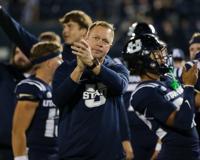
One question does face Walker’s upcoming tenure, and it’s how he will do now that the final decisions will be up to him as opposed to being in an advisory role. Barbour noted that for everyone, “you’ve got to start somewhere” and that Walker is “really well prepared” for his upcoming role.
“He’s had great experience at UCF. I think there are a lot of parallels between where UCF was when he went there and where Utah State is now,” Barbour said. “Obviously, the industry is tremendously different, but a lot of parallels there. His time at Tennessee, certainly in the SEC, at an institution that’s had high-level success, you’d work for a really, really talented athletic director. At both stops he’s seen how it’s done and then you just have to translate that into doing.”
Walker himself isn’t too fazed by the increase in responsibility, partly because he is planning on utilizing his own connections, including his old boss, Danny White, and his USU predecessor, Barbour, to help him and answer his calls when he needs their advice and input.
“There’s always a difference between being that lead advisor and being the one that the buck stops with you,” Walker said. “But outside that, day-to-day operations-wise, I don’t expect a ton [of difference]. I do think there’s just that shift of, ‘Oh, this decision is ultimately up to me at this point,’ And so, I think that’d be the biggest thing.”
A host of issues face Walker that he will have to tackle in the coming months and years, some with higher priority than others. One of his most immediate is moving Utah State into the new Pac-12. His vision is simple: don’t just participate, compete and dominate.
“With the imminent change to the Pac -12 we have to start sprinting now,” Walker said. “It’s an exciting opportunity, but we want to be ready for it. Not just ready, though, to participate. It’s not a Pac-12 participation trophy. We want to compete and we want to dominate. For those programs that have consistently been at the top, we’ll continue to push forward and reach new heights.”
A recent trend and issue that Utah State is facing is a lack of attendance at football games. In three home games this year the number of fans has sat between 16,000 and just over 17,000. That’s well short of what the capacity of Maverik Stadium allows and is certainly short of what its future Pac-12 peers are capable of. Not only is attendance a matter of prestige, but it’s a massive factor in revenue. The Aggies need to generate revenue and must be able to do so through ticket sales. According to data from Knight Commission On Intercollegiate Athletics, USU ranked 10th out of 11 full-member schools in the Mountain West in ticket revenue for 2023-24, earning $2,741,487 during the school year. The Mountain West average for that year was just over $6 million with San Diego State at the top with nearly $10 million in ticket revenue.
Utah State tried to raise money through a price hike for tickets, but have likely not seen revenue growth from that with the shortage of attendance. For USU’s last game against McNeese, it slashed prices early in the week to $20 a ticket and have engaged in a similar sale for the next home game against San Jose State.
Walker spoke about what his department needs to do to make attendance at football games, and the associated ticket revenue, go up.
“We need everybody here and we need to make it an event that they want to come to and when they come they need to have a blast,” Walker said. “We’ve got some work to on our side, and we’re going to have to ask them to come out and show up and be here and support us. Because it’s an incredible venue, but we’ve got to provide a situation where they want to be here.”
Tying right into the issue of revenue is that, perhaps now more than ever, collegiate athletics is becoming a zero-sum game with money. Teams that have it succeed more often than those that don’t. NIL and revenue-sharing make that increasingly the case. Finding ways to ensure Utah State remains competitive in the money space is imperative. Exactly how they pull that off is something to be worked on.
“The easy thing is to say we’re going to go to donors and we’re just going to ask them for more money. That’s not realistic and that’s not the right approach. Certainly, we’ll be needing donors and needing investors. Part of that, though, is sharing our vision and asking new people, not just the same people, to get involved. But then the other part is, we have to look and modernize all of our efforts so that we’re getting resources and generating as much resources as we can from every area. Resources aren’t just generated from fundraising. They’re generated from ticket sales. They’re generated from concessions. They’re generated through sponsorship. That variety of ways that you can generate resources, we have to maximize all of those resources. Rather than trying to move the donor pot from 100 to 200 percent, we need to look at all of those and move them all up 20 percent. And then build off that.”
Walker will officially take over duties from Barbour on Oct. 6th but is planning on attending USU’s women’s soccer game Thursday vs Colorado State and will be traveling with the football team for their contest vs Vanderbilt in Nashville, Tennessee on Saturday.