

As Utah State lined up for 1st & Goal late in its eventual win over Air Force last Saturday, the Aggies lined up in an unusual formation. Quarterback Bryson Barnes was lined up as a wide receiver and backup quarterback Anthony Garcia was standing behind center. Barnes then jogged over to stand behind Garcia, the latter then rushing up right behind center Jimmy Liston, as if he was about to take the snap and quickly run the ball up the middle. Instead, Garcia then sprinted to his right as Barnes took the shotgun snap but then passed the ball to a wide-open Garcia. The only thing that stopped an easy touchdown was an excellent solo tackle by Falcon’s safety Max Mustell.
Just see it for yourself.
What stands out about this play, as opposed to others where Garcia had more notable results (such as his two touchdowns and a two-point conversion), is the reaction of the Air Force defense. The players were scrambling, uncertain as to exactly what they were supposed to do. Each movement by Garcia introduced new uncertainty. Would Garcia take the snap and pass it? Run with it? Would he toss it backward to Barnes and then run a route himself? That’s too many possibilities to be reckoning with in mere seconds before a snap on a crucial late-game possession.
Garcia has been involved in five snaps on offense or special teams that could be defined as “gadget” or “trick” plays. Basically any non-traditional plays where the offense is trying to confuse the defense by doing something unusual. This matches his more generic five targets as a wide receiver. It means Garcia is showcasing as much value as a gadget player as he is at his listed position.
For his part, Garcia has been fully willing to be utilized in any way he can be.
“I came here having a lot of trust in Coach (Kevin) McGiven and knowing he was going to use me in the best way he thought possible,” Garcia said. “Real happy with him and how he’s just been lifting me up and keeping me confident at both positions and instilling in me that he has a lot of faith in me at both positions.”
It’s been a quick learning experience as Garcia only started the transition in fall camp. As late as this summer, he was expecting to be competing for a spot on the quarterback depth chart. But even in this short time, he’s earned the respect of his teammates for making an impact however he can.
“It’s not easy changing positions, especially that late in fall camp,” fellow USU wide receiver Braden Pegan said. “I see him just going to keep making plays for us. He’s doing a great job.”
Let’s take a closer look at the four other plays in which Garcia has found himself playing the trickster. The very first of all these plays is honestly a subtly interesting study into taking advantage of what your opponent is assuming about you. On the two-point conversion attempt against Air Force, Garcia lined up as the QB. And just by looking at the formation, the obvious guess of what’s about to happen is that he’ll just pick a side to throw a bubble screen to.

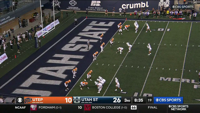
Surely, the one thing Garcia wouldn’t do is run into the teeth of the defense where five players could easily overwhelm 2-3 blockers and keep him from getting to the end zone. Doing that would call back to the infamous Indianapolis Colts’ fourth-down trick play failure almost a decade. It’d be the dumbest option. But sometimes the dumbest option becomes the smartest one as it’s something the defense is not expecting. So running it straight ahead ends up being exactly what Garcia does. Or perhaps flying would be a better description.
The next two cases of Garcia trickery were plays that failed at the initial point of attack. One wound up working thanks to perseverance and a bit of luck while the other couldn’t be salvaged. These were also back-to-back plays. One was a touchdown and the other a two-point conversion following that score (you can probably guess at this point which play worked in the end and which one didn’t).
Utah State’s first touchdown against Texas A&M required a trick play on a 4th & Goal from the three. Quite frankly a gutsy call, but the Aggies weren’t planning on being gun-shy in this game. It nearly ended in disaster, but Garcia ad-libbed and made it work.
The initial thrust of this play called for Garcia to take the end-around handoff and look to either throw it to Braden Pegan or, just as much of an option, simply run it in around the edge. But with Texas A&M rushing six players and getting a really good push at the point of attack, Garcia had to pull up on his run around the edge and Pegan was well covered. Luckily, the backside of the play featured Miles Davis on a short route and Garcia had enough arm strength (seriously, that was a difficult throw that a non-QB could not have made, even if it looks a bit like an ugly duck on film) to get the ball to the running back.
Garcia lined up as a receiver just off the hip of the left tackle and took an end-around handoff.
The ensuing two-point conversion attempt ended up failing, though that had a lot to do with bad timing and/or bad luck. Since USU put a play of Garcia running straight at the defense on film, the coaches then sought to take advantage of a defense looking for just that. Garcia was meant to begin to run at the defense to draw them in and then pop a quick pass over the top to a presumably wide-open Josh Sterzer who went in motion just before the snap. But Sterzer was bumped at the beginning of the play and wasn’t in position to receive his pass.
Good play design. Good defense. Bad luck for Utah State.
The most involved Garcia has been with his gadget plays, at least on offense, was against Air Force. We’ve already looked at one which turned into a two-yard pass near the goal line, let’s look at the one in which Garcia ran the ball into the end zone from 17 yards out.
Just like in the first clip showcased from this AFA game (which took place later in the game, chronologically speaking), you can see the scramble from the Falcons, who seemed pretty convinced that Garcia was going to run the ball up the middle as the linemen shifted into a tighter formation. This ended up being their undoing as Garcia found a lane outside, helped out by a great chip block from Kahanu Davis, and made a man miss to open a free path to the end zone.
Across these five plays, Garcia has completed one pass for a three-yard touchdown, ran for a 17-yard touchdown, caught a two-yard reception and converted one two-point conversion. In fact, Garcia is just one receiving TD away from completing the offensive triple-crown. It’s a feat no Aggie has pulled off since Steve Smith in 1976. Only five USU players have ever recorded at least one passing, one rushing and one receiving touchdown within a single season: Smith, John Strycula (1970), Roy Shivers (1965), Overton Curtis (1957) and Jack Hill (1956).
So why has Utah State opted to utilized its backup quarterback in such a manner? There’s a combination of factors, though Mendenhall’s first assertion was that he likes to get players involved however possible.
“At the University of Virginia, we loved having our backup quarterbacks, while they were competing and while they were the understudy, we loved them to participate in other positions,” USU head coach Bronco Mendenhall said. “It’s way more fun to play than watch. And I think you can actually learn to play the position of quarterback while playing another position.”
Mendenhall added that he would have considered this kind of move with Taysom Hill while at BYU. Hill played QB during his his entire tenure with the Cougars, though he has been a famous utility player in his NFL career, most of which has been with the New Orleans Saints.
“This philosophy really goes all the way back to Taysom Hill at BYU,” Mendenhall said. “While he was our quarterback, if there would have been another viable option at quarterback, where it was close, we certainly would have used Taysom elsewhere.”
Even McGiven, USU’s offensive coordinator, has history with a quarterback transitioning to wide receiver. When McGiven was the offensive coordinator at San Jose State, he oversaw the change in position for Nick Nash, who spent three seasons as a quarterback, even compiling just over 1,300 passing yards. In 2021, Nash moved to wide receiver which ultimately culminated in him becoming an All-American in 2024, a season in which he led FBS in receptions (104), receiving yards (1,382) and receiving touchdowns (16) and has since landed in the NFL with the Atlanta Falcons.
In addition to having a history of this out-of-the-box thinking, one could argue that necessity has driven this kind of creativity in using the running backs and tight ends in the passing game like this. The Aggies were expecting to have four transfer wide receivers — Pegan, Brady Boyd, Demick Starling and Corey Thompson Jr. — available to utilize in the passing game with some first-year prospects developing behind the scenes. Starling and Thompson have both suffered season-ending injuries, leaving a worrying hole in the receiver room.
Aside from the quartet of veteran transfers, Utah State’s wide receiver room consists largely of young, inexperienced players. You have true freshmen Ty Olsen, Nikko Boncore and Kaleb Mitchell. Then the redshirt freshmen Tate Kjar and Carlos Orr-Gillespie. And finally sophomore Jackson Olsen and Cade Baker. None of those seven players has caught a pass at the FBS level.
Kahanu Davis is the only other veteran in the receiver room to bridge the gap between the transfers and host of young, probably-not-quite-ready receivers. Mendenhall stuck up for Davis, saying he is “playing well” even if he “hasn’t had the number of yards or touches yet the others have,” but ultimately admitted that “we have a pretty drastic drop-off in terms of succession planning” with the team being largely made up of either young, inexperienced players or fourth/fifth year players.
One of those young receivers is likely going to have to step up. It’s hard to make a definitive guess at who will be making plays down the line, but the coaching staff has indicated it believes Kjar will potentially have an impact down the road. Nikko Boncore also impressed at times in fall camp.
As for Garcia, there’s the question as to whether this position change to receiver is permanent. That answer appears to be a definitive no.
“Anthony’s a really good athlete. That doesn’t mean that he’ll exclusively play receiver. We like him at quarterback also,” Mendenhall said.
Even when the start of the season was just around the corner, Garcia still had quarterbacking on his mind, such as when he picked out his jersey, the number 10.
“I know that Jordan Love wore it here as well and I’m a big fan of him in the NFL. So as soon as I got the opportunity, I grabbed it,” Garcia said.
Barnes is the clear QB1 now, and will be so as long as he remains healthy. Jacob Conover is listed as the QB2, though if Barnes went down it’s possible Garcia might get legit snaps at quarterback as well. But both Barnes and Conover are in their final season of eligibility. It’s quite possible Garcia makes the move back to quarterback in 2026, taking over the reigns of the offense full-time.