

Week 1 of Utah State’s college football season will go down as a success, if nothing else. The Aggies got a 12-point win over a team they were favored to beat by five or six points. That game is now well in the rearview mirror as USU prepares to face a fellow agricultural school, the Texas A&M Aggies.
Texas A&M enters the game ranked 19th in the AP Top 25 Poll and from that fact alone, Utah State’s odds of victory take quite the hit. All-time, USU is 3-28 against teams ranked in the top 20 by the AP. Although, this has also been the sweet spot for the times the Aggies have defeated a ranked opponent. The three most recent wins over AP-ranked opponents came in 2021 against No. 19 San Diego State, in 2014 at No. 18 BYU, and in 2012 at No. 19 Louisiana Tech.
All of the media rankings aside, Texas A&M are expected to be a good team. Last year, the Aggies went 8-5, but that ended up being a disappointment thanks to a 7-1 start to the season. An injury to Le’Veon Moss and a defense that struggled to stop the run led to a late-season collapse.
This year, Texas A&M has brought back nearly all its major playmakers, added multiple studs via the transfer portal and is shaping up to be a better version of its 2024 self. Quarterback Marcel Reed started eight games as a redshirt freshman last year and returns as one of best running QBs in the conference to go with a growing competence as a thrower. A&M also brought back seven starters on defense, including linebacker Taurean York and defensive back Will Lee III.
So far, the lone sample size backing up any hope for a major improvement to last year’s 8-5 campaign is a 42-24 win at home over UTSA in Week 1. The final score deceives the box-score-watcher slightly since, for roughly two-thirds of the night, that game was relatively close. By the eight-minute mark of the third quarter, A&M only led 21-17. But from that moment on (or really, starting from the 14:47 mark of the third when UTSA scored the 75-yard touchdown that led to the 21-17 score), Texas A&M dominated, adding three touchdowns to its tally while UTSA managed just 14 net yards prior to a garbage-time drive that netted the Roadrunners its final touchdown of the game with 14 seconds left in the contest.
New stars emerged along with great performances from returners. Two new receivers, Mario Craver and KC Concepcion, made massive impacts. Craver had eight catches for 122 yards and two touchdowns. Concepcion added 72 yards on three receptions while also returning a punt 80 yards for another score. Reed threw for 289 yards and a career-high four touchdowns (with no interceptions).
Reed was also the leading rusher for A&M, netting 39 yards on just eight carries. Although Reed is a capable rusher (543 yards last year) the lack of a run game from the Aggies against UTSA was a bit of a question mark. A&M were 26th in the nation in rush yards last season behind Reed’s running abilities and the very capable running back Le’Veon Moss, who averaged 94.6 yards per game in 2024 prior to a late-season injury. Moss carried the ball just three times against UTSA.
Mendenhall said the reason for A&M running the ball so little had a lot to do with how UTSA approached the game on defense.
“Each team takes their own approach defensively. UTSA made an emphasis to play the run really well and sometimes that comes at the expense of maybe a big play or two through the throw game. And so you balance it the best you can,” Mendenhall said. “But I think most really good offenses, regardless of what patch they’re wearing, conference-wise, or what their tradition is, they still have to play football and they still match up to the schemes they see. And no matter how good a team, if they’re giving you something, then you take what they’re giving rather than just run into the strength of a defensive approach. So I think that’s what (Texas A&M) did.”
Whether Texas A&M will go back to the well and establish the ground game is uncertain, since even its coaches are still trying to work out exactly what kind of defense Utah State will run against them. The one game on film from USU is of them playing a spread team that stretched the field sideline-to-sideline with its formations. Utah State also showed multiple looks outside of its base 3-4 defense.
“They’re a mix between three-down and four-down (defensive linemen)” Texas A&M head coach Mike Elko said. “Trying to figure out what they’re going to be this year at Utah State when they’ve only got one game against a wide open 10 personnel spread team is a little bit of a challenge.”
Whatever the case may be with Texas A&M’s gameplan, there are a wide variety of playmakers, something that couldn’t really be said of last year’s offense that struggled once Moss went down to injury. The additions of Craver and Concepcion at receiver have opened up the passing game in a way that it wasn’t ever really last season. Reed had a hard time as a passer last year due in part to a lack of receiving talent. Multiple solid portal additions have changed that.
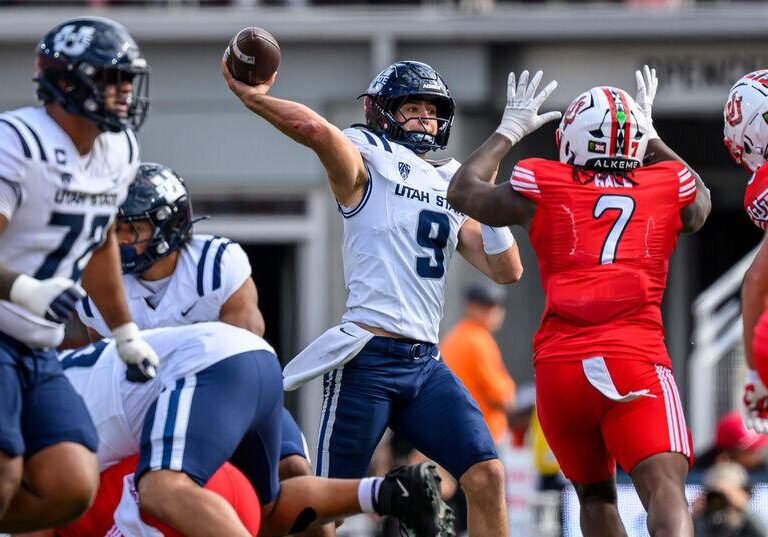
With the task of stopping A&M’s offense being rather difficult, the pressure will be on Utah State’s offense to keep up. Scoring 30, or even 40, points has to be on the table for a USU victory to be realistic. So can the visiting Aggies do that? Well, it depends on how well they can establish the run.
Run defense was an issue for Texas A&M last year, ranking ninth in its conference. Despite attempts to shore up that weakness this offseason, the issue reared its head against UTSA. A&M yielded 203 rush yards, most of those to Robert Henry Jr. who accumulated 177 yards and two touchdowns, one of those being the already briefly mentioned 75-yard scoring play. It’s a potential weakness Utah State can try to take advantage of, but it won’t be walking onto Kyle Field with UTSA’s run scheme or its talent, which makes it harder to say whether USU can find similar success.
“Any time you play an opponent, you look for what worked and see if you could replicate, see if those matchups might be similar. And then knowing the opponent’s looking at the same thing, working to address maybe any things that they could have done better,” Mendenhall said. “Our style isn’t exactly the same as UTSA’s. But you look for concepts. You look for things that might be helpful. And that’s what we’ll do.”
There’s perhaps a bit of hope Utah State can manage a high-level run game, though it requires some optimism. The Aggies weren’t consistently dominant in the run game against UTEP (mainly due to the second half), but showed promise. Exclude the 36 yards subtracted to the rushing total because of sacks and end-of-game-kneel-downs and Utah State averaged 6.5 yards per rush. Even if you exclude Miles Davis’ 58-yard run to remove the largest outlier and the Aggies still end up with a decent 4.3 yards per rush.
Utah State has potential to be harnessed in the run game, and its players are optimistic they’ll get there.
“I think we can be a fantastic run team,” USU left tackle Jake Eichorn said. “I think we run block well, which is the start of it all. But our backs, our quarterback, we’re deep at running back. So really, it’s as far as we want to take it. And I have a feeling we can do a lot with it.”
Kevin McGiven needs to get creative with play-calling, scheming and formations to keep A&M on its heels and give Utah State its best chance to gain yards on the ground and get the most out of their stable of running backs. Davis and Javen Jacobs are incredibly versatile, with Jacobs lining up as a receiver almost as much as at running back last week. The only problem with that is they won’t have the same element of surprise this week as Texas A&M will be fully focused on those two. Elko called Davis and Jacobs the “two best skill players” on USU’s roster.
One obstacle Utah State will run into all night is one that won’t be on the field physically: the fans at Kyle Field. The 12th Man, as it is known nationwide, is one of the loudest stadiums in all of football, professional or collegiate. Last week, 107,521 fans were present to watch A&M beat UTSA, the sixth-largest crowd in the program’s history. A similar, even if not quite as high, number will be present to cheer A&M on while disrupting Utah State as much as possible by making it nearly impossible to communicate on offense.
It’s a narrative that will come up plenty of times throughout the game, but it’s a challenge Utah State isn’t going to spend any time worrying over.
“You really can’t [prepare for it]. So you acknowledge it, the brutal fact that it’s going to be loud. There’s going to be lots of people. And then you just go play the game,” Mendenhall said. “I’m just really process oriented. So we’ve acknowledged it. We’ll continue to acknowledge it, but not overemphasize it and we’ll just go play football.”