
The first sample size of 2025 Utah State football is on the shelf and ready to overreact to. The Aggies’ 12-point win over UTEP isn’t going to go down as one of their best or even a dominant performance. There’s a lot that needs to be improved if there’s any hope of anything beyond a 5-6 win season. But head coach Bronco Mendenhall really put it best after the game.
“Our team is tough, our team is resilient, our team is not polished, we’re not finished, we’re not complete, but we’re willing,” Mendenhall said. “And that’s a great starting point.”
A great starting point indeed. One of the biggest frustrations of Utah State football over the past two seasons, the defense, saw major improvements and the offense flashed some potential. So long as there’s growth and in-season development, this will be a solid team capable of making a little bit of noise in the Mountain West.
Starting with the the better part of the Aggies’ performance, the most basic of defensive metrics shows how much better they were in this game. UTEP gained just 284 yards, only the fifth time this decade Utah State has held a team to fewer than 300 total yards and the seventh time they’ve held an FBS opponent to fewer than 20 points in the same time span. The former hasn’t happened in nearly two years (Week 1 of 2023) and the latter happened only twice in the last two seasons.
If nothing else, it seems Utah State is capable of playing good defense again.
One of the most important keys for Utah State came from eliminating extra yards. Two key stats in analyzing that are yards after contact on rushes and yards gained after the catch on pass plays. In 2024, the Aggies averaged 138.0 yards allowed after contact per game and 149.8 yards after the catch allowed according to PFF. For further context, UTEP averaged 96.3 yards after contact per game and 105.7 yards after the catch in 2024.
Utah State held UTEP to 57 yards after contact and 61 yards after the catch on Saturday.
The gameplan Mendenhall and his staff put together called for the Aggies to have to be able to corral UTEP in the pass game. The Miners boast multiple speedy pass-catchers that can easily cause issues for defenses in one-on-one scenarios. Mendenhall noted as much in the post-game presser by drawing a comparison to a UTEP play against Nebraska in 2024 and one of the touchdowns the Miners scored against USU on Saturday. The play is a simple fade route by the slot receiver. In a man coverage situation, it can be an incredibly difficult route to guard as a speedster will be running into space where they can often easily beat the cover man and help from the safety is unlikely to be able to provide much help over the top given the distance they’d have to travel in such a short time.
Just look at how both plays went for Nebraska and for Utah State.
This pretty much convinced the Aggie coaches to avoid running man the rest of the game and stick with keeping everything in front of them. The Aggies only blitzed Nelson on about a quarter of his dropbacks, compared to UTEP bringing a blitz on more than half of Barnes’ dropbacks. If Nelson wanted to throw a quick pass two seconds after the snap to a receiver four yards down the field, he was perfectly free to do so. Utah State was content to allow that completion but put the clamps on everything else. Case in point, Nelson was 17 for 18 on passes that traveled less than 10 yards past the line of scrimmage but only completed 4 of 13 passes beyond 10 yards downfield.
“The receivers are fast. They’re capable. And we would have rather just said, our collective body of work through the night will end up winning rather than giving up high-risk plays that we thought would hurt our team,” Mendenhall said. “We didn’t like a couple of the matchups. We thought some others are better. Our collective approach, we thought, would end up controlling the score, which it did. And then you saw more pressures at the end and more affecting the quarterback when it was more clear all they would do his past because they had to catch up.”
As Mendenhall noted, the Aggies brought the pressure late and Utah State dragged Nelson down for sacks twice in the game, both coming after UTEP had fallen behind 28-10.
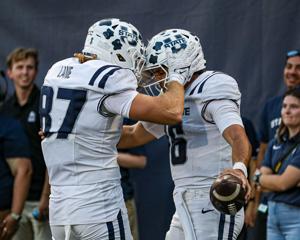
Now, let’s look at the offense. This is where the mixed reviews come from. In the first half Utah State scored 20 points and averaged 8.3 yards per play. Bryson Barnes was slinging the ball around the entire field and running back Miles Davis had himself 130 scrimmage yards by halftime. There wasn’t a whole lot to criticize about that performance. Utah State was utilizing some creative personnel packages (lots of two tight end sets and even three running back sets) to keep UTEP on its toes. The versatility of guys like Davis and Javen Jacobs, who combined for 20 snaps lined up as slot receivers, and both tight ends Broc Lane and Josh Sterzer, really helped the Aggie offense be effective in these personnel sets.
In the second half, however, the Aggies had eight points and averaged 3.0 yards per play. It’s kind of even worse because if you exclude the 93-yard drive on USU’s first possession of the second half (which itself had 30 free yards from a pair of UTEP penalties), the Aggies kind of had net negative yardage in the third and fourth quarters. Over the final six drives of the game, the Aggies ran 22 plays and had a net of -2 yards (that does include negative yards on penalties, which isn’t the official way to track team yardage, take those out and Utah State had 19 yards in those drives).
Mendenhall admitted his offense went more conservative — though was quick to specify “not conservative, but more conservative” — and that the offense just didn’t work as well as they’d planned it to.
“As UTEP sensed that, they played more and more and more aggressive,” Mendenhall said. “We didn’t really take an opportunity to exploit their aggressiveness and thought that we could methodically and just routinely move the chains, score, but also separate from them. So we didn’t execute quite well enough, especially on third down And that ended up being the primary difference of half two to half one. They were more aggressive. We were slightly more conservative We believed that we could be consistent on third down. We weren’t and that’s really what happened.”
Looking back on those final drives, there’s some sliver linings in that it likely isn’t as good of a representation of what Utah State’s offense can be. Here’s a very brief look at the five failed drives from the Aggies in the second half and what went wrong in the end (the sixth drive that was included in the earlier calculation ran down the clock so it’s not included here). Basically all are self-inflicted and things Utah State can clean up. They are not issues of ability, but more of focus and execution. The latter is much easy to fix in-season.
- Blown run block leading to 3rd & 16 (Barnes was sacked on that third down)
- Holding on a first-down run, botched screen play on re-played first down
- Got a first down and set up 2nd & 2, but eventual third-down pass is dropped
- Set up a makeable 3rd & 5 after two runs, Barnes goes down on a coverage sack
- Ineligible man downfield penalty wipes out first-down catch, leads to 3rd & 15
One specific area Utah State struggled in on offense, and not just the second half, was pass protection. It would justifiably receive a low grade (PFF currently has the Aggies ranked 99th in FBS in pass blocking). Barnes was sacked six times and it severely hampered the offense. Why all of these sacks happened isn’t easy to explain because there are a variety of reasons a sack might happen and pretty much all of them happened among all those times Barnes hit the turf.
“Sometimes it’s timing, rhythm and decision making by the quarterback. And so we had some of that,” Mendenhall said. “Sometimes it’s communication between the offensive front. We had some of that. Sometimes it’s the coordination between the front and the running back. We had some of that. And sometimes it’s just technical where someone does beat us and the ball is not delivered in time. And so each of those manifest at some level and great feedback for us, things we can certainly work on. And there was enough of each of those where I can’t say it’s any one thing, but certainly an area to approve.”
To show some of the variety of the sacks Utah State allowed, we’ll look at two. First up there’s this play where it largely just was an Aggie O-lineman losing to the guy in front of them.
UTEP brought six guys but USU had six blockers (5 OL plus the RB, Jacobs). The weak link ended up being center Jimmy Liston (No. 55) as he lost his block bad enough that it made Barnes move off his spot and Liston was called for holding for good measure. Left tackle Jake Eichorn (No. 56) didn’t exactly do much better as him getting pushed back closed down the pocket even more for Barnes. Eichorn’s man ended up recording the sack. The senior left tackle took responsibility for the play, but also emphasized he feels the O-line is trending in the right direction in its pass protection.
“On mine, I mean, it was completely my fault. You have to sustain blocks. Quarterback steps up in the pocket. It’s a blind spot for me but it’s my sack. So obviously, I can take accountability on that,” Eichorn said. “I think that there was a couple schematic things where we turn protections a different way, had field pressure or boundary pressure. But other than that, I think we were okay.”
Another sack to look at is one where it was a communication issue, not an issue of blocking skill.
I’m not picking on Eichorn on purpose here, but he was involved again. However, he clearly saw and let the UTEP defensive end go on purpose because he believed he had help from the running backs. But Jacobs had motioned out of the backfield and Davis wasn’t looking outside the tackles for defenders to pick up. So Barnes had a free defender bearing down on him from the start and the play was a wash from there.
Plenty of these pressures and sacks can be worked on by getting in the film room and getting more experience. But the unit will also get a boost with the anticipated return of right guard Tavo Motu’apuaka. He missed the season opener with an injury, but was listed at the top of the depth chart for the first time in this week’s game notes. Mendenhall was even asked about Motu’apuaka’s return and said “we expect to have him back.”
“(Motu’apuaka) certainly makes a difference. Experience, but also capacity and capability,” Mendenhall said. “That’ll make a real, helpful difference for us in terms of chemistry, coordination and the ability component of our offensive front. So we’re looking forward to having him back in the lineup.”
The season will only get harder, starting with a really tricky Texas A&M team that took care of business against a quality UTSA squad over the weekend. The Aggies from the Lone Star State are nationally ranked and have aspirations of being near the top of the SEC standings, with the starpower to back it up. Utah State put itself on a good path, but must improve to have hope in Week 2.