
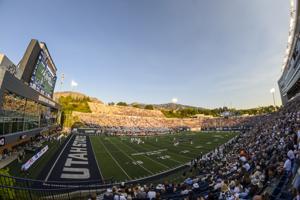
Supporters of Utah State football got pretty much everything they could want from the season opener. New head coach Bronco Mendenhall proved his worth as a $2 million coach by getting a roster full of new players that hadn’t shared the field before and rallying them to a solid 12-point win over UTEP.
The fans, however, were content to watch from home.
Only 16,448 fans were in attendance for USU’s victory, the lowest attendance for a home opener since 2007 (15,102 against UNLV). It’s just the third time in that same span that the Aggies have failed to eclipse 18,000 fans in the first game on Merlin Olsen Field.
Utah State Home Opener Attendance Since 2007 (excluding 2020 COVID season)
| Year | Attendance | Opponent |
|---|---|---|
| 2025 | 16,448 | UTEP |
| 2024 | 17,037 | Robert Morris |
| 2023 | 20,034 | Idaho State |
| 2022 | 19,553 | UConn |
| 2021 | 18,223 | North Dakota |
| 2019 | 22,247 | Stony Brook |
| 2018 | 18,223 | New Mexico State |
| 2017 | 19,638 | Idaho State |
| 2016 | 23,008 | Weber State |
| 2015 | 21,209 | Southern Utah |
| 2014 | 20,249 | Idaho State |
| 2013 | 25,513 | Weber State |
| 2012 | 17,009 | Southern Utah |
| 2011 | 18,239 | Weber State |
| 2010 | 18,347 | Idaho State |
| 2009 | 18,472 | Southern Utah |
| 2008 | 19,061 | Utah |
| 2007 | 15,102 | UNLV |
Why Utah State failed to capture the attention of more fans for what was billed as the start of an exciting new era can come down to a host of factors, and likely a combination of all options.
Firstly, there’s a blending of Utah State’s poor 2024 season and uncertainty from the offseason that could have driven down attendance. Just looking at the aforementioned 18-year sample size, the Aggies have averaged 18,346 fans in home openers after a season where the team didn’t make a bowl game but had 20,881 in the stands in the first home games in seasons after the team participated in a bowl game.
USU’s fans have been far more willing to show up in numbers early if there is momentum from the year prior. For instance, the early-2010s saw consistent attendance in the 20,000s for home openers and that era featured a conference championship, multiple appearances in the Mountain West title game and a 43-24 record from 2011 to 2015.
Secondly, prices of tickets are up. In June, USU announced an increase in ticket prices, with the cheapest season tickets available coming in a $168 (or $28 per game). For single-game buyers, the low end for good seats against UTEP was in the $35 range, though that was not the absolute lowest price. A family of five could wind up spending $200-$350 for one evening depending on how stingy they got on how good of a seat they wanted, whether they would purchase a parking pass, concessions, and how far they had to drive to get to the game.
Prices for future games on Utah State’s schedule get more expensive, with prices for the Aggies’ next home game against Air Force starting at $42 for an adult ($30 for youth) Utah State does offer discounts for bulk purchases on single-game tickets (down to $30 for an adult), but that floor to get the lower rate is 10 tickets, a frankly unlikely amount for your typical buyer.
Thirdly, and related to the first point, is that Mendenhall did little to stoke the fire of hype with his fanbase. A group desperate and starving for concrete information about the team they were being asked to spend more time and money on than ever before received effectively nothing. Interviews with media were plentiful enough but often lacked substance as coaches were openly unwilling to divulge any critical information on the team. Practices and scrimmages were closed to the public, even during the fall when the threat of poaching from opposing teams was long gone.
Of these factors, two are the direct choice of this year’s athletics department and coaching staff. But both decisions are backed up by solid and understandable logic. In Utah State’s press release announcing the rise in ticket prices, the university cited a need to “(help) Utah State, its coaches and student-athletes succeed in the new era of intercollegiate athletics” as the reason for the increase in pricing. Furthermore, the press release stated that the increase is meant to “attract top talent to Logan and ensure the sustainability of its athletics department.” The release also stated that the university will “continue to modernize its programs and explore opportunities for revenue generation.”
According to data from Knight Commission On Intercollegiate Athletics, USU ranked 10th out of 11 full-member schools in ticket revenue for 2023-24, earning $2,741,487 during the school year. The Mountain West average for that year was just over $6 million with San Diego State at the top with nearly $10 million in ticket revenue. For that same academic year, Utah State ranked eighth in combined total attendance for football and men’s basketball.
In an era of a money arms race in collegiate sports, Utah State has had little choice but to try and wring more money out of its fanbase lest it fail to keep up with its peers.
Mendenhall has faced some scruitiny for his decision to keep all practices and scrimmages private. He also held off on releasing a depth chart publicly (though he was far from alone in that move). Additionally, while Mendenhall said he supported manditory availability reports — partly due to pressure from gamblers who often reach out to athletes on social media and wind up putting mental strain on said athletes who have to fend off desperate individuals trying to make money off their performance — Mendenhall opted to not submit a report for this week (he wasn’t required to under Mountain West rules as it’s a non-conference game). That wound up leaving his players open to the risks Mendenhall himself outlined.
All of this secrecy was a means to an end: give Utah State as much of an advantage in its opening game as possible. Mendenhall wanted UTEP to know as little as possible, and clearly had a few surprises that the Miners would hardly have been prepared for. Things like moving Anthony Garcia from quarterback to wide receiver, starting a true freshman, Chris Joe, at linebacker, or injuries to Tavo Motu’apuaka and Corey Thompson Jr. (Ike Larsen’s suspension was probably not supposed to go public and only got confirmed when reports emerged and media inquiries were made).
How much of an impact did this all make? Mendenhall himself couldn’t even say.
“I’m not sure. I didn’t visit with their coach much about that. But I do know in the season opener with a new program, competitive advantage is critical. And you only get one chance to do that,”Mendenhall said. “We held spring closed and there wasn’t much access through fall camp. And if that gave our team even a slight advantage of playing better and having a chance to win, that’s my job. It’s moral. It’s ethical. It’s within the rules. And it’s serving the young people that I care for. So I don’t know how much of an impact, but I do think it was the right decision.”
Even though Mendenhall was perfectly within his rights, morally, ethically, and logically, to close off his team to the fans, it clearly didn’t resonate with the buying public and they chose to stay home and follow the game on TV, radio or not at all.
But amid all this discussion, there’s an important point to be made. Neither Mendenhall’s job, nor the eventual satisfaction of fans regarding the season, rest on Week 1 attendance numbers. Consider this. The 2012 WAC championship team had 17,009 fans at its home opener. The 2018 Aggies had just 18,223 with the exact same total announced for the 2021 opener. Those are three of the lowest home opener attendance numbers from 2008 to 2023. And yet, those teams didn’t flinch. All three finished in the AP Top 25 Poll, combined to win a pair of conference titles, three bowl wins a a 33-7 overall record.
Few watched the beginning, but everyone was watching by the end. And no one remembers how full the stands were in August or September.